
Webb Telescope Reveals Centaurus A Galaxy with New Camera Images
The James Webb Space Telescope is celebrating four years of scientific operations by releasing stunning new images of the Centaurus A galaxy, highlighting its advanced camera capabilities.

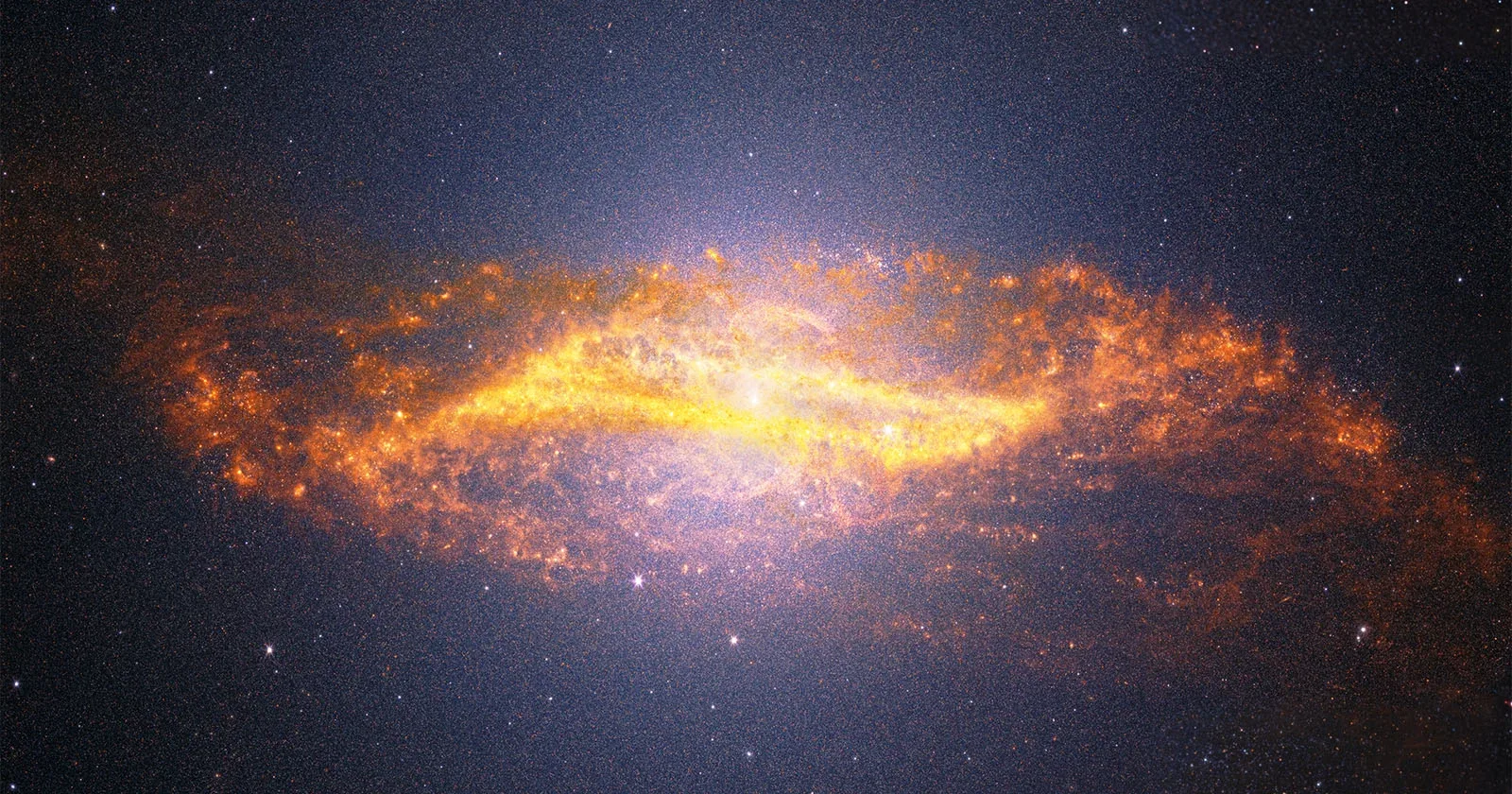
The James Webb Space Telescope (JWST), operated jointly by NASA, ESA, and CSA, is marking its fourth anniversary of scientific operations by showcasing its advanced imaging systems with newly released photographs of the Centaurus A galaxy. These images highlight the telescope's remarkable ability to penetrate cosmic dust and uncover the universe's deepest secrets.
The newly captured views focus on Centaurus A, also cataloged as NGC 5128, a galaxy that has long been a subject of intense scientific debate. Situated approximately 11 million light-years from Earth, Centaurus A is recognized as one of the nearest large starburst galaxies. These galaxies are characterized by exceptionally high rates of star formation, believed to be the consequence of a galactic collision.
The primary point of contention among astronomers regarding Centaurus A is its exact classification. Despite extensive study and its prominence as one of the brightest galaxies in the night sky, there is no universal agreement on its fundamental properties. NASA has officially classified it as a 'peculiar elliptical galaxy,' a leading theory among researchers. However, alternative hypotheses suggest it might be a lenticular galaxy. Further complicating matters, there is even disagreement about its precise distance from our planet.
Galactic Archaeology Unveiled
Regardless of these debates, Centaurus A remains a captivating object for astronomical study. This exceptionally active galaxy, a rarity so close to Earth, serves as a cosmic laboratory for understanding the co-evolution of galaxies and supermassive black holes. The central black hole in NGC 5128 is perpetually accreting matter and expelling colossal jets of energy, which in turn sculpt the surrounding galactic environment. While these processes are ongoing, Centaurus A also bears the visible scars of its past – remnants of a violent galactic collision that occurred roughly two billion years ago. The aftermath of this stellar encounter is evident in the galaxy's distinct morphology.
Previous observations, including those by the venerable Hubble Space Telescope, have provided valuable data on NGC 5128. However, Hubble's reliance on visible light limits its capacity to see through the dense dust and interstellar material obscuring the galaxy's core. The now-retired Spitzer Space Telescope possessed the ability to peer through dust and resolve inner regions, but its resolution was insufficient to distinguish individual stars. This is where the James Webb Space Telescope excels, equipped with its state-of-the-art, ultra-high-resolution Near-Infrared Camera (NIRCam) and Mid-Infrared Instrument (MIRI).
Celebrating Webb's fourth year of operations by demonstrating the unique power of its cameras is a fitting tribute. "Webb brings both clarity and depth," stated the ESA. The telescope's MIRI instrument has captured intricate dust structures within the galaxy, including a distinctive S-shaped feature that continues to intrigue scientists. Questions persist about its origin: Was it influenced by the central black hole, or is it a residual effect of the galaxy's collision history?
Webb's NIRCam image, though appearing 'grainy' to the untrained eye, reveals a dense field of stars. Each point of light represents an individual star, allowing astronomers to study them in unprecedented detail. "With Webb's view of Centaurus A, it becomes a case of galactic archaeology," explained the ESA. "Each star revealed helps to reconstruct when different events happened: when older stars first formed, when activity slowed down, a burst of star formation during the collision, and stars born from gas stirred in its aftermath. Together, they form a timeline of the galaxy’s evolution."
By meticulously tracing dust, resolving millions of stars, and mapping the motion of gas near the supermassive black hole, the JWST transforms Centaurus A into a vivid chronicle of cosmic history. The ongoing scientific research promises significant advancements in understanding galactic evolution and the profound impact of black holes on this process. These new images from Webb are already yielding substantial insights.