
James Webb Telescope Marks 4 Years with Galaxy Collision Spectacle
NASA's James Webb Space Telescope is celebrating its fourth anniversary of public image releases with a breathtaking view of Centaurus A, a galaxy shaped by a massive collision.

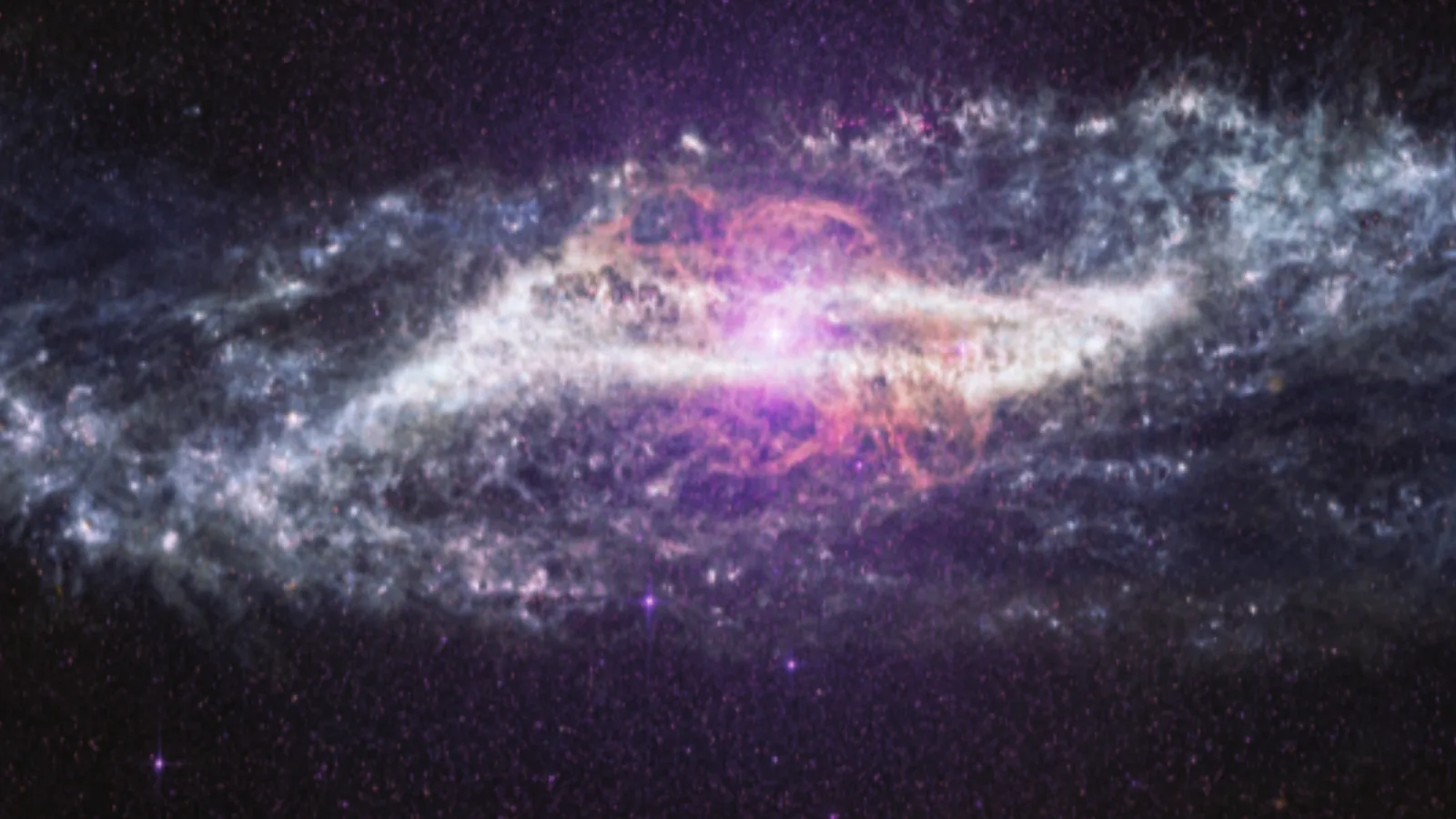
The James Webb Space Telescope (JWST), NASA's premier observatory, is marking four years since its first images captivated the public in July 2026. To commemorate this milestone, space agency officials have unveiled a spectacular new image of Centaurus A, a galaxy renowned for its peculiar form, resulting from a galactic merger approximately 2 billion years ago. This cosmic collision provided Centaurus A with a rich supply of gas and dust, fueling vigorous star formation and feeding the supermassive black hole at its core, which in turn generates powerful jets of plasma.
While Centaurus A is relatively close by, just 11 million light-years away, its detailed study by JWST offers unprecedented insights into galactic evolution. The telescope's advanced infrared capabilities allow it to penetrate the dense dust clouds that obscure the galaxy's center, revealing details previously hidden from view. This capability surpasses that of earlier instruments like the Hubble Space Telescope, which relied on visible light, and the Spitzer Space Telescope, which offered infrared views but lacked the resolution for finer details.
Shawn Domagal-Goldman, division director of Astrophysics at NASA Headquarters in Washington, emphasized the cumulative nature of scientific discovery. "No single telescope tells the whole story," he stated. "Discoveries build over time, and new observatories expand on the foundations laid by earlier missions. The JWST represents the most powerful step forward yet, opening a window into wavelengths and details never before accessible." This advanced vision enables astronomers to scrutinize structures and processes invisible to previous telescopes.
Peering into Centaurus A's Dusty Heart
The JWST's Mid-Infrared Instrument (MIRI) and Near-Infrared Camera (NIRCam) have provided exceptionally detailed views of Centaurus A. These observations highlight active stellar nurseries, where new stars are being born and expelling gas and dust. However, the images also reveal an enigmatic S-shaped feature within the MIRI view, the origin of which remains a mystery. Scientists are investigating whether the supermassive black hole at the galaxy's center played a role in its formation. Understanding such features is crucial for piecing together the complex life cycles of galaxies.
The new data from JWST significantly illuminates the impact of the galaxy's central black hole on its structure and evolution. Observations show fast-moving ionized gas being ejected by the black hole's energetic activity. Furthermore, the telescope detected warm molecular hydrogen in a swirling disk near the galactic core. This evidence suggests a dual role for central black holes: they can both trigger intense starbursts by condensing gas and dust, and conversely, suppress star formation by expelling the necessary raw materials, effectively 'killing' their host galaxies.
The detailed infrared views of Centaurus A are painting a more complete cosmic narrative for this nearby galaxy. These discoveries hold profound implications for understanding how galaxies like our own Milky Way formed and evolved. The success of the James Webb Space Telescope in capturing such intricate details underscores its role as a revolutionary instrument in 21st-century astronomy. As scientists continue to analyze the wealth of data being transmitted from this orbiting observatory, further groundbreaking revelations about the universe are anticipated. The telescope's ability to observe in the infrared spectrum is key to unlocking secrets of the early universe and the formation of stars and planets within dusty nebulae, areas previously inaccessible to human observation. This ongoing mission promises many more years of scientific advancement and stunning cosmic imagery, building on the legacy of Hubble and Spitzer.