
Webb Telescope Maps Universe's Largest Structure in New Detail
The James Webb Space Telescope has mapped the universe's largest structure, the cosmic web of galaxies, with unprecedented detail. This extensive survey reveals galactic evolution from the early universe.

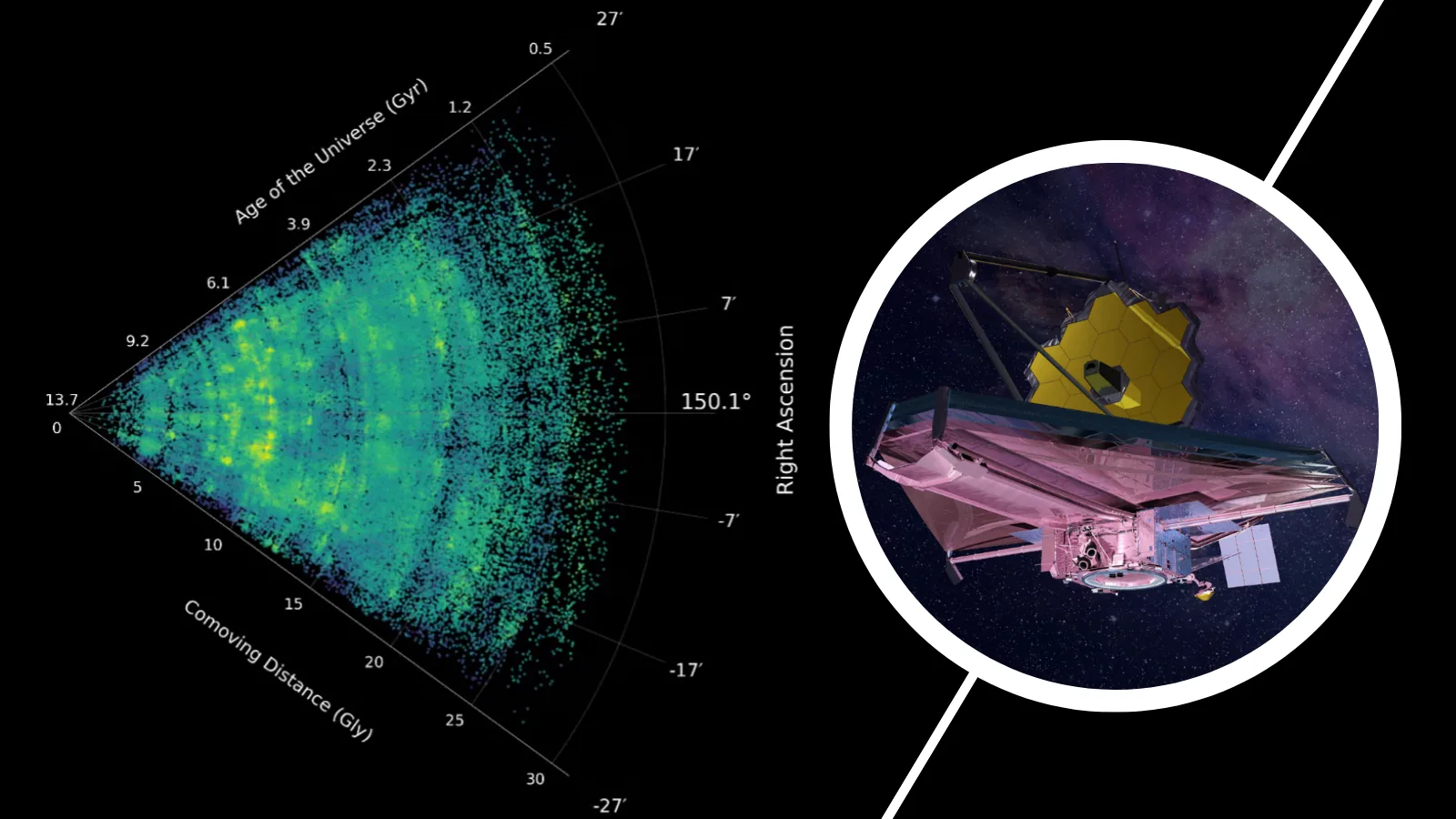
Astronomers utilizing the powerful James Webb Space Telescope (JWST) have produced the most detailed map to date of the universe's largest known structure: the cosmic web of galaxies. Known as the COSMOS-Web survey, this ambitious project meticulously traces the intricate network of galaxies back to an era when the universe was approximately 1 billion years old, offering an unparalleled glimpse into cosmic architecture.
The cosmic web, a term coined by scientists, describes a vast, interconnected scaffolding of dark matter and gas filaments along which galaxies form and cluster. This filamentary structure, punctuated by immense voids, dictates the distribution of matter across the cosmos. The groundbreaking results from the COSMOS-Web project underscore the revolutionary capabilities of the JWST, a $10 billion observatory that began transmitting data in the summer of 2022, fundamentally reshaping our understanding of the universe.
“JWST has completely changed our view of the universe, and COSMOS-Web was designed from the start to give us the wide, deep view we need to see the cosmic web,” stated Hossein Hatamnia, leader of the research from the University of California, Riverside (UCR). “For the first time, we can study the evolution of galaxies in cluster and filamentary structures across cosmic time, all the way from when the universe was a billion years old up to the nearby universe.”
By “nearby universe,” Hatamnia refers to distances up to about 1 billion light-years. This vast scale highlights the immense reach of the COSMOS-Web survey, extending the observable cosmic structure by roughly 13 billion light-years. Such profound depth is essential for astronomers to construct an accurate representation of the cosmic web.
Unveiling Early Cosmic Structures
The detailed large-scale structure provided by COSMOS-Web surpasses previous maps, including those generated by the Hubble Space Telescope. Bahram Mobasher, a scientist at UCR and team member, explained that comparisons reveal structures previously appearing as single entities in Hubble data are now resolved into multiple components in the JWST images. “The jump in depth and resolution is truly significant, and we can now see the cosmic web at a time when the universe was only a few hundred million years old, an era that was essentially out of reach before JWST,” Mobasher said. “What used to look like a single structure now resolves into many, and details that were smoothed away before are now clearly visible.”
This significant leap in observational detail is attributed to the synergy of the JWST’s advanced instruments. “The telescope detects many more faint galaxies in the same patch of sky, and the distances to those galaxies are measured far more precisely,” Hatamnia noted. “Each galaxy can therefore be placed into the correct slice of cosmic time, sharpening the map’s resolution.” This enhanced precision allows researchers to study the formation and evolution of galaxies within the complex filamentary networks and clusters that define the universe’s largest structures. The COSMOS-Web project promises to unlock new insights into the early stages of galaxy formation and the distribution of matter in the universe’s infancy.