
NASA's 34th SpaceX Mission Delivers Science Experiments to ISS
NASA's 34th SpaceX resupply mission successfully launched on a Falcon 9 rocket, carrying nearly 6,500 pounds of cargo and new scientific experiments to the International Space Station.

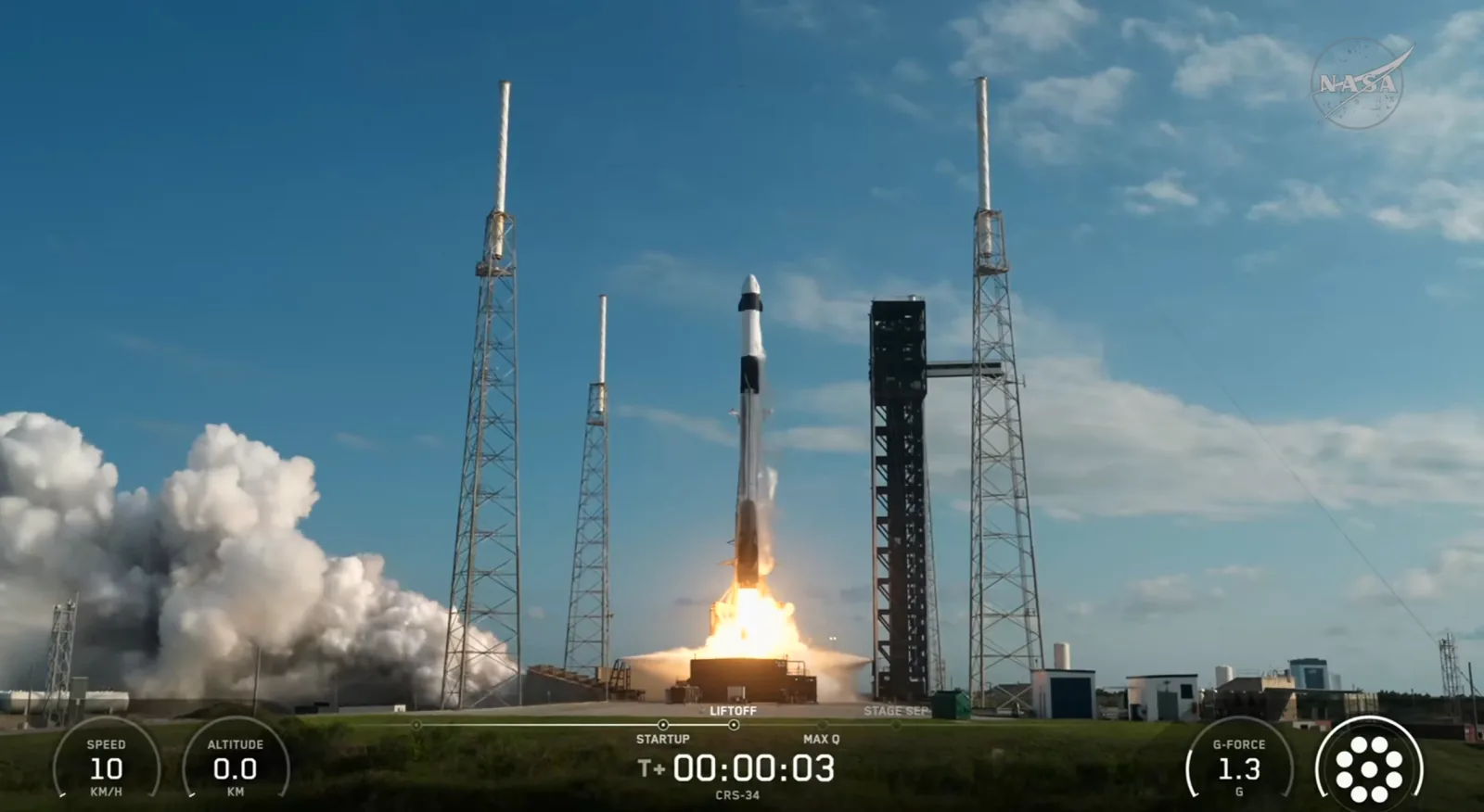
The 34th SpaceX commercial resupply mission for NASA successfully launched Friday at 6:05 p.m. EDT from Cape Canaveral Space Force Station in Florida, carrying nearly 6,500 pounds of vital cargo and cutting-edge scientific experiments to the International Space Station (ISS). The Falcon 9 rocket lifted off from Space Launch Complex 40, marking another step in the ongoing collaboration between NASA and SpaceX to support operations aboard the orbiting laboratory.
The SpaceX Dragon spacecraft is expected to autonomously dock with the ISS around 7 a.m. Sunday, May 17, attaching to the forward port of the station’s Harmony module. NASA will provide live coverage of the rendezvous and docking beginning at 5:30 a.m. on NASA+, Amazon Prime, and the agency’s YouTube channel, allowing the public to follow the critical arrival process.
This mission is not just about delivering supplies; it's a payload brimming with innovation. Among the new experiments are projects designed to understand the nuances of microgravity. One investigation aims to determine how well Earth-based simulators replicate the unique conditions experienced in space, crucial for preparing astronauts for long-duration missions. Another focuses on creating a bone scaffold from wood, with the potential to yield novel treatments for debilitating conditions like osteoporosis.
Advancing Space Science and Earth Observation
Beyond biology and health, the Dragon capsule is equipped with advanced instruments to further scientific understanding of our planet and the cosmos. A new instrument will study charged particles in Earth's vicinity, providing insights into phenomena that can impact vital power grids and satellites. This research could lead to a fundamental understanding of planetary formation processes. Additionally, an instrument designed for highly accurate measurements of sunlight reflected by Earth and the Moon promises to enhance our comprehension of celestial mechanics and atmospheric conditions.
These sophisticated experiments are part of hundreds of investigations continuously conducted aboard the ISS. For over 25 years, the station has served as a unique platform for advancing scientific knowledge across biology, biotechnology, physical sciences, and Earth and space science. It enables breakthroughs that are simply not possible in terrestrial laboratories. The International Space Station not only helps NASA tackle the challenges of human spaceflight but also fosters commercial opportunities in low Earth orbit.
The ISS plays a foundational role in NASA's broader ambitions, including preparing for long-duration missions to the Moon under the Artemis program and eventual crewed missions to Mars. The insights gained from microgravity research and technological development on the station are vital for enabling humanity's expansion beyond Earth.
The Dragon spacecraft is scheduled to remain attached to the ISS until mid-June. It will then undock and return to Earth, carrying valuable time-sensitive research and cargo back to the planet. The mission will conclude with a splashdown off the coast of California, completing another successful cycle of resupply and research transfer.