
Mars Express Reveals Ancient Waterway Lined with Volcanic Ash
ESA's Mars Express spacecraft has captured striking images of Shalbatana Vallis, revealing dark volcanic ash deposits within a 3.5-billion-year-old Martian riverbed.

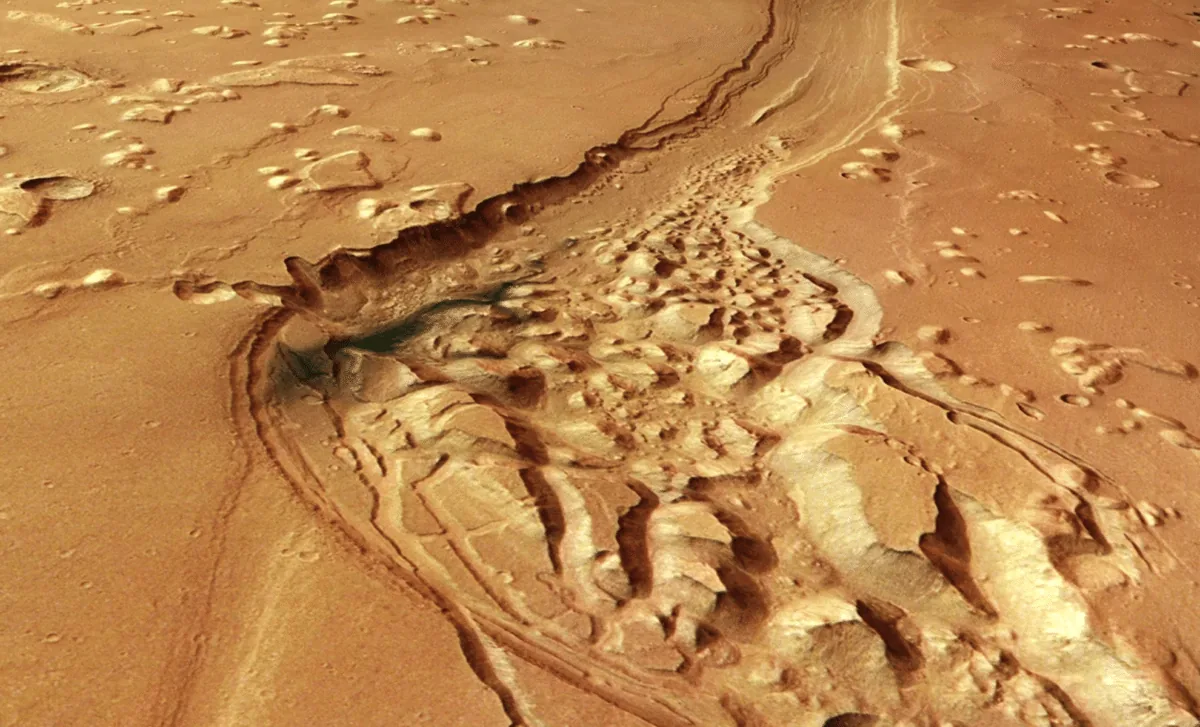
New imagery from the European Space Agency's (ESA) Mars Express spacecraft has unveiled enigmatic dark material coating a portion of Shalbatana Vallis, an immense ancient channel on Mars where water once flowed approximately 3.5 billion years ago. This detailed view of the northern sector of the valley system, situated near the Martian equator, offers a glimpse into a period when the Red Planet was significantly wetter than it is today.
Shalbatana Vallis itself is a colossal feature, stretching an estimated 800 miles (1,300 kilometers) across the Martian surface. Scientists theorize that this extensive valley was carved by vast quantities of liquid water surging across the terrain in the planet's early history. The section highlighted in the recent Mars Express release measures about 6 miles wide and roughly 0.3 miles deep. While geological processes such as sedimentation, dust accumulation, volcanic ash deposition, and lava flows have gradually filled parts of the channel over eons, the valley remains a potent testament to Mars' hydrological past.
The persistent discovery of ancient river networks, water-formed mineral deposits, and layered sedimentary rocks by orbiters and rovers has fundamentally reshaped our understanding of early Mars. Such regions as Shalbatana Vallis are particularly valuable for preserving direct physical evidence of dramatic flood events that likely reshaped large swathes of the planet. Researchers suggest that these intense floods may have originated from the sudden rupture of underground water reservoirs, unleashing enormous volumes of water in comparatively short geological timescales and carving valleys with remarkable speed.
Dark Ash Deposits Suggest Past Volcanic Activity
A particularly compelling feature within the new Mars Express images is the presence of dark blue and black-toned material concentrated along the valley floor. Analysis by scientists involved with the ESA mission indicates that this material is most likely volcanic ash. This ash was likely transported across the Martian surface by powerful ancient winds. While Mars currently displays no signs of active volcanism, the planet's ancient past was marked by intense volcanic activity, the remnants of which are still observable. These ash deposits serve as a dual reminder that ancient Mars was shaped not only by water but also by large-scale volcanic processes. The planet is home to Olympus Mons, the largest volcano in the Solar System.
The dark material appears especially dense near an unusual bulging geological structure along the channel. This feature is thought to have formed when subsurface ice began to melt. The subsequent collapse of the terrain above the disappearing ice created the distorted landscape visible today, a process known as subsidence. This phenomenon, observed in other Martian locations, underscores the complex interplay between volcanic heating, buried ice, and shifting geological layers.
The combination of volcanic ash and evidence of ancient ice within Shalbatana Vallis makes this region a scientifically significant site. It preserves multiple critical chapters of Martian history in a single location, allowing scientists to study how these diverse environments evolved. Researchers are keen to understand if these past conditions could have supported microbial life at any point.
The Mars Express mission, operational since 2003, has been instrumental in transforming our understanding of the Red Planet. Its high-resolution imaging capabilities allow for detailed examination of Martian terrain, revealing geological structures often missed by lower-resolution instruments. Data from Mars Express indicates that the terrain surrounding Shalbatana Vallis also shows signs of extensive volcanic flooding. Much of the landscape appears unusually smooth, suggesting past lava flows that cooled and hardened, forming features like "wrinkle ridges" – textured patterns across plains created by contracting lava.
Impact craters, scars from asteroid and meteoroid collisions over billions of years, are also scattered throughout the area. Mars's lack of active plate tectonics and its thin atmosphere have allowed many of these ancient impact features to remain remarkably preserved. The latest Mars Express imagery collectively illustrates how various geological forces—water erosion, volcanic eruptions, ice collapse, lava flows, and asteroid impacts—have simultaneously shaped the Martian landscape across different eras. For scientists, this confluence of evidence offers a rare opportunity to reconstruct the environmental conditions of ancient Mars, a planet that may have once harbored conditions far more akin to Earth than previously imagined.