
Galactic Sugar: Life's Building Blocks Found Near Milky Way Center
Astronomers have detected erythrulose, a sugar found in raspberries, in interstellar dust clouds near the Milky Way's core. This discovery suggests key life compounds can form in space, boosting theories about life's origins.

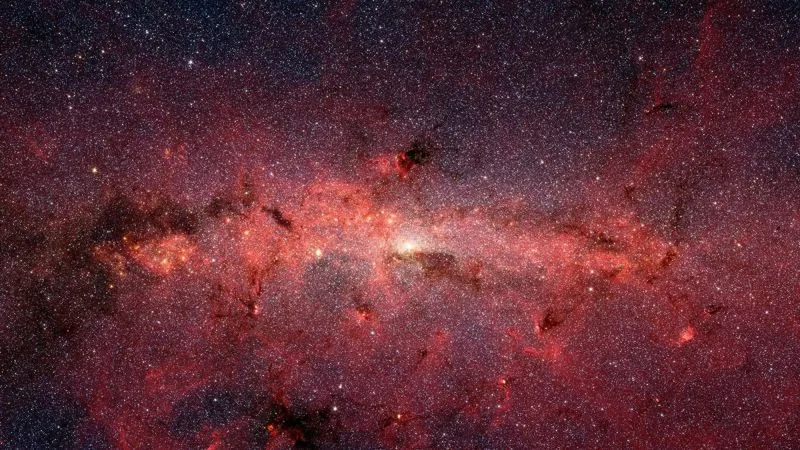
Astronomers have detected a natural sugar, erythrulose, in interstellar dust and gas clouds near the center of the Milky Way galaxy. The discovery, announced Monday, marks the first time such a key compound for life has been found in the vast expanse between stars. This finding fuels optimism that other essential molecules for the origins of life may also exist in space.
A team led by researchers at Spain’s Center for Astrobiology identified erythrulose, a sugar molecule composed of four carbon atoms, using radio telescopes. Sugars are fundamental to life on Earth, playing critical roles in providing energy, building biological structures, and forming components of genetic material like RNA and DNA. The observations were made using radio telescopes at the Yebes Observatory and the Institute for Radio Astronomy in the Millimeter Range (IRAM) in southern Spain. The scientists focused on a molecular cloud designated G+0.693−0.027, located close to the galactic center.
The researchers identified the sugar by comparing its unique molecular signature, detected in radio waves emanating from the molecular cloud, with the laboratory-measured wavelength pattern of erythrulose. The team had initially searched for simpler, three-carbon sugars but did not find them. “This finding was unexpected, as the prevailing view in astrochemistry is that interstellar molecules grow in size through the sequential addition of carbon atoms,” said Izaskun Jiménez-Serra, an astronomer at the Center for Astrobiology in Madrid and the Spanish National Research Council, who was the lead author of the study published in Nature Astronomy. “Our discovery demonstrates that relatively complex sugars can already be synthesized in interstellar space, before stars and planets are born,” she added via email.
Origin of Life in the Cosmos
The study proposes that erythrulose can form from simpler molecules on icy dust grains in the harsh environment of interstellar space. These complex sugars could then become integrated into more elaborate chemical systems. While scientists have cataloged over 340 different molecules in the Milky Way’s interstellar medium, sugars had not previously been among them. Mark Sephton, a professor at Imperial College London’s Department of Earth Science and Engineering, who was not involved in the research, commented on the significance of the find. “Sugar and sugar-related compounds have been found in asteroids, but the discovery of these compounds in interstellar space strengthens suggestions that our solar system may have been seeded with pre-existing organic compounds,” he stated in an email.
Scientists have long sought to understand how sugar molecules first formed on Earth, as laboratory experiments indicate they do not readily form under the extreme conditions believed to have existed during Earth's early history. Previous detections of sugars, such as ribose and glucose, in primitive meteorites and in samples collected from the asteroid Bennu in 2020 had already suggested to some researchers that certain sugars might originate in space. Sephton theorized that sugars could have been incorporated into asteroids during their formation and subsequently delivered to Earth via meteorites.
Yoshihiro Furukawa, a professor at Tohoku University’s Department of Earth Sciences in Japan and a member of the team that discovered sugars in Bennu samples, concurred that sugars could indeed reach planets like Earth through comets and asteroid dust. However, the precise mechanisms by which life emerged from such organic compounds remain an open question. “This finding is very interesting, as we have been waiting for an actual detection like this,” Furukawa said.
The research team estimated that between 0.5 million and 50 million metric tons of erythrulose could have impacted Earth's surface during the Late Heavy Bombardment period, approximately 4 billion years ago, a time when the inner solar system experienced intense asteroid activity. However, the occurrence and scale of this ancient bombardment are still subjects of ongoing scientific debate, according to NASA.
Erythrulose, found in small quantities in raspberries and some other fruits, is also utilized in the cosmetics industry as an ingredient in self-tanning and bronzing products due to its ability to react with the skin’s outer layer and produce a tanned appearance. “The detection of erythrulose is very exciting because it opens up the possibility of discovering in space other sugars such as ribose, which is part of RNA, and other important molecules for the origin of life,” Carlos Briones, a study co-author and researcher in molecular evolution at the Spanish National Research Council and the Center for Astrobiology, stated.