
Gus T. rex Fossil Smashes Records at $50.1 Million Auction
A remarkably complete Tyrannosaurus rex fossil, nicknamed Gus, has sold for a record-breaking $50.1 million at a Sotheby's auction in New York. The 67-million-year-old specimen is one of the largest T. rexes ever unearthed.

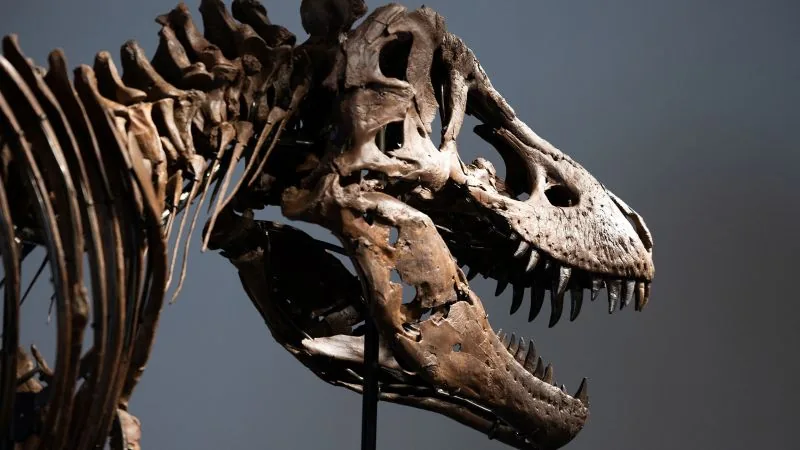
A colossal Tyrannosaurus rex fossil, affectionately known as Gus, shattered previous records Tuesday, commanding a staggering $50,130,000 at a Sotheby's auction in New York City. The 67-million-year-old specimen, excavated from South Dakota, stands as the most expensive fossil ever sold at public auction, surpassing the prior record set in 2024. Gus measures an impressive 38 feet long and 12.5 feet tall, boasting a skull that is 54 inches wide, making it one of the most substantial T. rex finds to date. The skeleton comprises 183 individual bone elements, achieving approximately 61% completeness by bone count and an estimated 75% to 80% completeness by mass.
The specimen originates from the renowned Hell Creek Formation, a geological treasure trove spanning Montana, Wyoming, and the Dakotas, which has yielded numerous significant dinosaur discoveries, including one of the earliest T. rex fossils found in 1902. The land where Gus was discovered is owned by the estate of the late Gary ‘Gus’ Licking, a Harding County, South Dakota cattle rancher who passed away in 2022, just as the excavation of the fossil was underway. Sotheby's had placed the presale estimate for Gus between $20 and $30 million, with the final winning bid placed remotely via telephone.
Scientific Concerns Over Private Ownership
The sale of exceptionally rare fossils to private collectors often sparks debate within the scientific community. Paleontologists widely express concern that once such specimens enter private collections, they are effectively lost to scientific research. Peer-reviewed scientific journals typically mandate that research must be reproducible, a standard that is difficult to meet when specimens are held privately and inaccessible for independent verification. This poses a significant challenge to advancing our understanding of prehistoric life. Gus, however, possesses several features that appealed to both potential scientific study and private acquisition. Its skull is remarkably intact, with approximately 82% of its original bones present. The skeleton also includes rare components such as a complete pelvis, both feet, and a wishbone—elements infrequently found together in other specimens. In fact, Sotheby's noted that only one other T. rex fossil is known to feature two complete feet.
Further adding to its unique allure, Gus exhibits evidence of healed fractures and bite marks, suggesting the dinosaur survived traumatic encounters during its lifetime. While Sotheby's lauded Gus as one of the most complete T. rex fossils ever discovered, it is notably less complete than other notable finds like Stan, a T. rex sold in 2020 for $31.8 million and approximately 70% complete by bone count, or Sue, the groundbreaking fossil sold in 1997 that achieved an impressive 90% completeness. A distinctive advantage for Gus is that it comes with "full rights," meaning its skeletal structure does not incorporate casts or elements from other dinosaurs to fill gaps. Typically, when bones are missing, casts from other specimens are used, a practice exemplified by the Stan T. rex, which also hails from the same South Dakota county. The new owner of Gus could potentially develop a competitive market for creating and licensing casts for museums and private collectors, mirroring the path taken with Stan.
The identity of the buyer remains undisclosed, leaving the scientific and collecting worlds keenly observing what decisions will be made regarding the future accessibility and study of this extraordinary T. rex fossil. The record-breaking sale highlights the immense market value placed on significant paleontological discoveries, while simultaneously underscoring the ongoing tension between private ownership and public scientific access.