
Green Tech: Energy Storage Breakthroughs Transform Climate
Advanced battery systems and thermal storage innovations are reshaping how utilities manage renewable power, with major investments accelerating deployment across North America.

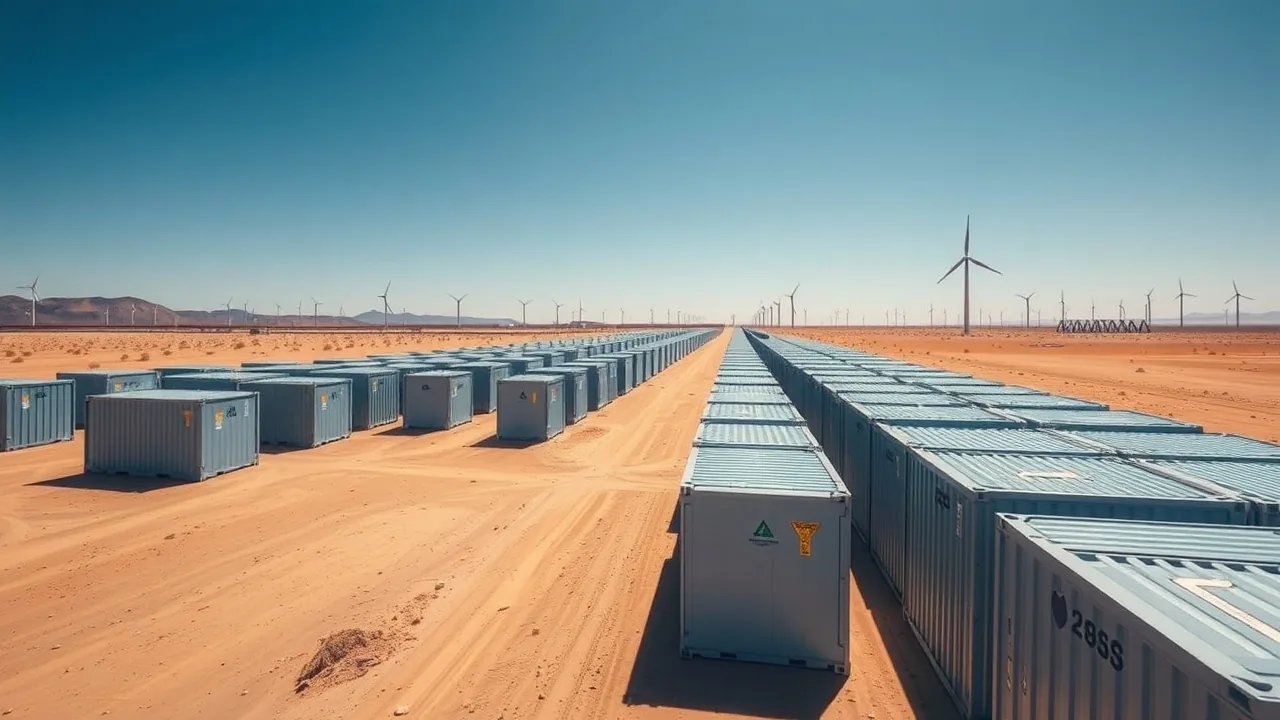
Billionaire conservationist Ted Turner's vast ranches and renewable investments underscore a growing reality: the global energy landscape is shifting toward storage-dependent systems that can absorb wind and solar output. Last month, the U.S. Energy Information Administration reported that battery storage capacity will more than triple by 2030, driven by falling lithium-ion costs and grid modernization demands.
The urgency reflects a fundamental physics problem. Solar panels generate peak power at midday; wind turbines perform best at night. Without sophisticated energy storage infrastructure, utilities cannot reliably source electricity from intermittent renewables. Grid operators in California, Texas, and the Northeast now prioritize storage projects as aggressively as generation capacity, reshaping investment priorities.
Major technology advances are accelerating deployment. Tesla's Megapack units, each holding 15 megawatt-hours of capacity, have been installed at projects in Oregon and Australia. Form Energy, backed by venture capital and strategic investors, is commercializing iron-air batteries that store energy for 100-plus hours at costs below $100 per kilowatt-hour. Eos Energy Enterprises went public in 2021 to scale its zinc-hybrid cathode systems.
The Storage Imperative Reshapes Utility Strategy
Electric utilities are rewriting capital budgets to accommodate what industry analysts call the "storage-first" era. According to a November 2024 report from BloombergNEF, global investment in battery technology and long-duration storage exceeded $15 billion in 2023, up 40 percent year-over-year.
"We are no longer optimizing for peak capacity," said James Bradley, director of energy strategy at the American Public Power Association. "Every dollar spent on grid infrastructure now includes a storage component in the financial model. It is the default assumption."
This shift reshapes which projects attract capital. Utility companies now evaluate renewable energy installations alongside integrated battery systems, rather than treating storage as optional ancillary equipment. South Carolina-based Duke Energy announced in March 2024 that it would deploy 5 gigawatt-hours of battery storage by 2028, a 10-fold increase from prior targets.
Thermal storage systems complement battery technology by shifting heating and cooling loads. Cryoenergia, a Swiss company, has installed phase-change tanks that freeze water during off-peak hours, releasing cooling energy when peak demand arrives. These systems address commercial and industrial facilities where electricity demand is concentrated and predictable.
Cost Declines Drive Mainstream Deployment
The economic case for clean energy storage has strengthened dramatically. Lithium-ion battery pack prices fell to $139 per kilowatt-hour in 2023, according to BloombergNEF data, down from $1,100 in 2010. This 87 percent cost reduction has triggered a inflection point in grid-scale projects.
Several factors converge:
- Global lithium and cobalt supply chains have matured, reducing raw material volatility.
- Manufacturing scale-up by Tesla, CATL, and SK Innovation has compressed production costs.
- Policy incentives, including the U.S. Investment Tax Credit expanded under the Inflation Reduction Act, reduce effective project costs by 30 percent.
- Competition among battery makers intensifies downward price pressure year-over-year.
Long-duration storage technologies remain expensive but are moving toward parity. Form Energy's iron-air batteries target $20 per kilowatt-hour by 2030, a threshold that would justify 10-to-24 hour storage solutions in competitive electricity markets. Compressed air energy storage (CAES), another established but underutilized technology, operates at full scale in Alabama and Germany with minimal degradation over decades.
Venture capital and corporate investors are betting on material science breakthroughs. Breakthrough Energy Ventures, founded by Bill Gates, has funded flow batteries, compressed air systems, and novel chemistries that do not depend on lithium. These approaches target different use cases: some excel at 2-hour discharge cycles, others at multi-day durations.
Why Grid Resilience Demands Storage Scale
Climate volatility is reshaping electricity demand patterns. Extreme heat waves increase air-conditioning load precisely when solar output declines in late afternoon. Winter storms coincide with peak heating demand but weak sun and variable wind. Sustainability initiatives alone do not address these physical constraints; storage is the engineering requirement.
The Northeast blackout of August 2003 demonstrated that aging grids cannot absorb variable generation without storage. Modern grid simulation by the National Renewable Energy Laboratory shows that regions with greater than 50 percent renewable penetration require storage equivalent to 4-to-6 hours of peak load, roughly 20-to-50 gigawatt-hours in major metros. Today, the U.S. operates approximately 8 gigawatt-hours of grid-scale battery storage.
Microgrids in remote areas and islands now treat storage as mandatory infrastructure. Puerto Rico's electric authority has contracted for 500 megawatt-hours of battery capacity to replace aging diesel generators and mitigate outages. Guam's renewable transition depends on 300 megawatt-hours of storage systems paired with solar and wind.
Corporate ESG commitments are accelerating private investment in storage infrastructure. Amazon, Google, and Meta have collectively contracted for multi-billion-dollar renewable projects over the past three years, and increasingly these include integrated storage components. Companies recognize that Scope 2 emissions (purchased electricity) depend on grid carbon intensity, which storage directly improves by enabling renewable adoption.
The convergence of falling costs, policy support, climate urgency, and corporate investment signals a fundamental reconfiguration of electrical grids. Storage is shifting from niche project add-on to core infrastructure, reshaping how green tech is financed, deployed, and regulated across North America.