
2026 El Niño Intensity Forecast Shows Stronger Ocean Pattern Ahead
Climate scientists are tracking a potentially stronger El Niño developing in 2026, with forecasts suggesting significant impacts on global weather patterns and extreme weather events. New models indicate ocean currents may amplify the warming effect across the Pacific.

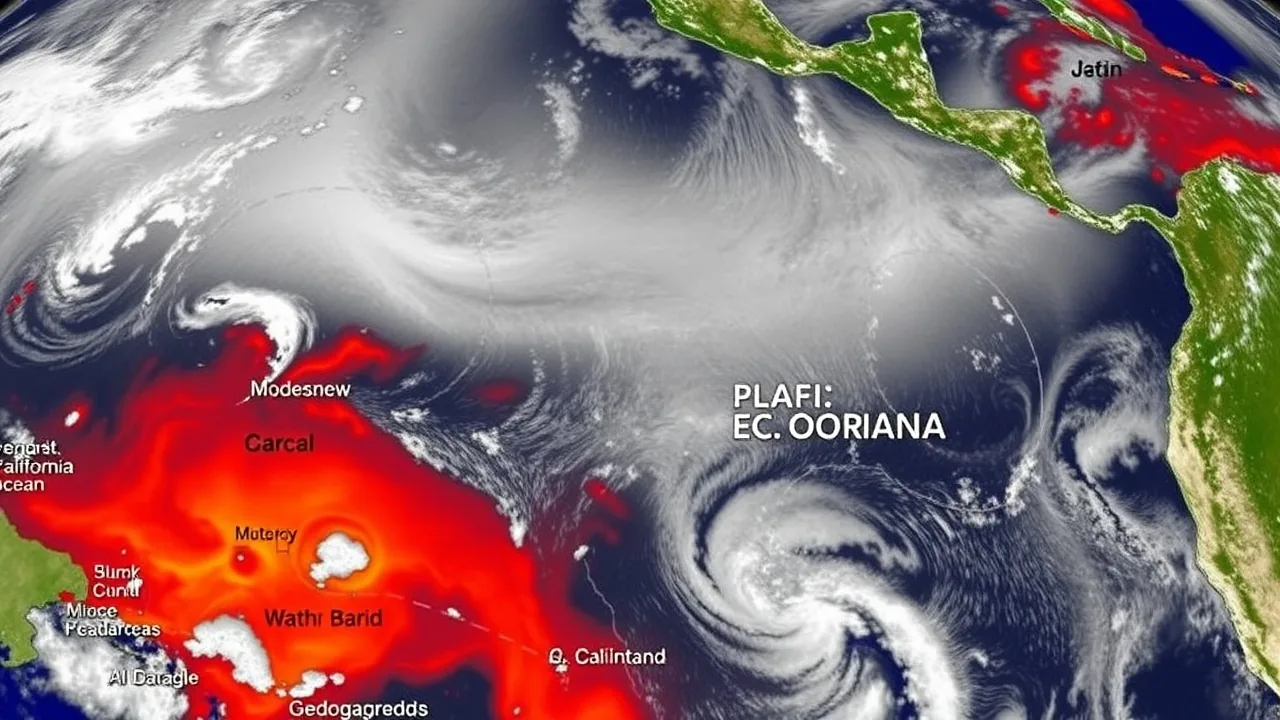
The National Oceanic and Atmospheric Administration released updated forecasts this week projecting a moderate-to-strong El Niño pattern forming in the Pacific Ocean during 2026, marking the second significant warming cycle in three years. Scientists at NOAA's Climate Prediction Center are monitoring sea surface temperatures and subsurface ocean conditions that typically signal the onset of the phenomenon.
El Niño occurs when warm water in the central and eastern Pacific Ocean strengthens, disrupting normal ocean currents and atmospheric circulation patterns. The 2023-2024 El Niño was among the warmest on record, and preliminary data suggests 2026 may rival or exceed that intensity based on current trajectory modeling.
"We're seeing indicators in the subsurface that suggest warm water anomalies are positioning themselves for a significant event," said Michael Halpert, chief of NOAA's Climate Prediction Center, in a statement released January 8, 2026. The agency updates its forecasts monthly based on real-time ocean buoy data, satellite measurements, and computational models.
What Makes 2026 Different
The 2026 forecast differs from typical El Niño projections because of persistent climate change warming in the background. Ocean temperatures globally are running 0.2 to 0.3 degrees Celsius above 20th-century averages, which means any El Niño event now occurs on top of an already-warmed baseline.
Current climate models indicate several factors may amplify the 2026 event:
- Above-normal subsurface heat content in the tropical Pacific
- Reduced trade wind strength in the western Pacific, which normally suppresses El Niño development
- Positive feedback loops from reduced cloud cover over warming waters
- Interaction with the Atlantic Meridional Overturning Circulation, which influences Atlantic hurricane activity
The European Centre for Medium-Range Weather Forecasts and the Japan Meteorological Agency independently issued similar intensity assessments in their December forecasts, lending confidence to the projection.
Global Impacts on Extreme Weather and Food Security
A stronger El Niño in 2026 would reshape weather patterns across multiple continents. Historical data shows that strong El Niño years correlate with increased rainfall in the southern United States, drought conditions across Australia and parts of Asia, and disrupted monsoon behavior in India and Southeast Asia.
Agricultural economists warn that drought impacts in key grain-producing regions could strain global food supplies. The UN Food and Agriculture Organization noted that the 2023-2024 El Niño contributed to crop failures in East Africa, Central America, and Indonesia, affecting over 100 million people dependent on rain-fed agriculture.
Fisheries are also vulnerable. Peru's anchovy catch, the world's largest single-species fishery, collapsed during strong El Niño events as warm water reduces nutrient upwelling from the deep Pacific. Scientists project potential fish stock disruptions extending into 2027.
Extreme weather events typically intensify during El Niño years. Forecasters anticipate higher-than-average tropical storm activity in the eastern Pacific, potential for severe flooding in parts of North America, and increased heat waves across multiple regions.
The Atlantic hurricane season may see below-average activity, however, because El Niño conditions increase wind shear that typically suppresses storm formation in the Atlantic basin.
Climate Science Advances Sharpening Predictions
Improved forecasting owes to advances in climate science technology and oceanographic monitoring. The Argo float network, consisting of over 3,800 autonomous ocean profilers distributed across the global oceans, provides real-time temperature and salinity data to depths of 2,000 meters.
Satellite sea surface temperature measurements from NOAA's GOES satellites now update every 10 minutes, compared to hourly intervals five years ago. Combined with advanced machine learning algorithms that identify El Niño precursor patterns, lead times for predictions have extended from 6-9 months to 12-18 months.
"The ability to predict El Niño intensity 12-18 months in advance gives farmers, water managers, and public health officials critical time to prepare," said Emily Becker, research oceanographer at NOAA, in an email exchange. "But we're still limited by our understanding of how climate change itself is altering the amplitude and frequency of these natural cycles."
Researchers continue debating whether global climate warming is changing El Niño frequency or intensity. Some studies suggest a shift toward more extreme events, while others indicate no clear trend yet. The 2026 event will provide scientists with valuable data to refine these competing hypotheses.
Water resource managers across the western United States are already factoring 2026 forecasts into reservoir operations. Higher precipitation projections over the Southwest may ease drought conditions in Lake Mead and Lake Powell, though much depends on the specific timing and latitude of atmospheric rivers steered by El Niño.
International climate bodies including the Intergovernmental Panel on Climate Change are incorporating ensemble El Niño forecasts into their long-term climate assessments. The 2026 event will serve as a stress test for how modern societies have adapted to extreme weather in the four years since the 2023-2024 El Niño disrupted global systems.