
Uranus, Neptune Could Be Magma Worlds, New Study Suggests
New computer models from UCLA researchers suggest Uranus and Neptune may not be ice giants, but instead possess interiors of magma oceans. This could have implications for understanding exoplanets.

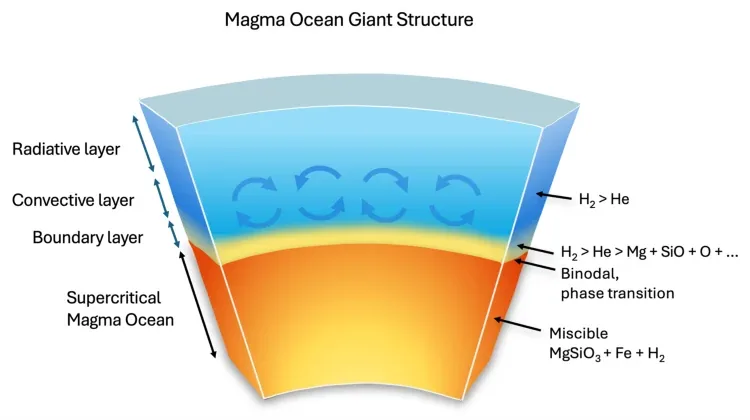
New computer simulations propose that the distant planets Uranus and Neptune might not be the "ice giants" long believed to be, but instead could harbor vast oceans of magma beneath their atmospheres. The findings, based on extensive modeling by researchers at the University of California, Los Angeles (UCLA), challenge decades of scientific understanding about the composition of these enigmatic worlds.
Uranus and Neptune have remained largely mysterious since their only close encounters were by NASA's Voyager 2 spacecraft in 1986 and 1989, respectively. Current hypotheses describe them as "ice giants," with a dense, icy mantle composed of water, ammonia, and methane, layered above a rocky core and beneath a hydrogen and helium atmosphere. However, inconsistencies in observed magnetic fields and heat distribution have long puzzled scientists, prompting the UCLA team to investigate alternative interior structures.
"While this is just one of a number of models that successfully reproduce the observed features of Neptune and Uranus, this model has several aspects to recommend it," the study's authors concluded. "One is the connection with other gas dwarf planets; it is not clear that ice giants and sub-Neptunes should be fundamentally different simply because of their distances from their host star."
Rethinking Planetary Interiors
The UCLA study utilized sophisticated computer models to simulate the internal processes and compositions of both planets. The simulations suggest a different planetary layering than previously accepted. The proposed structure includes the familiar hydrogen/helium atmosphere, but beneath this lies a boundary layer containing hydrogen, helium, magnesium, silicon monoxide (SiO), and oxygen. The deepest layer, according to this model, is a magma ocean composed of silicate, iron, and hydrogen.
This magma ocean theory could help explain observed planetary characteristics that have defied previous explanations. For instance, the way heat is distributed and how magnetic fields are generated within these planets might be better understood if their interiors are indeed molten rather than solid ice. The possibility of magma worlds fundamentally alters our perception of the dynamics and evolution of these outer solar system bodies.
The implications of this research extend beyond our own solar system. Sub-Neptune exoplanets, which have radii between 1 to 4.5 times that of Earth, are the most common type of planet discovered in the Milky Way galaxy. Understanding the formation and evolution of these distant worlds remains a significant challenge due to the lack of analogous planets within our solar system. The Uranus and Neptune magma ocean model could serve as a crucial analog for these prevalent exoplanets, offering insights into their potential internal structures and atmospheric conditions.
"Related to this is the fact that the most basic chemical features of the ice giants resemble those of gaseous sub-Neptunes, perhaps indicating similar boundary conditions for the chemistry of the atmospheres imposed by the magma oceans," the researchers noted. This suggests that the processes occurring within Neptune might mirror those on countless exoplanets, bridging a gap in our understanding of planetary science across the cosmos.
Despite the compelling new models, direct observation remains limited. No missions are currently planned to revisit Uranus or Neptune, though several concepts, such as the Uranus Orbiter and Probe (UOP) and Neptune Odyssey, have been proposed. These proposed missions aim to conduct more in-depth studies, potentially by entering orbit or sending probes into the atmospheres, which could either confirm or refute the magma ocean hypothesis and provide unprecedented data on these distant giants. The ongoing quest to understand these planets highlights the dynamic nature of scientific discovery and the ever-evolving picture of our solar system and beyond.