
NASA Swift Mission Orbit Boost Set for June 30 Launch
NASA's Swift Observatory is slated for an orbital boost mission on June 30, launched by a new robotic satellite named LINK. The mission aims to extend the life of the vital space telescope.

NASA and its partners are preparing for a critical mission to extend the operational life of the Neil Gehrels Swift Observatory, with a launch window opening on June 30, 2026. The mission, dubbed Swift Boost, will utilize a new robotic servicing satellite called LINK, developed by Katalyst Space, to gently raise the observatory's orbit. LINK will be carried into space atop a Northrop Grumman Pegasus XL rocket, launching from Kwajalein Atoll in the Republic of the Marshall Islands.
Over several months, LINK will rendezvous with, grapple, and incrementally elevate Swift’s altitude, a maneuver designed to prevent its premature re-entry into Earth's atmosphere later this year. "Swift is NASA’s multitool when it comes to studying the cosmos," stated S. Bradley Cenko, principal investigator for Swift at NASA’s Goddard Space Flight Center. "It observes the sky using a wide range of light and rapidly points at short-lived outbursts, alerting other facilities in space and on the ground to help coordinate follow-up observations. For the last two decades, Swift has been a key player in NASA’s efforts to understand how the universe works, and we’re looking forward to getting back to that work after the boost is complete."
Spacecraft in low Earth orbit naturally experience atmospheric drag, causing their altitudes to decrease unless counteracted by propulsion. Recent increases in solar activity have intensified this drag on Swift, which was originally launched in November 2004. Instead of letting Swift re-enter the atmosphere, NASA is leveraging this situation to foster the growth of the U.S. commercial satellite servicing sector. In September 2025, the agency awarded a contract to Katalyst to design, build, test, and launch a satellite capable of capturing and boosting Swift’s orbit within a year.
A Blueprint for In-Orbit Servicing
"Swift wasn't designed to be serviced," explained Ghonhee Lee, CEO of Katalyst Space. "By demonstrating we can quickly and cost-effectively extend its lifetime, we're creating a blueprint for servicing spacecraft that were never designed for on-orbit maintenance. If we're going to build an enduring presence beyond Earth, we need the capability to manipulate our environment in space. That means deploying robotic spacecraft that can reposition, repair, refuel, and refit satellites after launch."
The LINK spacecraft is a compact yet capable unit, weighing approximately 880 pounds and standing about 5 feet tall—roughly a third of Swift's size. It is powered by expansive solar panels, nearly 20 feet in width, which will energize three ion thrusters and three robotic arms. LINK has successfully undergone rigorous environmental testing at NASA Goddard and further preflight assessments at Katalyst’s facility in Broomfield, Colorado, simulating both launch stresses and the vacuum of space.
For the boost mission to succeed, Swift must maintain an altitude above approximately 185 miles. Orbital predictions generated by NASA indicated that the observatory could dip below this critical threshold as early as July 2026. To mitigate this, the operations team at Penn State’s Eberly College of Science has implemented specific orbital management strategies. During normal operations, Swift targets scientifically interesting sky regions. However, for this mission, the team selects targets that orient the observatory into a more aerodynamic position, reducing drag. They have also minimized power consumption and positioned the satellite’s large solar panels to further enhance aerodynamic efficiency. These adjustments are projected to keep Swift above the critical altitude until the fall of 2026.
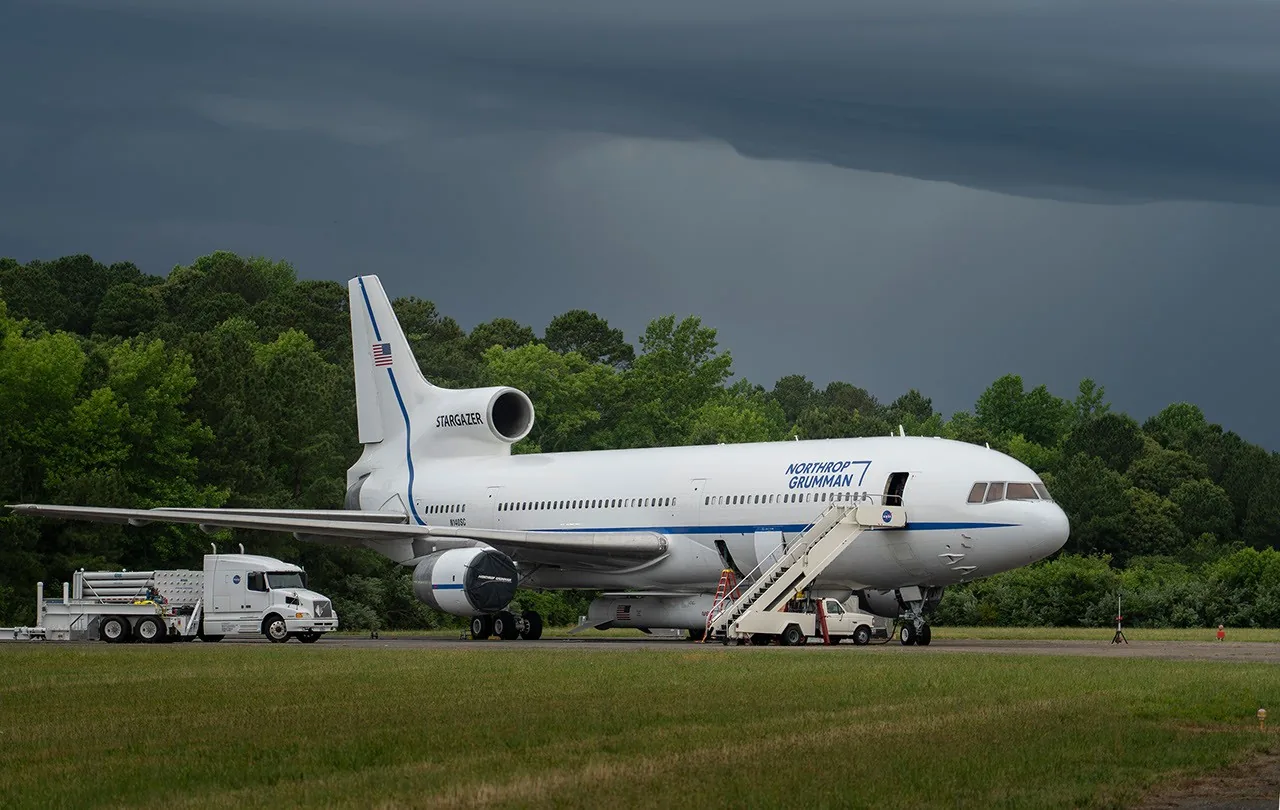
The launch vehicle, Pegasus XL, offers significant flexibility. "We can deploy Pegasus from almost anywhere in the world using our Stargazer, a modified L-1011 aircraft," said Wes Collier, vice president of launch systems at Northrop Grumman. "That combination of flexibility and responsive access to space will help LINK quickly reach Swift, giving the teams time to complete the boost." Earlier in June 2026, engineers integrated the LINK spacecraft into the Pegasus XL rocket and attached it to the Stargazer aircraft at NASA’s Wallops Flight Facility in Virginia. The aircraft and its payload have since departed for Kwajalein Atoll, awaiting the launch window.
Once LINK reaches orbit, it will undergo several weeks of commissioning. Katalyst engineers will verify its propulsion, navigation, and sensor systems. Subsequently, LINK will cautiously approach and survey Swift before employing its robotic arms to grapple the observatory. The satellite will then initiate the slow process of raising Swift’s orbit to nearly 370 miles, its original operational altitude.
This endeavor represents a significant step in space servicing capabilities. "This is a high-risk, high-reward mission," commented Shawn Domagal-Goldman, division director for Astrophysics at NASA Headquarters. "Swift plays a notable role in our fleet. We have much to gain by attempting this boost, which is more affordable than trying to replace Swift’s capabilities and allows NASA to advance the nation’s satellite servicing industry, for the benefit of all."