
Universe's Largest 2D Map Reveals 4 Billion Cosmic Objects
Astronomers have unveiled the most extensive 2D map of the universe, featuring 5.6 trillion pixels and nearly 4 billion celestial bodies. This new cosmic portrait is built from over a decade of telescope data.

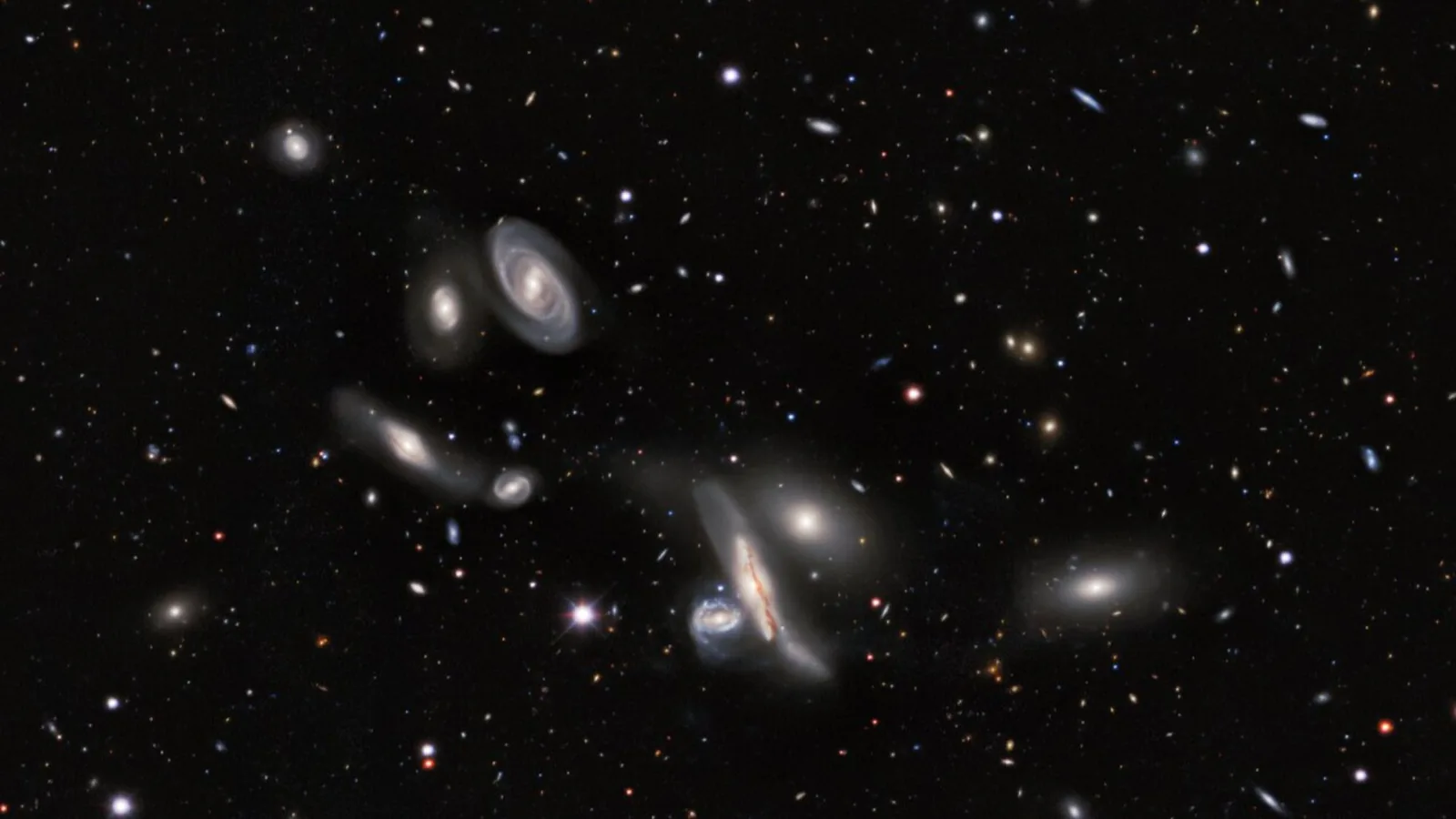
Astronomers have unveiled the largest two-dimensional map of the universe ever created, providing an unprecedented cosmic vista of nearly 4 billion celestial objects across approximately three-quarters of the observable sky. The monumental map, a product of the Dark Energy Spectroscopic Instrument (DESI) Legacy Imaging Surveys team, comprises a staggering 5.6 trillion pixels. It meticulously combines over 263,000 individual telescope exposures gathered over more than ten years. These observations, capturing both visible and near-infrared wavelengths, form an immense portrait of stars, galaxies, and other cosmic phenomena, according to a statement from the National Science Foundation (NSF) NOIRLab.
"It's part of the fabric of astronomy research now," stated David Schlegel, co-lead of the Legacy Surveys and a scientist at the U.S. Department of Energy's Lawrence Berkeley National Laboratory. "When you're working with astronomical objects today, you often start by pulling up the Legacy Imaging Viewer to see what you're looking at." This latest 2D cosmic map represents the culmination of 13 years dedicated to observation and intensive data processing.
The Legacy Imaging Surveys were initially conceived to guide DESI in directing its thousands of robotic optical fibers. This foundational 2D survey was designed to establish the base for DESI's more ambitious endeavor: mapping the universe in three dimensions. DESI, situated on the Nicholas U. Mayall 4-meter Telescope at Kitt Peak National Observatory in Arizona, operates by measuring the spectra of galaxies and quasars. By calculating their redshifts – the degree to which their light has been stretched due to the universe's expansion – astronomers can ascertain their distances. This process effectively transforms a flat, 2D representation of the sky into a detailed 3D map of the cosmos.
Mapping Cosmic Expansion and Dark Energy
Since its commencement in 2021, DESI's main survey has aimed to trace the universe's expansion over billions of years. This objective is crucial for helping scientists gain a deeper understanding of dark energy, the enigmatic force believed to be accelerating this expansion. The project has significantly exceeded its initial goals. As of April 2026, DESI had meticulously mapped over 47 million galaxies and quasars, establishing the most extensive high-resolution 3D map of the universe to date. Preliminary DESI findings have also offered compelling evidence suggesting that dark energy might not be constant, but rather evolves over time, a notion that challenges the prevailing standard model of cosmology.
The DESI instrument is not the sole project making strides in cosmic mapping. Earlier in 2026, astronomers utilizing the Hobby-Eberly Telescope Dark Energy Experiment (HETDEX) constructed a distinct 3D map. This map utilized faint Lyman-alpha emission from hydrogen gas residing between galaxies, shedding light on previously obscured structures dating back to a period between 9 billion and 11 billion years ago, coinciding with a peak in cosmic star formation. The new map from the Legacy Imaging Surveys promises broad utility beyond the DESI project itself. Earlier iterations of this dataset have already been cited in over 1,800 scientific papers. The most recent release is expected to assist astronomers in identifying rare objects and unusual phenomena, studying the intricate processes of galaxy evolution, and training artificial intelligence systems to process the colossal data volumes anticipated from future observatories like the Vera C. Rubin Observatory.
This extensive 2D map is a testament to collaborative scientific effort and technological advancement. It provides a foundational resource for a wide array of astronomical research, from understanding the fundamental forces shaping the universe to the detailed study of individual cosmic structures. The sheer scale of the data promises to unlock new insights for years to come, supporting both established research methodologies and the development of cutting-edge AI-driven analysis techniques for astronomical data.