
James Webb Telescope Reveals Majestic Lion Nebula in Stunning Detail
The James Webb Space Telescope has captured a breathtaking new image of the Lion Nebula (NGC 2392). The view offers unprecedented detail of the dying star's remnants and surrounding gas.

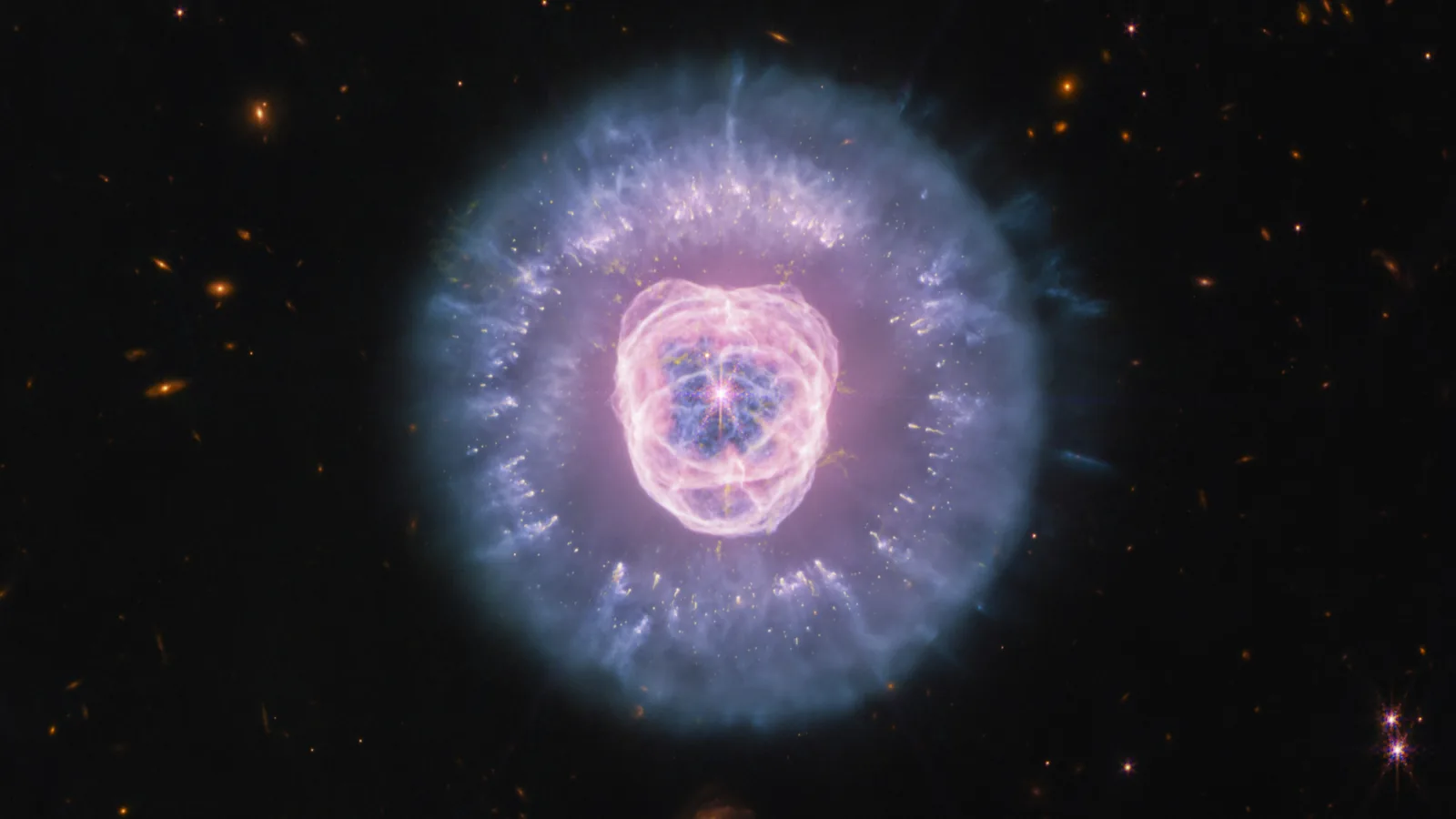
The majestic Lion Nebula, formally known as NGC 2392, has been captured in a spectacular new image by the James Webb Space Telescope (JWST), showcasing its vibrant purple gas and dust clouds. The nebula earned its evocative nickname from its striking resemblance to a lion's head, complete with a fuzzy mane and a bright central spot that forms the 'nose'. This central point is the hot core of a dying star, a white dwarf, radiating energy that illuminates the surrounding cosmic structure.
This white dwarf is the remnant of a star that, in its final stages, became unstable and shed its outer layers, creating the vast, glowing planetary nebula. The intense energy expelled by the star left behind this dense core, which continues to energize the ionized gas forming the nebula's distinctive shape. Astronomers estimate that the current form of the nebula will continue to expand and may dissipate entirely within the next 10,000 years.
A New Perspective on a Familiar Cosmic Neighbor
While the Lion Nebula has been observed before, notably by the Hubble Space Telescope in 2000, the JWST's advanced instruments, the Near Infrared Camera (NIRCam) and the Mid Infrared Instrument (MIRI), provide an exceptionally detailed and accurate portrayal. This latest image reveals features, such as intricate dust and gas structures, with a clarity previously unattainable. The new perspective helps astronomers better understand the physical processes at play and the forces that shape and sustain this stellar remnant.
The detailed observations from the JWST are crucial for understanding the life cycle of stars. Planetary nebulae, like the Lion Nebula, are a significant phase in the evolution of low-to-intermediate mass stars. They play a role in enriching the interstellar medium with heavier elements, which are essential for the formation of new stars and planetary systems. Studying these structures provides valuable insights into stellar death and the cosmic recycling of matter.
The James Webb Space Telescope, launched in December 2021, continues to push the boundaries of astronomical observation. Its unparalleled sensitivity and resolution allow it to peer deeper into the universe and capture celestial objects with breathtaking detail. This latest imagery of the Lion Nebula exemplifies the telescope's power to both awe the public with cosmic beauty and advance scientific understanding of the universe.