
UK Sees Best Solar Eclipse Since 1999 as Moon Shrouds Sun
Residents across the UK will experience a significant solar eclipse on Wednesday evening, with up to 96% of the Sun obscured. This marks the most substantial eclipse visible in the UK since 1999 and won't be matched for 50 years.

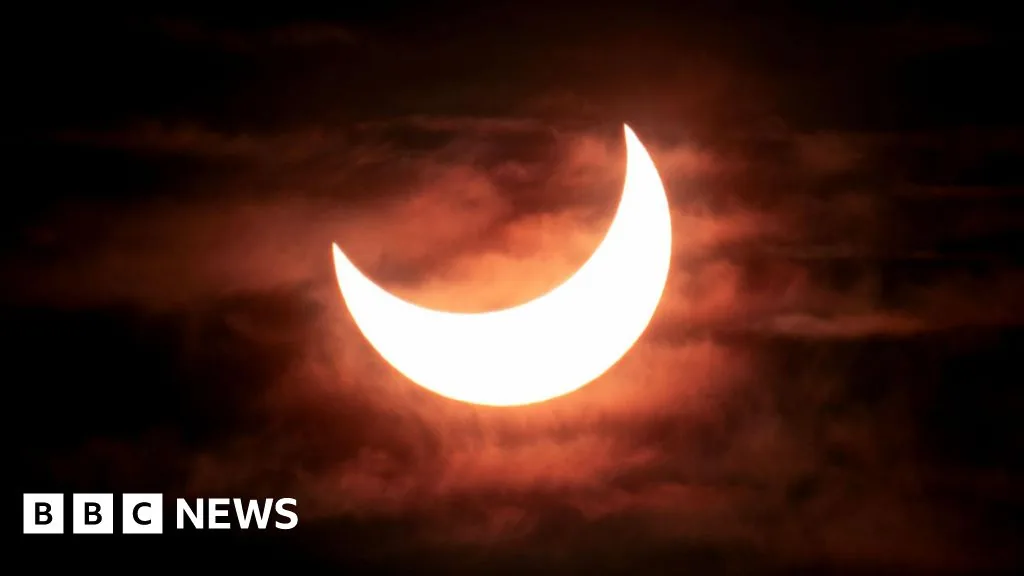
The United Kingdom is set to witness its most profound solar eclipse in over two decades on Wednesday evening, with the Moon obscuring up to 96% of the Sun's disk for observers across the nation. This celestial event, the most significant partial solar eclipse visible from the UK since 1999, will not be surpassed in magnitude for the next half-century. While the UK will experience a deep partial eclipse, some regions in Europe, including northern Spain, Russia, Greenland, Iceland, and Portugal, will be treated to a total solar eclipse.
In the UK, the peak of the eclipse is expected between 18:58 and 19:15 BST, varying slightly by location. Western areas such as Devon, Cornwall, and parts of Pembrokeshire in Wales are anticipated to see the highest percentage of solar coverage, ranging from 94% to 96%. Other regions, including Northern Ireland, parts of Scotland, and the West Midlands, will observe between 92% and 94% coverage.
Specialist eclipse glasses, essential for safe viewing, have seen increased demand. A report from a London bakery indicated they had sold approximately 100 pairs on Tuesday alone, highlighting public enthusiasm for the event.
Weather forecasts suggest mixed conditions across the UK. Many areas are expected to have clear skies, offering good viewing opportunities. However, cloud cover is a possibility for parts of north Wales, northern England, and particularly Scotland and Northern Ireland, between 18:00 and 19:00 BST. Ominously, some western parts of Scotland and areas in Northern Ireland could even experience rain during the eclipse's progression.
Path of Totality Across Europe
Meanwhile, fortunate viewers in northern Spain are poised for a complete solar blackout. Cities like Bilbao, Valencia, and Palma in Mallorca are expecting clear skies for the total eclipse. Even major hubs such as Barcelona and Madrid will witness over 99% of the Sun being covered. The total eclipse is scheduled to peak between 20:26 and 20:33 local time (19:26 to 19:33 BST). This astronomical spectacle has drawn hundreds of thousands of visitors to northern Spain, with an estimated half a million people flocking to the region, according to the nation's finance ministry.
Julie, who traveled with her family from Brest, France, to Burgos, Spain, expressed her excitement. "We came from very far to see it in totality. I have seen [it] once and it was beautiful and amazing - I am so happy to have the chance to see one again," she shared. Leonor Aguilar from Jaén, Spain, also conveyed her anticipation: "During that minute and a half, what I hope to see is the grandeur of nature and to experience it with my family. We often spend money on trivial things instead of investing in something as beautiful as witnessing such a marvellous sight."
Martin Griffith, director of Brecon Beacons Observatory in Wales, lauded the event as "one of the great phenomena of nature." He noted, "It is going to be a fantastic eclipse in Spain, we are right on the path of totality. What they will see is about a minute and 40 seconds of totality. It will be dark, the Moon will completely cover the Sun." Griffith emphasized the rarity of experiencing such an event over land, stating, "Although we know they happen quite often we're not always in the path of totality - they could be over the Pacific Ocean, but to have it over land is just incredible."
The science behind a solar eclipse involves the precise alignment of the Earth, Moon, and Sun. When the Moon passes between the Earth and the Sun, it casts a shadow on Earth. A total solar eclipse occurs approximately every 18 months somewhere on the planet, but observing it requires being within the narrow path of the Moon's shadow, known as the path of totality. Those outside this path, like most of the UK population, experience a partial eclipse.
During totality, the sky darkens significantly, and the Sun's corona—a pearly-white halo of superheated plasma extending millions of miles—becomes visible. This ethereal phenomenon is millions of times fainter than the Sun's surface and is usually invisible during daylight. Just above the corona lies the chromosphere, a thin, pinkish layer briefly visible as a red ring around the Moon's edge at the start of totality.
Safe viewing is paramount. Looking directly at the Sun without certified protection can cause permanent eye damage. Regular sunglasses, welding goggles, or even phone cameras offer insufficient protection. Specialized solar filters are required for binoculars and telescopes. The safest methods include using certified eclipse glasses or constructing a pinhole viewer. This involves projecting the Sun's image onto a surface through a small hole, allowing safe observation. Kitchen items like colanders can also create multiple projected images of the eclipse.
The next significant solar eclipse visible in the British Isles is not predicted until 2081, with a total solar eclipse in the UK anticipated in 2090. While the chance of seeing a meteor shower during the eclipse is extremely slim, Dr. Becky Smethurst of the Royal Astronomical Society highlighted that witnessing such a rare celestial event is a worthwhile investment in natural wonder.