
Supermassive Black Hole's 27-Year Plasma Jet Aimed at Earth Tracked
Astronomers have monitored a powerful plasma jet from a supermassive black hole, active for 27 years and incidentally pointed towards Earth. The phenomenon offers a unique opportunity to study black hole behavior.

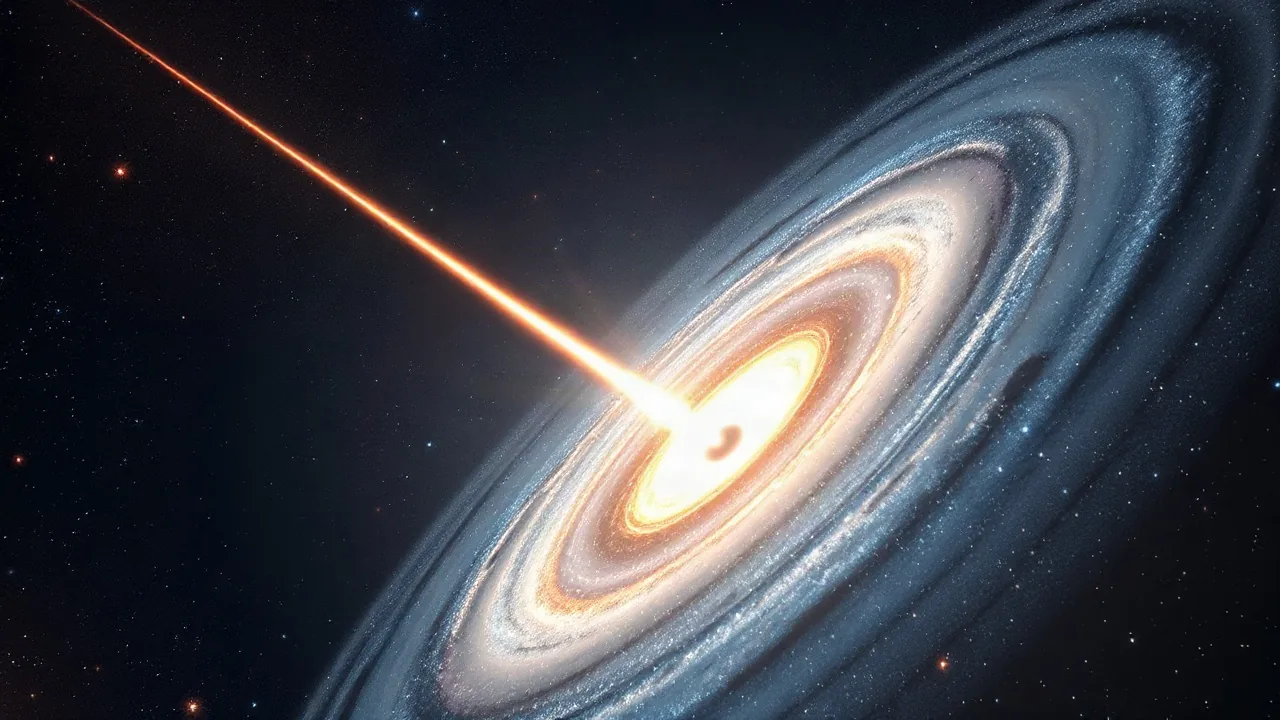
Astronomers have successfully tracked a colossal plasma jet emanating from a supermassive black hole for an unprecedented 27 years. This persistent cosmic outflow, originating from the galaxy Messier 87 (M87), has been observed to be continuously blasting matter and energy into space, with its trajectory incidentally aligned towards our own planet. The prolonged observation offers scientists a remarkable window into the dynamics of these enigmatic celestial objects.
The supermassive black hole at the center of M87, located approximately 55 million light-years away in the constellation Virgo, is known for its powerful jet. Previous studies had documented its existence, but the recent 27-year continuous monitoring campaign, utilizing data from various radio telescopes, has provided a more detailed and extended view of its behavior. This ongoing phenomenon is crucial for understanding the accretion processes around black holes and the subsequent expulsion of material.
Understanding Black Hole Jets
The immense power behind these jets is still a subject of intense scientific research. It is believed that as matter spirals into a supermassive black hole, not all of it is consumed. Instead, intense magnetic fields in the vicinity of the black hole can channel some of this infalling material into highly focused beams, accelerating it to near the speed of light. These jets can extend for hundreds of thousands, or even millions, of light-years into intergalactic space.
While the M87 jet is pointed in the general direction of Earth, scientists emphasize there is no cause for alarm. The sheer distance involved means the plasma poses no threat to our planet. However, its proximity in angular terms allows for detailed study. The fact that the jet has remained active and relatively stable for nearly three decades provides invaluable data for testing theoretical models of black hole physics and jet formation. Researchers are analyzing how the jet's structure, intensity, and composition have evolved over the 27-year period.
This long-term tracking is essential for comprehending how black holes influence their host galaxies. These powerful outflows can impact star formation rates by either heating or dispersing the gas within a galaxy. The M87 jet, being one of the most prominent and well-studied examples, serves as a critical case study in this regard. By observing the jet's interaction with the surrounding intergalactic medium, scientists can gain insights into galactic evolution.
The observations also contribute to the broader field of astrophysics, particularly in the study of relativistic outflows and extreme environments. The techniques developed and refined for tracking the M87 jet may be applied to other phenomena, potentially unlocking further secrets of the universe. The sustained nature of this plasma emission underscores the dynamic and powerful processes occurring at the hearts of galaxies across the cosmos.