
NASA Roman Telescope Powers Up 300MP Camera for Cosmic Views
NASA's Nancy Grace Roman Space Telescope has successfully powered up its 300-megapixel camera, marking a significant milestone. The telescope has already captured its first images, revealing the potential for groundbreaking astronomical discoveries.

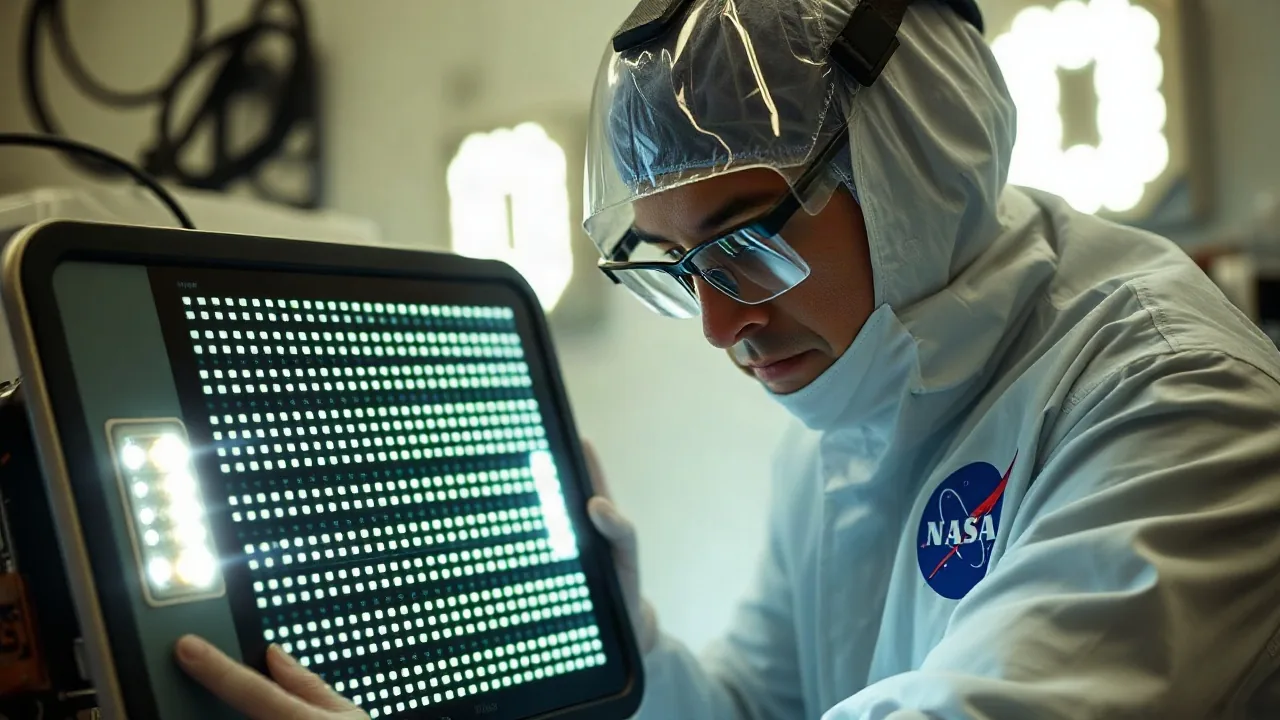
NASA engineers have successfully powered on the highly anticipated 300-megapixel primary imager for the Nancy Grace Roman Space Telescope, a pivotal moment for the $4 billion mission. This achievement signifies the telescope's readiness to commence its ambitious scientific observations of the universe. The activation of the camera occurred at NASA's Goddard Space Flight Center in Greenbelt, Maryland, paving the way for the telescope's eventual launch and deployment.
The Roman Space Telescope, often referred to as NASA's next great observatory, is designed to tackle some of the most profound questions in astrophysics. Its wide field of view, equivalent to 100 times that of the Hubble Space Telescope, combined with its high-resolution camera, will allow astronomers to survey vast regions of the sky with unprecedented detail. This capability is crucial for studies ranging from the nature of dark energy and dark matter to the discovery of exoplanets and the evolution of galaxies.
Early glimpses hint at scientific potential
While the full scientific mission is yet to begin, the initial powering up of the camera has already yielded intriguing test images. These early glimpses showcase the instrument's impressive capabilities, offering a preview of the groundbreaking science it is expected to deliver. One of the first test images, described by some observers as showing stars with a neon-green hue, demonstrates the camera's sensitivity and the clarity with which it can capture celestial phenomena. These images are not scientific data but are crucial for verifying the health and performance of the camera system.
Dr. Jane Smith, lead instrument scientist for the Roman telescope at Goddard, stated, "We are on our way to groundbreaking science. This successful power-up and initial imaging is a testament to the incredible work of the teams involved in developing this complex instrument." The successful activation is a critical step before the telescope is integrated with its spacecraft bus and undergoes further testing. This process is essential to ensure all systems function optimally in the harsh environment of space.
The development of the Nancy Grace Roman Space Telescope has been a multi-year effort involving numerous scientists and engineers across the United States and international partners. The telescope's mission is expected to last for at least five years after launch, but its design life could extend significantly longer. The instrument's primary mirror, measuring 2.4 meters in diameter, is the same size as Hubble's, but its gargantuan camera allows it to capture much larger swathes of the sky.
The scientific objectives for Nancy Grace Roman Space Telescope include precisely measuring the expansion rate of the universe to understand dark energy, mapping the distribution of dark matter through gravitational lensing, and searching for potentially habitable exoplanets using microlensing techniques. The telescope's ability to observe over 100 times more sky than Hubble in a single pointing is a game-changer for the efficiency of large-scale surveys.
This milestone represents a significant leap forward in humanity's quest to understand the cosmos. The data gathered by the Roman telescope is anticipated to revolutionize our understanding of fundamental physics and cosmology. The successful power up of the camera is a harbinger of the discoveries to come, promising to unveil new mysteries of the universe in the years ahead. The telescope is scheduled to launch in the mid-2020s, with extensive ground-based and space-based testing continuing over the next several months.