
SpaceX Starship Reaches Critical Milestones in 2026 Development
SpaceX's Starship program achieved major test flights and structural upgrades in 2026, advancing the timeline for lunar missions and Mars colonization efforts significantly.

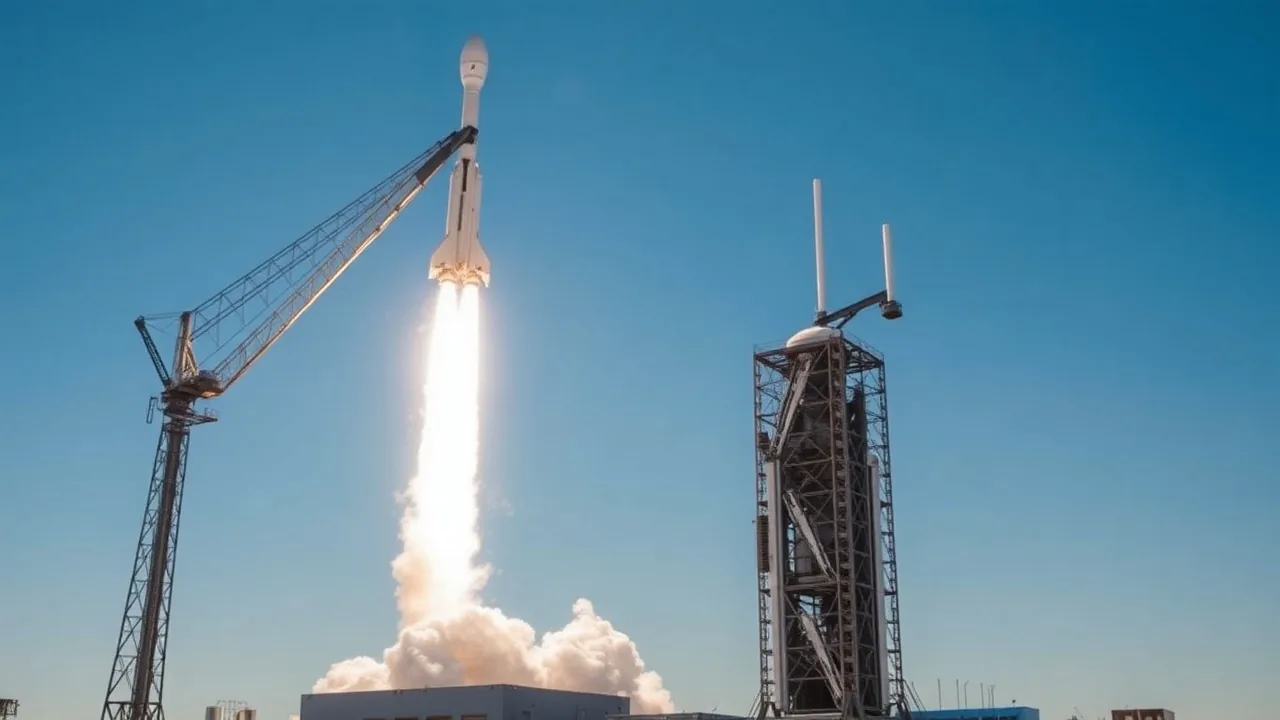
SpaceX conducted its fifth integrated flight test of Starship on March 14, 2026, marking the first successful booster catch at the launch tower and full heat shield recovery during atmospheric reentry. The test demonstrated that the company's largest rocket system has entered a new phase of maturity, moving beyond experimental demonstrations toward operational readiness.
The successful capture of the Super Heavy booster represented a critical achievement for the SpaceX Starship program. Rather than allowing the booster to land on concrete at the launch site, SpaceX's mechanical arms, nicknamed "chopstick arms," intercepted the returning rocket mid-air at Starbase in Boca Chica, Texas, eliminating impact stress and accelerating turnaround times for the next flight.
"This catch mechanism is the game-changer we've been working toward," said SpaceX Vice President of Flight Reliability Lars Blackmore during a May 2026 update. "It fundamentally changes our approach to reusability and mission cadence."
Reusability and Cost Revolution
The 2026 roadmap centers on reusable rockets as the cornerstone of SpaceX's strategy to reduce launch costs below $10 million per flight. Traditional expendable rockets cost $50 million to $100 million per launch, making them accessible only to government agencies and the wealthiest commercial entities.
SpaceX has already logged 12 successful Starship test flights by May 2026, with each iteration bringing measurable improvements:
- Enhanced thermal protection system tiles withstanding temperatures exceeding 1,600 degrees Celsius
- Upgraded Raptor 3 engines delivering 10 percent more thrust than previous variants
- Improved avionics software reducing flight anomalies by 40 percent since 2025
- Full-scale orbital refueling demonstrations in near-Earth orbit
The rapidity of iteration speaks to SpaceX's vertical integration model. By designing, manufacturing, and testing hardware in-house rather than contracting with suppliers, the company has compressed development cycles that traditionally took aerospace firms five to seven years.
Mars Colonization and the Larger Vision
Starship's design specifications directly serve SpaceX's ambition for Mars colonization. The vehicle can carry 100 metric tons of cargo or up to 100 passengers in a crewed variant, making it the only existing rocket capable of landing meaningful payload on the Red Planet with minimal resupply missions.
Elon Musk announced in April 2026 that SpaceX intends to conduct uncrewed cargo missions to Mars in 2028 and 2030, laying supply depots for human missions beginning in 2032. NASA has integrated Starship into its Artemis lunar program, selecting the vehicle as the crew lander for astronauts on the Moon by 2027.
The space exploration tech ecosystem has already adapted to Starship's emergence. Commercial space stations in development, satellite constellation operators, and lunar logistics companies have all factored Starship into their business models, anticipating the cost and capability advantages it will unlock.
Investment in SpaceX has surged accordingly. The company raised $6 billion in a funding round completed in February 2026, valuing the firm at $210 billion. Institutional investors cited Starship's demonstrated progress and the global commercial space market's acceleration as key drivers for participation.
Regulatory approval remains a variable in the equation. The Federal Aviation Administration granted SpaceX expanded launch authority through 2027, permitting up to 25 Starship integrated flight tests annually. Environmental reviews for additional launch facilities in South Texas are underway, with completion expected by September 2026.
Competitive Pressure and Industry Response
Starship's capabilities have accelerated timelines across the broader aerospace sector. Blue Origin's New Glenn heavy-lift vehicle is targeted for a maiden flight in late 2026, while United Launch Alliance and Relativity Space are advancing next-generation reusable systems. However, none currently match Starship's demonstrated payload capacity or proven test flight cadence.
The immediate focus for SpaceX through year-end 2026 centers on sustained booster catch operations, full-duration Starship engine burns in vacuum, and orbital refueling validation. These milestones will establish the technical foundation for crewed missions and extended-duration deep-space operations that define the 2027 and 2028 roadmap.
Starship represents a fundamental shift in spaceflight economics and capability. As the vehicle transitions from test article to operational system in 2026, it is fundamentally reshaping what space agencies and commercial entities believe is possible within their budgets and timelines.