
Record-Breaking T. Rex Fossil 'Gus' Fetches $50 Million at Auction
A remarkably complete T. rex fossil, nicknamed 'Gus,' sold for a record $50.1 million to an anonymous bidder at Sotheby's. The sale highlights the intense market for significant paleontological finds.

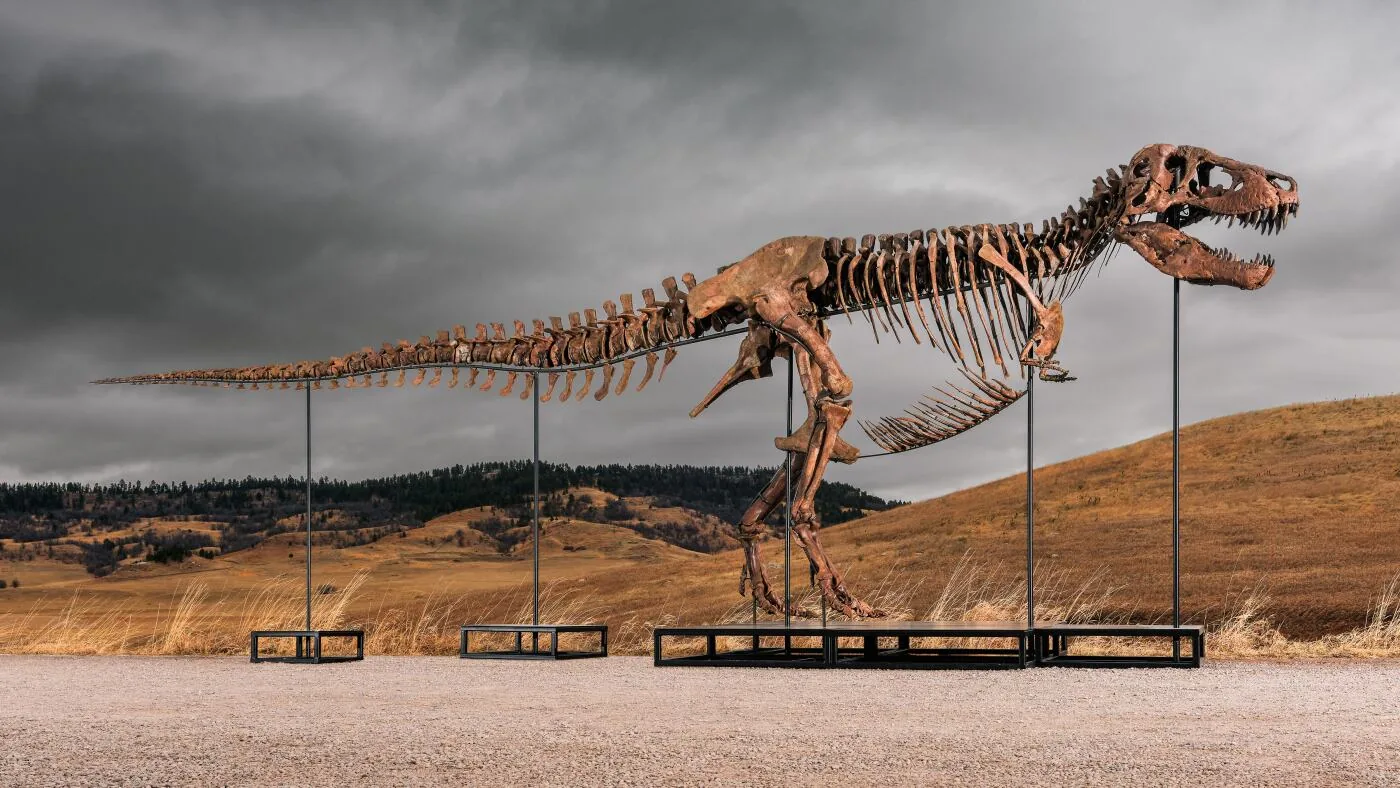
A towering 67-million-year-old Tyrannosaurus rex fossil, affectionately known as "Gus," has shattered previous records, selling for an astonishing $50.1 million at a Sotheby's auction on Tuesday. The anonymous buyer, who participated via phone, outbid six other contenders for the rare specimen, described as one of the most complete T. rex skeletons ever discovered. The sale marks a new benchmark for dinosaur fossils at auction, surpassing the previous record of nearly $45 million for a stegosaurus in 2024 and the $32 million paid for a T. rex named "Stan" in 2020.
Sotheby's vice chair, Cassandra Hatton, expressed satisfaction with the outcome, stating, "Gus is not only an exceptional find, but a specimen that's been excavated, documented, prepared, and cared for with real excellence. The market responds when great specimens are taken care of in the right way." The T. rex, standing approximately 12.5 feet tall and measuring 38 feet long, is an adult specimen estimated to be 61% complete. It boasts an "exceptionally preserved" skull featuring a formidable set of teeth, two complete feet, and several rare bones, including a furcula, or wishbone. The fossil was unearthed in 2021 on a South Dakota ranch and underwent a roughly five-year excavation and preparation process before coming to auction.
Scientists Advocate for Public Access to Fossil Discoveries
While the auction concluded with a record-setting sale, the Society of Vertebrate Paleontology has voiced concerns about the potential loss of scientific and educational access to such significant finds. The advocacy group, comprising scientists, scholars, and students, emphasizes that fossils like "Gus" should ideally be housed in public museums and research institutions. "Our hope is that the new owner recognizes the extraordinary scientific and educational value of Gus the T. rex and that they aim to keep it in the public trust by immediately donating it to an accredited natural history museum," stated Kristi Curry Rogers, the society's president-elect. She added, "That outcome would ensure that this remarkable specimen continues to advance science, rather than becoming unavailable for study."
This sentiment echoes previous high-profile dinosaur sales. The stegosaurus fossil, known as "Apex," is currently on a long-term loan to the American Museum of Natural History in Manhattan. "Sue," a T. rex that made history as the first dinosaur sold at auction in 1997, is a star attraction at Chicago's Field Museum. Another T. rex skeleton, "Stan," is displayed at the Natural History Museum Abu Dhabi, engaged in a dramatic posed battle with a triceratops fossil.
The Tyrannosaurus rex, whose name signifies "King of the Tyrant Lizards," reigned supreme during the late Cretaceous period. Renowned for its massive skull, powerful bite, and distinctive short arms, this dinosaur has captivated the public imagination, appearing in countless books, films, and children's programs. Fossils indicate that these formidable predators roamed what is now western North America, an ecosystem characterized by warm climates and abundant prey like the triceratops, according to Sotheby's. The intense bidding for "Gus" underscores the enduring fascination with these prehistoric giants and the high value placed on preserving and displaying their remains.