
NASA Awards $590 Million for Lunar Lander Missions to Support Moon Base
NASA has awarded nearly $600 million to three companies for four robotic lunar lander missions set to launch by late 2028. These missions aim to support the agency's ambitious lunar base development goals.

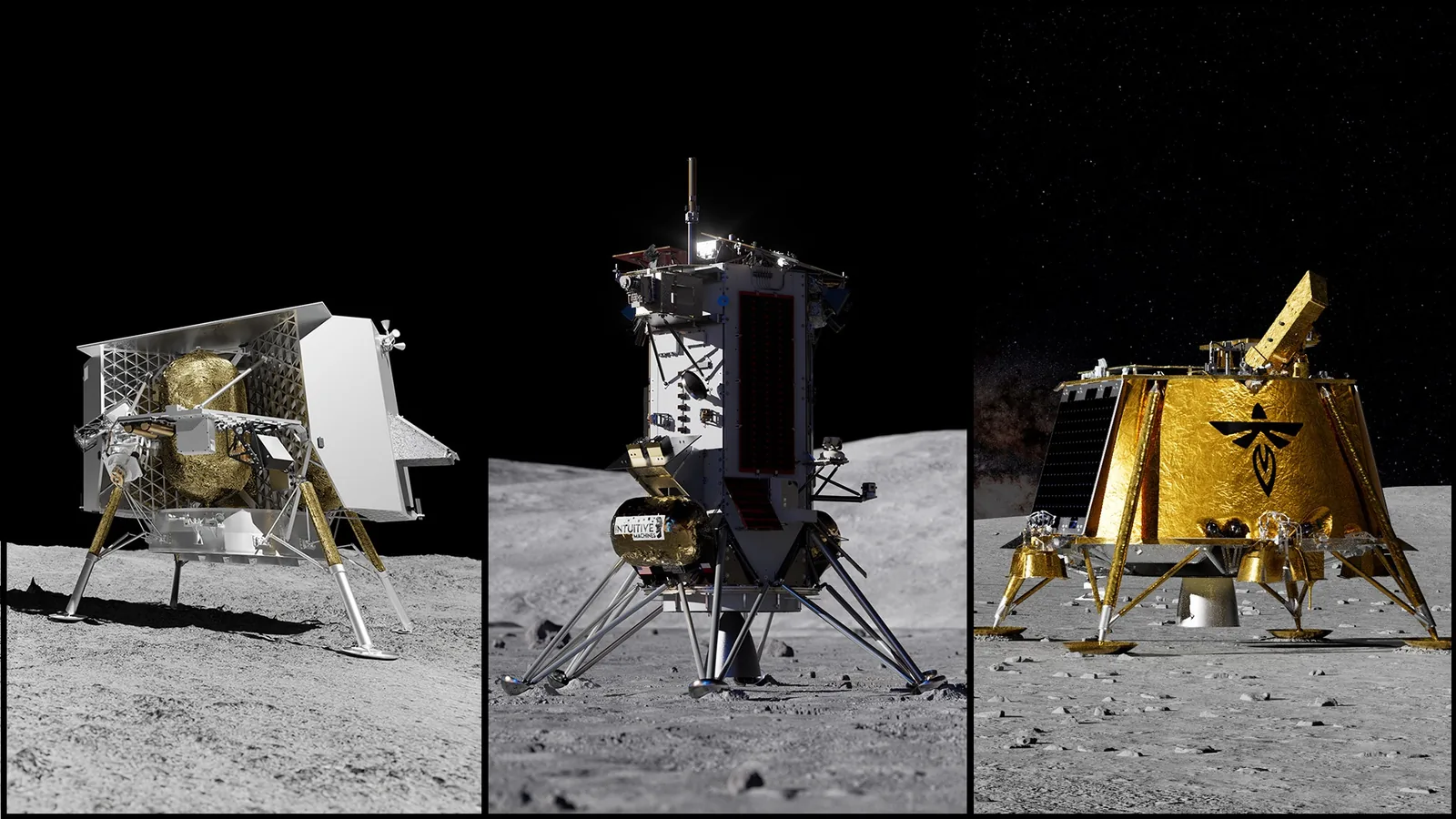
NASA announced on June 30 that it has selected three companies to conduct four robotic lunar lander missions, collectively valued at $590.4 million, as part of its broader strategy to establish a presence on the Moon. The missions, scheduled for late 2028, involve Astrobotic Technology, Firefly Aerospace, and Intuitive Machines, with each lander carrying an identical set of three scientific payloads.
Astrobotic Technology received awards totaling $297.9 million for two flights of its Peregrine lander. Firefly Aerospace was awarded $144.2 million for its Blue Ghost lander, and Intuitive Machines secured $148.3 million for its Nova-C lander. The identical payloads include the Stereo Camera for Lunar Plume Surface Studies (SCALPSS), designed to observe regolith plumes generated by lander engines; the Linear Energy Transfer Spectrometer (LETS), which measures radiation in transit and on the surface; and the Laser Retroreflector Array, a passive instrument for lunar rangefinding. These instruments, some of which have flown on previous missions, will help NASA gather critical data.
"By flying the same science instruments on multiple landers, we will better understand potential hazards during landing and build out a global network of environmental data and location markers on the moon," stated Joel Kearns, deputy associate administrator for exploration in NASA’s Science Mission Directorate. He compared these instruments to essential weather stations for lunar exploration. While NASA has not yet disclosed specific landing sites for all missions, Astrobotic confirmed its two Peregrine landers will target the Gruithuisen Domes region on the Moon's near side.
Repurposed Rover Under Consideration for Lunar Deployment
In addition to the lander awards, NASA is actively exploring the possibility of sending a rover originally designed for Mars missions to the lunar surface. This rover, designated the Polar Rover for Observation, Mapping, and In-Situ Exploration (PROMISE), is an engineering model derived from the design of the Curiosity and Perseverance rovers. NASA Administrator Jared Isaacman mentioned during the June 30 presentation that the agency is "thinking very hard right now about sending PROMISE to the moon" as part of an initiative to utilize existing hardware for lunar missions.
PROMISE, currently housed at the Jet Propulsion Laboratory, is equipped with a radioisotope thermoelectric generator (RTG), similar to its Mars counterparts, enabling it to operate independently of sunlight and potentially survive in permanently shadowed regions. This nuclear power source contrasts with the solar-powered VIPER rover, currently slated for a 2027 launch on Blue Origin's Blue Moon lander. "With PROMISE we would not be constrained by solar power," explained Carlos García-Galán, NASA program executive for Moon Base. He emphasized the rover's robust design, developed for Mars's harsh conditions, as a significant advantage. However, deploying PROMISE could affect other NASA missions due to the limited availability of RTGs, which are also needed for potential outer solar system missions and a proposed Uranus orbiter.
These developments follow NASA's recent designations of the initial three lander missions as Moon Base 1, 2, and 3, including the Blue Moon Mark 1 as Moon Base 1. However, a static-fire test anomaly involving Blue Origin's New Glenn rocket, intended to launch the Blue Moon landers, has prompted NASA to consider alternative launch options. Despite the incident, NASA remains optimistic about the New Glenn program. "Plan A is very much still to launch the Mark Ones on New Glenn, and we have time," Administrator Isaacman stated, noting the Blue Origin team's progress in repairs and rebuilding the launch pad. NASA is prepared to wait until mid-2027 before exploring backup launch providers for the Mark 1 mission, indicating confidence in the existing plan.