
NASA Considers Moon Mission for Backup Mars Rover 'Promise'
NASA is exploring a novel plan to send a full-scale engineering model of the Perseverance rover, dubbed 'Promise,' to the Moon. This nuclear-powered rover could accelerate lunar south pole exploration.

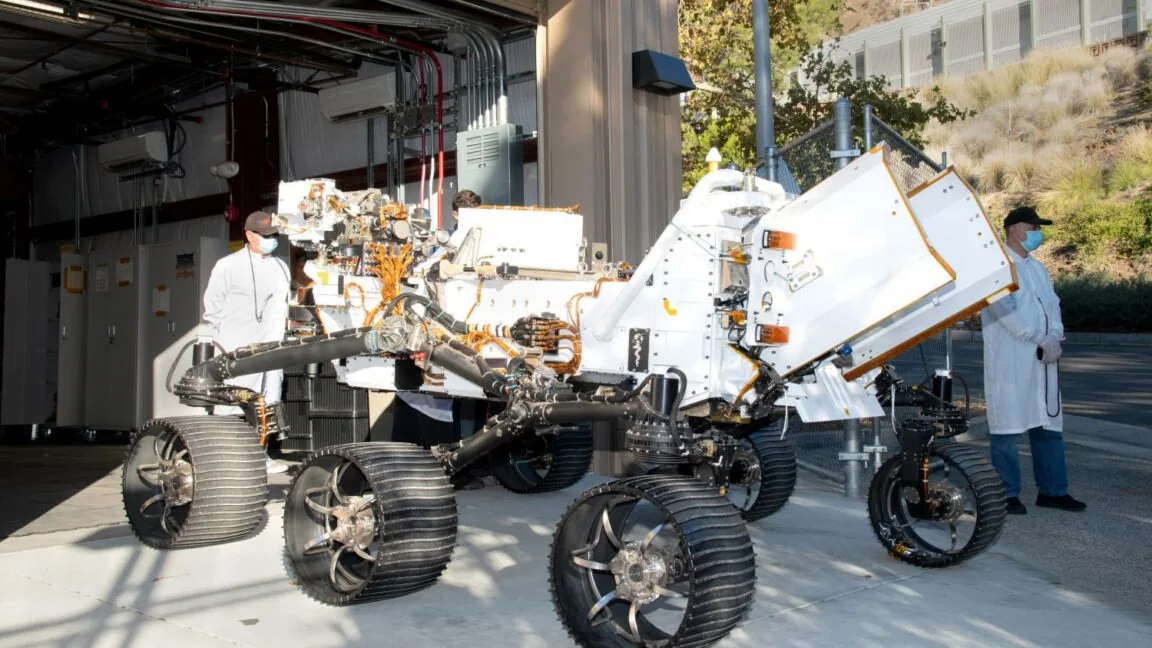
NASA is seriously considering repurposing a full-scale engineering model of its Mars rover, Perseverance, for a lunar mission aimed at exploring the Moon's south pole. The rover, nicknamed 'Promise' and currently housed at the Jet Propulsion Laboratory in California, could be sent to the Moon equipped with a multi-mission radioisotope thermoelectric generator (MMRTG) for power. This would allow it to operate independently of sunlight, a crucial advantage for navigating the challenging lunar terrain and enduring the prolonged lunar night.
NASA Administrator Jared Isaacman announced the agency's contemplation of sending 'Promise' during a recent update on lunar base development plans. "We are thinking very hard right now about sending Promise to the Moon," Isaacman stated. He highlighted that NASA possesses an available MMRTG unit, powered by Plutonium-238, which is currently underutilized. The one-ton rover would likely require a heavy-lift launch vehicle like Blue Origin's Blue Moon lander or SpaceX's Starship for transport to the lunar surface.
Carlos García-Galán, a NASA official leading the Moon base initiative, expressed enthusiasm for the potential of utilizing existing hardware to enhance lunar exploration capabilities. "That would be an awesome capability," García-Galán remarked. "For Moon-based objectives, having a nuclear RTG on it allows us to go anywhere we want, regardless of the illumination. Surviving the lunar night is going to be one of the bigger challenges with this capability, we wouldn’t have to worry about that. So, long traverses getting into those very hard-to-reach areas, just like Curiosity and Perseverance have shown us on the surface of Mars, that would be awesome."
Repurposing a Testbed for New Frontiers
For years, 'Promise' has served as a vital testbed for anticipating and resolving potential issues that the operational Perseverance rover might encounter on Mars. Engineers at JPL frequently test commands and traverse maneuvers on this model in the facility's "Mars yard" before uploading them to the actual rover on the Red Planet. It has also been instrumental in verifying Perseverance's ability to navigate diverse Martian landscapes.
The Perseverance rover was launched to Mars in July 2020, following its predecessor, the Curiosity rover, which began its mission in November 2011. "It makes sense, early on, when we’ve got a problem that we might want to test it out here before we upload it to Mars," Isaacman explained. "But we’ve had years now of experience operating the two rovers on the surface of Mars, and we’ve got this hardware that the taxpayers invested a lot in. So the question was posed, what if we sent it to the Moon?"
While the Mars rovers were engineered for Martian conditions, JPL engineers believe 'Promise' can be adapted for the lunar environment. Modifications would also be necessary for its scientific instruments, but Isaacman views this as an innovative approach to advancing NASA's objective of understanding the Moon to establish a long-term human presence. "We’ve got the hardware, and this is exactly what we should be trying to do to put wins on the board, getting a capability like Promise to the surface of the Moon," he added.
A rover of 'Promise's' caliber could undertake significant scientific research. NASA explored similar possibilities over a decade ago with a proposed "Endurance" rover, designed to traverse nearly 2,000 kilometers across the South Pole-Aitken basin. That ambitious project, however, was never realized.
This potential deployment is not yet finalized, with NASA currently assessing the feasibility of integrating 'Promise' into its future lunar exploration fleet. Nevertheless, the announcement underscores a concerted effort by Isaacman and his team to identify and leverage existing assets to accelerate the agency's ambitious goals of returning humans to the Moon and establishing a sustainable surface base. NASA is operating with a sense of urgency, aiming to land astronauts on the lunar south pole before China and to first explore the region's most scientifically compelling areas. Casey Dreier, chief of space policy for The Planetary Society, commented on the move, calling it "quite symbolic, in a way, the harvesting up what’s left of the Mars program and shipping it to the Moon."