
Milky Way Galaxy Larger, Heavier Than Previously Thought
New research suggests the Milky Way's spiral arms are farther out than estimated, potentially increasing the galaxy's size and mass. Scientists used gamma-ray bursts to remap galactic structures.

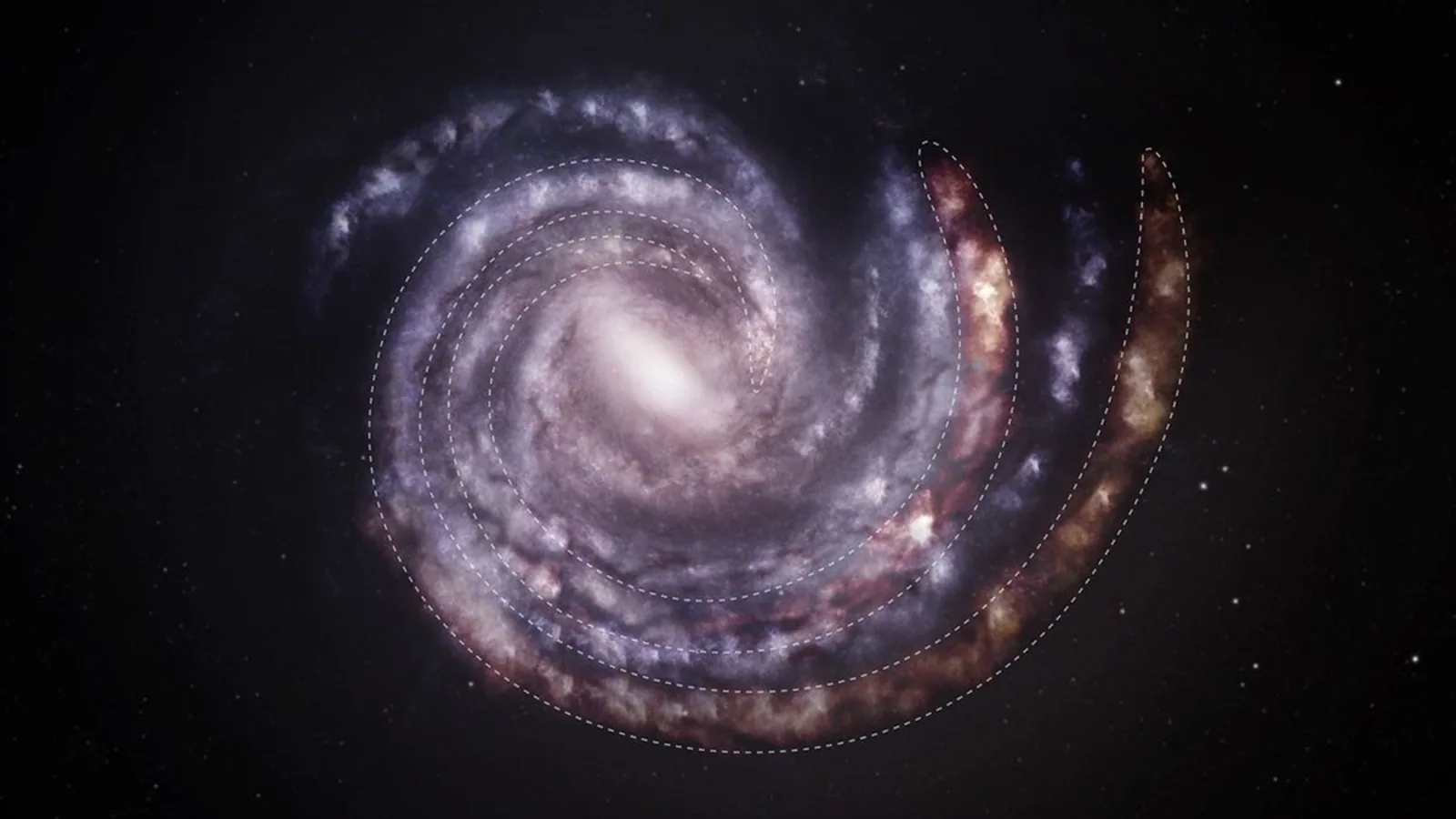
Astronomers are revising their understanding of the Milky Way's dimensions following a new study that indicates two of its major spiral arms are significantly farther from Earth than previously calculated. The findings, which utilized the echoes of distant cosmic explosions, could prompt a reassessment of the galaxy's total mass and its overall shape.
The Milky Way, a barred spiral galaxy, is characterized by a central region housing a supermassive black hole, known as Sagittarius A*, surrounded by four primary spiral arms: Sagittarius, Scutum-Centaurus, Perseus, and the Outer arm. These arms, extending outward like a pinwheel, contain the bulk of the galaxy's stars and gas. Until recently, estimates of these arms' extents relied heavily on the galaxy's rotation rate, a method limited by our internal perspective within the galaxy. This indirect measurement has historically shaped our estimations of the Milky Way's size, approximately 100,000 light-years across, and its mass, roughly 1.5 trillion solar masses, according to NASA data. However, this method has introduced uncertainties about our galaxy's precise structure.
“We usually model the Milky Way's outer arms indirectly based on what we know of how our galaxy rotates, but doing it this way leaves room for error,” stated Beatrice Vaia, lead author of the new study and a researcher at the Italian National Institute for Astrophysics. “The farther away from the galactic center, the more uncertain the measurements become.”
The research, published on June 19 in the journal Astronomy and Astrophysics, introduced an innovative approach using gamma-ray bursts (GRBs) – some of the most powerful explosions in the universe. When X-ray light from these cosmic events traverses dense gas clouds, such as those found in the galaxy's arms, it generates luminous rings, or echoes. The size of these echoes directly corresponds to their distance from Earth.
Mapping Galactic Distances with Cosmic Echoes
The research team analyzed data from NASA's Chandra X-ray Observatory and the European Space Agency's XMM-Newton observatory. They focused on echoes from three distinct GRBs that passed through gas clouds within the Perseus, Outer, and Scutum-Centaurus arms. This analysis revealed that both the Outer arm and the Scutum-Centaurus arm are approximately 10% farther away than previously estimated, translating to several thousand light-years.
“The differences are small, but any revision of these distances is important because they are so fundamental for understanding our galaxy,” explained Ilaria Fornasiero, an astronomer at the University of Bologna and co-author of the study. “For example, this could mean that astronomers have to revise estimates of the mass of the galaxy, because that affects how wide the arms stretch.”
The implications of this revised understanding are substantial. A larger galactic radius naturally suggests a greater overall mass. This adjustment could have significant ripple effects on our comprehension of our immediate cosmic vicinity and the dynamics governing celestial bodies within it. Visualizations based on the new data suggest the Milky Way might appear more lopsided, resembling a snail's shell more than a perfect spiral, with the Outer and Scutum-Centaurus arms extending further into intergalactic space.
While these visualizations offer a glimpse, they do not necessarily represent the galaxy's definitive shape, as other arms like the Sagittarius arm have not yet been measured with this methodology. Intriguingly, the Perseus arm's distance did not show a similar outward shift, hinting at an unexpected asymmetry within the Milky Way galaxy. This asymmetry challenges current models and suggests a more complex structure than previously assumed.
Researchers are now actively seeking more GRBs to refine their mapping of the galaxy's structure and gain a clearer picture of our cosmic home. However, identifying suitable GRBs remains a challenge. “We're relying on the universe to provide us with these events, and so far, over 25 years, we've only found a handful that we can use,” commented Andrea Tiengo, an astronomer at Scuola Universitaria Superiore Pavia and study co-author. “That said, we will continue to be on the lookout for more.” This ongoing work promises to refine our understanding of the Milky Way's true scale and complexity.