
Oldest Right-Handedness Evidence Found in 550 Million-Year-Old Australian Fossils
Researchers have identified the earliest known evidence of right-handedness in 550-million-year-old fossils of Spriggina floundersi, an ancient wormlike creature from Australia. The findings suggest this directional preference existed billions of years before humans.

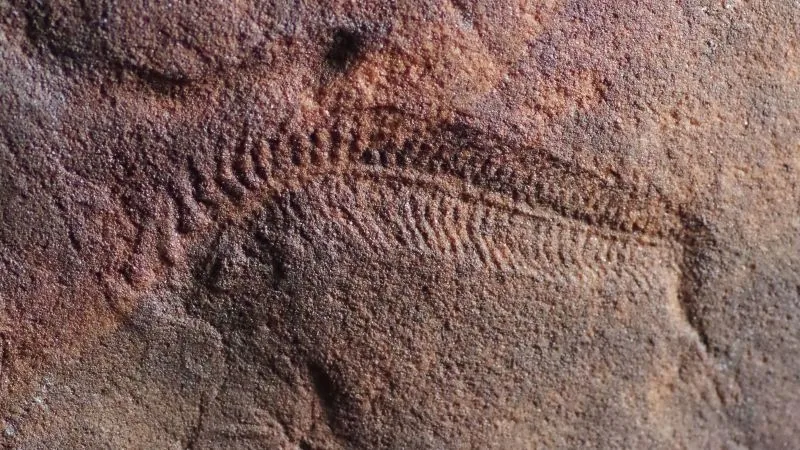
An analysis of fossils discovered in Australia has revealed the earliest known evidence of right-handedness, a trait present in creatures dating back 550 million years. The ancient organism, a wormlike animal named Spriggina floundersi, exhibited a distinct tendency to curve its body to the right, suggesting a behavioral preference for one side.
Spriggina floundersi lived during the Ediacaran Period, a time of early animal life on Earth. Fossils of this creature, found in what is now South Australia, show a flat, segmented body that tapered at one end and possessed a curved structure at the other, indicating it was one of the first animals with a discernible head. Paleontologists first described Spriggina in 1958, sparking debate about its ability to move independently.
A recent comprehensive study examined over 100 Spriggina fossils to address this long-standing question. The researchers concluded that these ancient animals not only moved across the seafloor but also displayed a significant bias towards their right sides. The study, published in the journal Scientific Reports, found that the majority of fossil specimens curved to the left, implying their bodies were flexed to the right in life. This directional preference mirrors handedness observed in many modern animals, including humans.
Scott Evans, lead author of the study and an assistant curator of invertebrate paleontology at the American Museum of Natural History, noted the significance of the findings. "Fossils of early animals, to most people — even to me — they look weird," Evans stated. "But if you push past that weirdness, what we see is that a lot of the fundamental characters that we associate with animals today, things like the ability to move and even having this behavioral handedness, are present in these earliest animal communities."
Tracing Ancient Behavior Through Fossil Curves
The research team meticulously analyzed the curvature of more than 100 Spriggina floundersi fossils. While some fossilized bodies were straight, most showed distinct curves. These impressions preserved the soft bodies of the animals, with the majority bending to the left in the rock, indicating a rightward curve in life. The organisms themselves were small, typically measuring between 0.8 to 1.2 inches (2 to 3 centimeters) in length, with some reaching up to 4 inches (10 centimeters).
To determine if the curves were due to external forces like water currents or were self-induced movements, scientists studied the surrounding rock strata for signs of environmental disturbances. They found fossil specimens oriented in various directions and exhibiting different degrees of curvature, suggesting independent movement rather than passive bending by currents or storms. The researchers also considered post-mortem body deformation, such as drying out, but found that variations in curvature among specimens found close together on the same rock beds pointed against this hypothesis.
The statistical analysis revealed that approximately twice as many fossils curved left (indicating right-sided preference) as curved right. This ratio is comparable to the distribution of right-handedness observed in living populations. Diego García-Bellido, a senior paleontology researcher at the South Australian Museum and an associate professor of paleontology at Adelaide University, who was not involved in the study, commented on the findings. "I am very cautious when interpreting the fossil record, and I believe Evans and coauthors have been as well," García-Bellido said via email. "They have clearly considered and stated all alternative hypotheses and they offer clear, valid arguments for their interpretations."
This discovery suggests that even in the earliest complex animal life, directional bias was established, hinting at the presence of a developed nervous system connected to musculature. This capability for preferential movement is a foundational trait that paved the way for more complex behaviors observed in later animal evolution, including the dominance of right-handedness in many species today. The study of Spriggina floundersi highlights how paleontological research can uncover subtle behavioral patterns from the deep past.