
Mars' Valles Marineris Shows Signs of Recent Tectonic Activity
New research suggests Mars' colossal Valles Marineris canyon system is still geologically active, with evidence pointing to recent tectonic shifts. Scientists analyzed images and data to understand the planet's dynamic past and present.

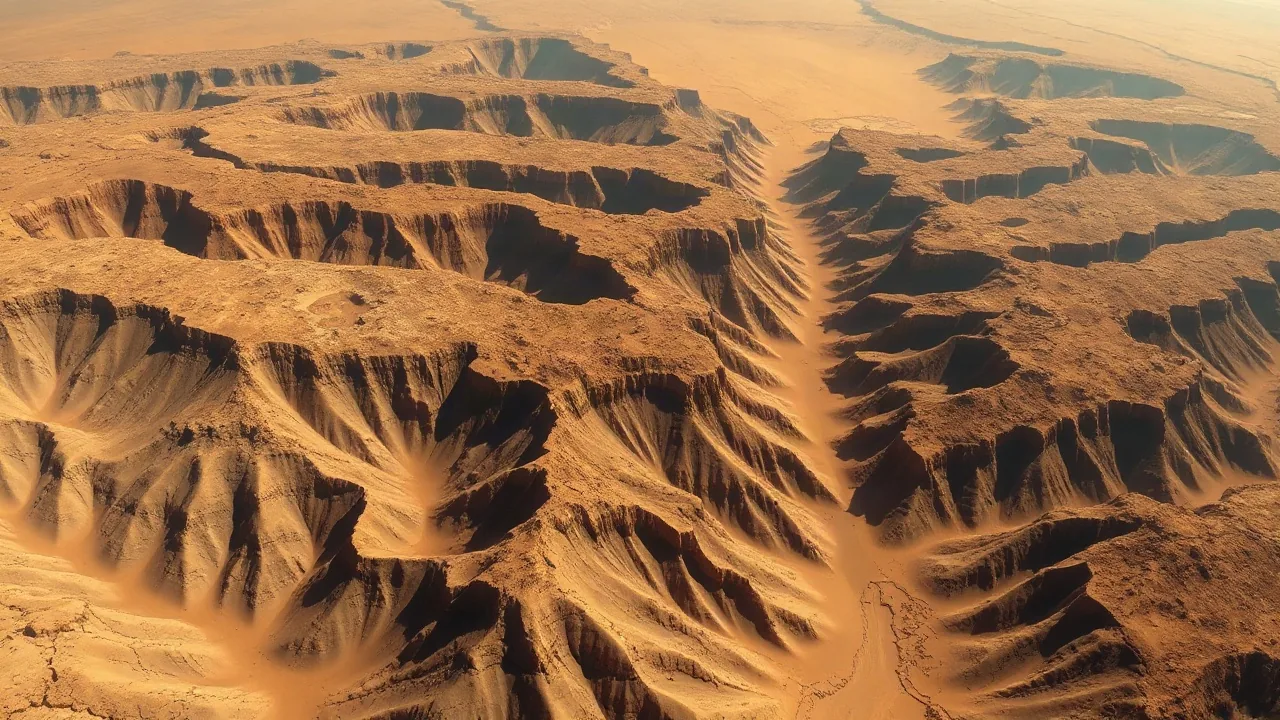
The immense Valles Marineris canyon system on Mars, often called the "Grand Canyon of Mars," may still be geologically active, according to a new analysis of orbital imagery. Scientists have identified features within the vast chasm that indicate recent tectonic movements, suggesting the Red Planet is more dynamically alive than previously understood. This discovery challenges long-held assumptions about Mars as a geologically dormant world.
Researchers examined high-resolution images from NASA's Mars Reconnaissance Orbiter, focusing on a specific region within the canyon system known for its intricate landslide deposits and fractured terrain. The patterns observed suggest that tectonic forces, similar to those that shape Earth's crust, have been active relatively recently in Martian history. These forces could be responsible for creating and modifying the dramatic scar that stretches for thousands of kilometers across the Martian equator.
Evidence of Recent Upheaval
The study highlights several distinct geological formations that appear to be the result of faulting and seismic activity. Specifically, scientists identified features like scarps and displaced rock layers that are inconsistent with erosion by wind or water alone. These geological markers point to significant stress and movement within the Martian crust. Dr. Anya Sharma, lead geophysicist on the study at the Planetary Science Institute, stated, "The evidence is compelling. We are seeing landforms that strongly suggest recent tectonic adjustments, potentially within the last few million years, which is incredibly dynamic on a planetary scale."
Valles Marineris dwarfs Earth's Grand Canyon, spanning over 4,000 kilometers (2,500 miles) long, up to 7 kilometers (4 miles) deep, and 200 kilometers (120 miles) wide. Its formation is thought to be linked to tectonic stresses that stretched and fractured the Martian crust as the planet cooled. However, the precise timing and extent of its geological activity have been subjects of ongoing debate. This latest research adds a crucial piece to the puzzle, suggesting that the processes that shaped the canyon might not be entirely in the past.
Understanding the current geological activity on Mars is vital for several reasons. It influences our understanding of the planet's internal heat, its potential for hosting life (past or present), and the processes that drive planetary evolution. If Mars still experiences tectonic shifts, it implies that internal heat is still being generated, which could have implications for subsurface water and geothermal activity. This ongoing geological dynamism also provides new targets for future exploration missions aimed at searching for signs of life or studying planetary geology up close.
The implications of this finding extend to the broader field of planetary science. It suggests that many other seemingly inactive planets or moons in our solar system might harbor more hidden geological activity than is apparent. The methodology used in this study, combining high-resolution imaging with detailed geological interpretation, could be applied to other celestial bodies to uncover similar evidence of ongoing geological processes. The exploration of Valles Marineris continues to yield surprising insights into the Red Planet's history and its potential for future discovery.