
Kennedy Space Center: NASA's Florida Hub for Modern Exploration
Kennedy Space Center remains the operational heart of NASA's crewed spaceflight program, supporting both near-term missions and long-term lunar ambitions through renovated launch facilities and cutting-edge technology.

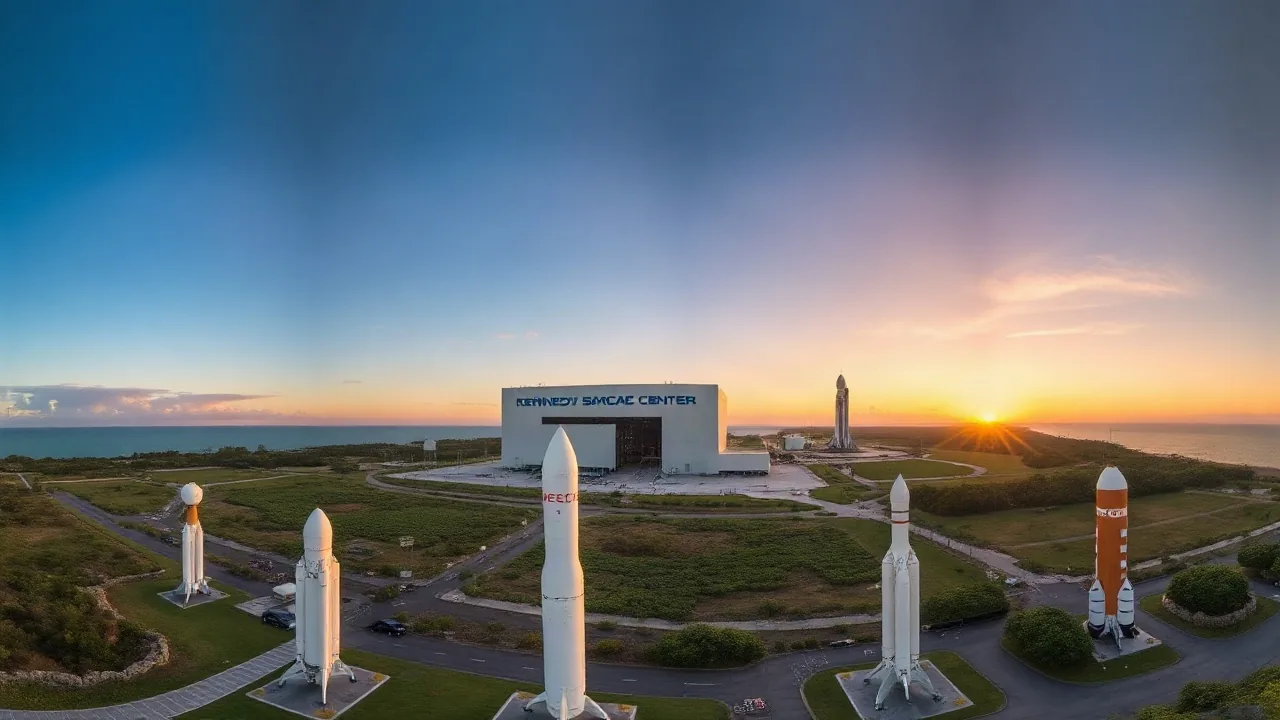
On a humid morning in September 2026, the Vehicle Assembly Building at Kennedy Space Center towers above the Florida coastline, its 52-story silhouette casting long shadows across the sprawling Brevard County campus. Inside, technicians from NASA and private contractors work on launch vehicles destined for Earth orbit and beyond, continuing a tradition that began with Mercury and Gemini in the 1960s.
Kennedy Space Center, located on a 140,000-acre parcel of land south of Melbourne, Florida, has served as the primary launch site for every crewed American spaceflight program since 1968. Today, after decades of renovation and modernization, the facility operates as a dual-use complex: it remains the anchor for NASA's Artemis missions to the Moon while simultaneously supporting commercial launch operators through leased facilities and shared infrastructure.
The Historic Core and Modern Transformation
The original launch complex at Kennedy, built during the Apollo program, reflected Cold War engineering and ambition. Launch Complex 39A and 39B, originally designed to send astronauts to the Moon, now launch space launch vehicles of varying designs and payload capacities. SpaceX has operated LC-39A since 2014, using the pad for Falcon 9 and Falcon Heavy missions, while NASA reserved LC-39B for the Space Launch System (SLS) and Artemis program.
"Kennedy Space Center represents the only fully operational government spaceport in the United States," says Dr. Sarah Chen, Senior Analyst at the Aerospace Industries Association. "The facility's unique position as both a NASA center and a multi-user spaceport creates operational efficiencies that are difficult to replicate elsewhere."
Between 2023 and 2026, Kennedy invested over 1.2 billion dollars in infrastructure upgrades. These included reinforced launch towers, enhanced environmental monitoring systems, and modernized ground support equipment designed to accommodate vehicles ranging from current-generation Falcons to the yet-to-debut Falcon Heavy variants and SLS itself.
The Visitor Complex, which opened in 1967, has undergone its own transformation. In 2025, Kennedy debuted the Artemis Gateway exhibit, a 24,000-square-foot space detailing the technical requirements and objectives of the Moon-focused Artemis program. Annual visitation has rebounded to 1.4 million visitors, up from pandemic lows.
The Artemis Mission and Lunar Ambitions
Kennedy's role in returning humans to the Moon anchors NASA's strategic priorities. The Space Launch System, assembled and tested at Kennedy's facilities, stands 322 feet tall and represents the most powerful rocket currently in the American inventory. In September 2026, NASA confirmed that Artemis II, carrying four astronauts in an orbit around the Moon, remains on track for a 2027 launch window from Kennedy.
The mission sequence reflects decades of planning. Artemis II will test the heat shield and life support systems of the Orion spacecraft in a lunar environment. Artemis III, expected in 2028 or 2029, will land two astronauts near the Moon's south polar region, an area of scientific and resource-exploration significance.
Supporting these missions requires aerospace integration at Kennedy that extends well beyond launch operations. The center houses the Human Spaceflight Launch Complex, a specialized facility where engineers conduct water flow tests, sound suppression system checks, and final vehicle assembly. The Exploration Ground Systems (EGS) division, headquartered at Kennedy, oversees SLS and Orion integration for all Artemis flights.
Commercial Partnership and Economic Impact
Kennedy's transformation into a multi-user spaceport reflects broader shifts in space exploration economics. The center currently leases facilities to SpaceX, Blue Origin, and Axiom Space. This arrangement generates federal revenue and reduces NASA's operational burden for non-government missions.
Brevard County, where Kennedy is located, has experienced economic diversification tied to the spaceport's activity. In 2026, the aerospace and defense sector employs approximately 47,000 workers across the region, with direct Kennedy employment at roughly 8,000 civil service positions plus 15,000 contractor roles. Annual payroll impact exceeds 2.3 billion dollars.
The Florida location itself provides strategic advantages. Kennedy sits at latitude 28.5 degrees north, which offers favorable launch azimuth for equatorial and polar orbits. The Atlantic Ocean provides a safe downrange corridor for first and second stage recovery. These geographic assets have made Kennedy irreplaceable despite the emergence of commercial launch facilities in Texas, Mississippi, and coastal California.
Blue Origin's New Shepard vehicle, while not launching from Kennedy, has utilized Kennedy's facilities for astronaut training and mission support. Axiom Space, which leases dock space at Kennedy for its commercial space station modules, represents a model of public-private partnership that NASA increasingly relies upon.
Looking forward, Kennedy Space Center will continue to serve as the operational and symbolic center of American crewed spaceflight. The facility's 700-acre industrial complex remains the most heavily utilized government spaceport in the world, processing, assembling, and launching vehicles that carry humans and cargo to Earth orbit, the Moon, and beyond. Its role in achieving Artemis objectives and sustaining long-term lunar exploration remains assured for the next decade and beyond.