
Harvest Moon Meets Saturn: A Double Celestial Treat This Weekend
Look up this Saturday for a rare alignment as the full Harvest Moon shines near the ringed planet Saturn. This celestial pairing offers a stunning view for skywatchers across the globe.

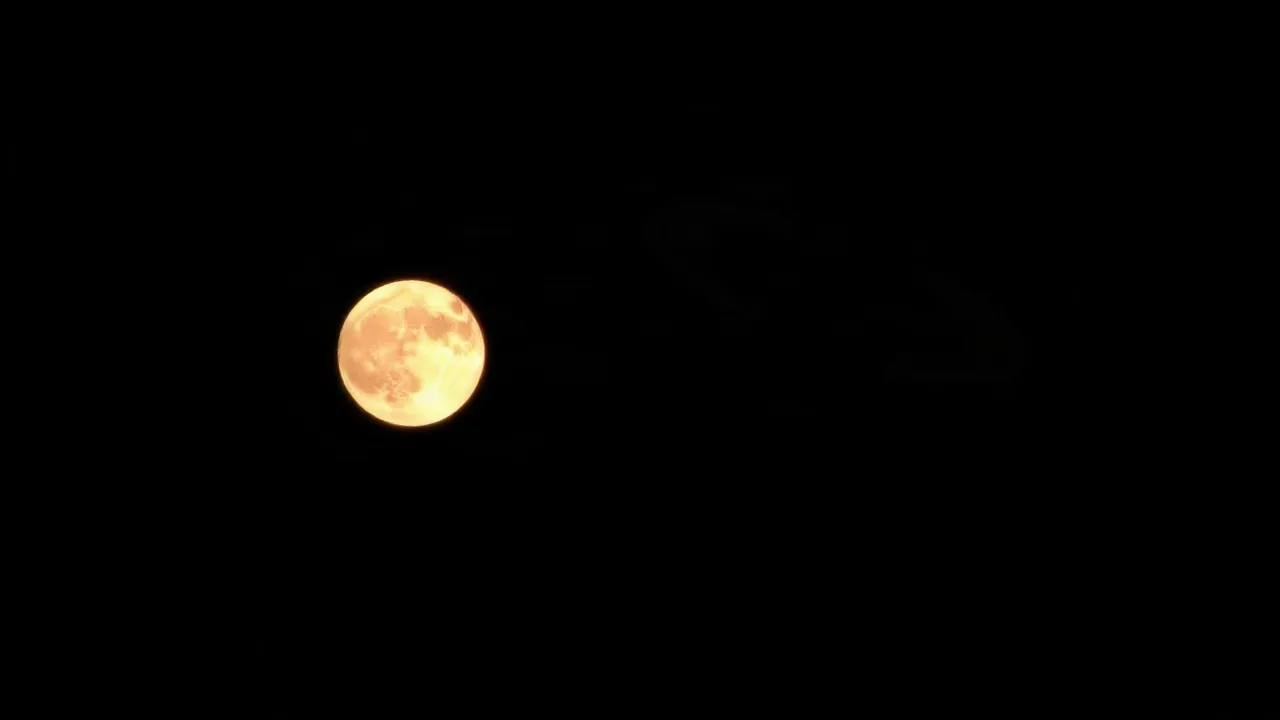
Skywatchers are in for a treat this Saturday, September 26, 2026, as the full Harvest Moon makes a close approach to the planet Saturn. This celestial event, often referred to as a conjunction, will allow observers to see both the bright, full moon and the golden hue of Saturn in the same field of view.
The Harvest Moon, which is the full moon that occurs closest to the autumnal equinox, traditionally marks the time for gathering crops. This year, its appearance alongside Saturn provides an extra layer of astronomical interest. Saturn, visible as a bright, steady point of light, will appear close to the moon, offering a beautiful two-for-one celestial display. The exact timing and visibility will depend on local weather conditions and the observer's specific location, but the best viewing opportunities are expected shortly after sunset.
A Close Encounter in the Night Sky
While the moon and Saturn will appear very close together in the sky, they are actually vast distances apart. The moon orbits Earth at an average distance of about 238,900 miles (384,400 kilometers), while Saturn is an average of 793 million miles (1.27 billion kilometers) from Earth. The phenomenon of conjunctions, where two celestial bodies appear near each other from our perspective on Earth, is a common occurrence that delights stargazers. This particular alignment is notable for the brightness of the Harvest Moon and the distinct visibility of Saturn, even without a telescope, though binoculars or a small telescope will enhance the view of Saturn's rings.
According to Dr. Evelyn Reed, an astrophysicist at the National Astronomical Observatory, "Events like these offer a fantastic opportunity for people to connect with the cosmos. You don't need expensive equipment to appreciate the beauty of the night sky; simply stepping outside on a clear night can be rewarding." She added, "The Harvest Moon itself is a beautiful sight, but seeing it paired with a planet like Saturn adds a special element that's truly memorable."
This year's conjunction is particularly noteworthy because Saturn will be well-positioned for observation. The planet will be at one of its closest points to Earth in 2026, making it appear brighter and larger than usual. This proximity, combined with the brilliant light of the full Harvest Moon, creates a visually striking spectacle. Early observers on Saturday evening might also be able to spot other planets, such as Jupiter, which is often visible around the same time, though it will be further away from the moon's position.
The Harvest Moon's name has historical significance, tied to agricultural cycles in many cultures. It's the moon that signals the end of summer and the beginning of autumn, illuminating the sky during harvest times, allowing farmers to work late into the night. This year's celestial pairing adds a modern marvel to an ancient tradition, reminding us of the enduring fascination with the night sky and the predictable, yet always wondrous, movements of the planets and moons.