
James Webb Telescope Detects Salty Clouds on Distant 'Pink Planet'
New research using the James Webb Space Telescope suggests the exoplanet GJ504b, nicknamed the 'Pink Planet,' may possess clouds composed of salt. This finding offers new insights into the atmospheres of cold, distant celestial bodies.

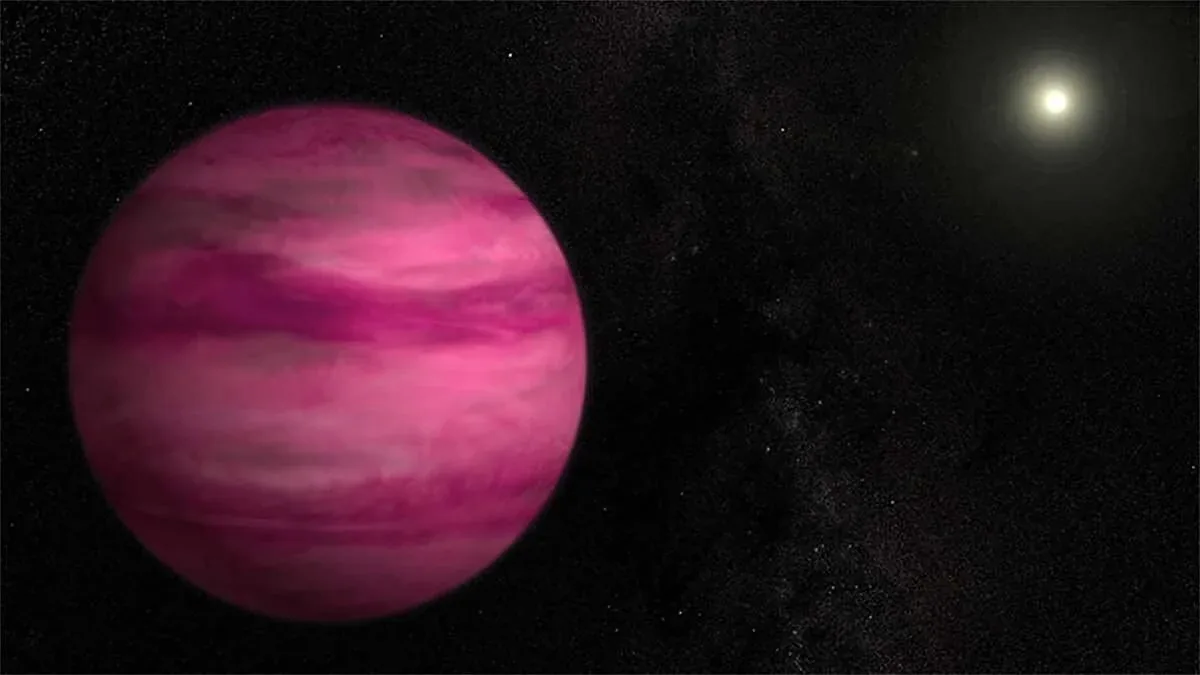
Astronomers leveraging the powerful capabilities of the James Webb Space Telescope have uncovered intriguing evidence suggesting that the exoplanet GJ504b, a peculiar object known for its vibrant pink hue, may be enveloped by clouds made of salt. The groundbreaking findings, detailed in a recent study, offer a deeper understanding of the atmospheric composition of some of the coldest and dimmest exoplanets, which have historically been challenging to observe.
GJ504b, located less than 60 light-years from Earth, was first discovered in 2013. It orbits its Sun-like star at an exceptionally vast distance, more than 40 times farther than Earth orbits our Sun. This enormous separation makes it a difficult target for ground-based telescopes, but an ideal candidate for the sensitive instruments aboard the JWST. Researchers have debated whether GJ504b is a massive planet or a brown dwarf, a celestial object that falls somewhere between a planet and a star. Due to this ambiguity, it is often referred to as a "planetary-mass companion." The latest analysis, combining JWST spectral data with advanced astrophysical models, has also refined estimates of its mass and age, indicating it is significantly more massive and older than previously thought.
The study's lead author, Aneesh Baburaj, a postdoctoral associate at Northwestern University specializing in exoplanetary evolution, highlighted the challenges in studying such distant objects. "The Pink Planet is the coldest companion ever discovered using ground-based instruments," Baburaj stated. "Many teams all around the world performed follow-up observations to study its light, but it was too faint for ground-based instruments. That made it a perfect target for JWST." Upon obtaining the exoplanet's spectrum, the data immediately presented an anomaly that intrigued the research team.
Atmospheric Anomalies and Salt Cloud Hypothesis
Further investigation into the JWST data revealed a puzzling thermal anomaly, suggesting a missing source of opacity in GJ504b's atmosphere. This anomaly could only be resolved by simulating cloud cover. When astrophysicists incorporated the presence of clouds into their models, the results aligned with the known characteristics of cold planets. Specifically, simulations involving three different types of clouds indicated that salt clouds provided the best fit for the observed spectral data. "We ran simulations with clouds, and the results aligned with what we know about cold planets," Baburaj explained. "We tried three different types of clouds, and salt clouds fit best. When we accounted for salt clouds, it subdued the signature of molecules hidden deeper in the companion's atmosphere. Then, the results became physically possible."
While the exact composition of these potential salt clouds remains under investigation, scientists hypothesize they could be composed of compounds like potassium chloride or zinc sulfide. In addition to the salty clouds, the spectral analysis detected a complex atmospheric mix within the pink haze, potentially containing water, carbon monoxide, methane, ammonia, and hydrogen sulfide – chemicals commonly found in kitchens. This complex chemical cocktail adds another layer to the mystery of GJ504b's atmosphere.
The refined estimates suggest GJ504b is approximately 10 percent smaller than Jupiter but possesses a mass about 25 times greater. Its temperature is also notably lower than other gas giants, estimated to be around 290 degrees Celsius (550 degrees Fahrenheit). This relatively cool temperature, compared to the thousand-degree counterparts of newly formed giant planets, points to an age between 2.5 billion and 4.5 billion years, placing it potentially around the age of our own Solar System. The presence of heavy elements, such as carbon, oxygen, and possibly sulfur, in GJ504b's composition, similar to Jupiter's enrichment, tentatively suggests it may have formed as a planet from a disk of debris rather than as a brown dwarf.
This study marks a significant advancement in the use of the JWST and sophisticated modeling techniques to analyze dim and indistinct celestial bodies. "This is the first time we've found that salt clouds are critical to explaining the spectrum of an object," Baburaj concluded. "It's a good reminder to account for clouds in our models." The ability to detect and characterize the atmospheres of such exoplanets is crucial for understanding planetary formation and the diversity of worlds beyond our solar system.