
1.2Tb/s Internet Speeds Achieved in Hollow-Core Fiber Field Test
A groundbreaking field trial in China demonstrated a hollow-core fiber transmission system reaching speeds of 1.2Tb/s per wavelength, a significant leap for future internet infrastructure.

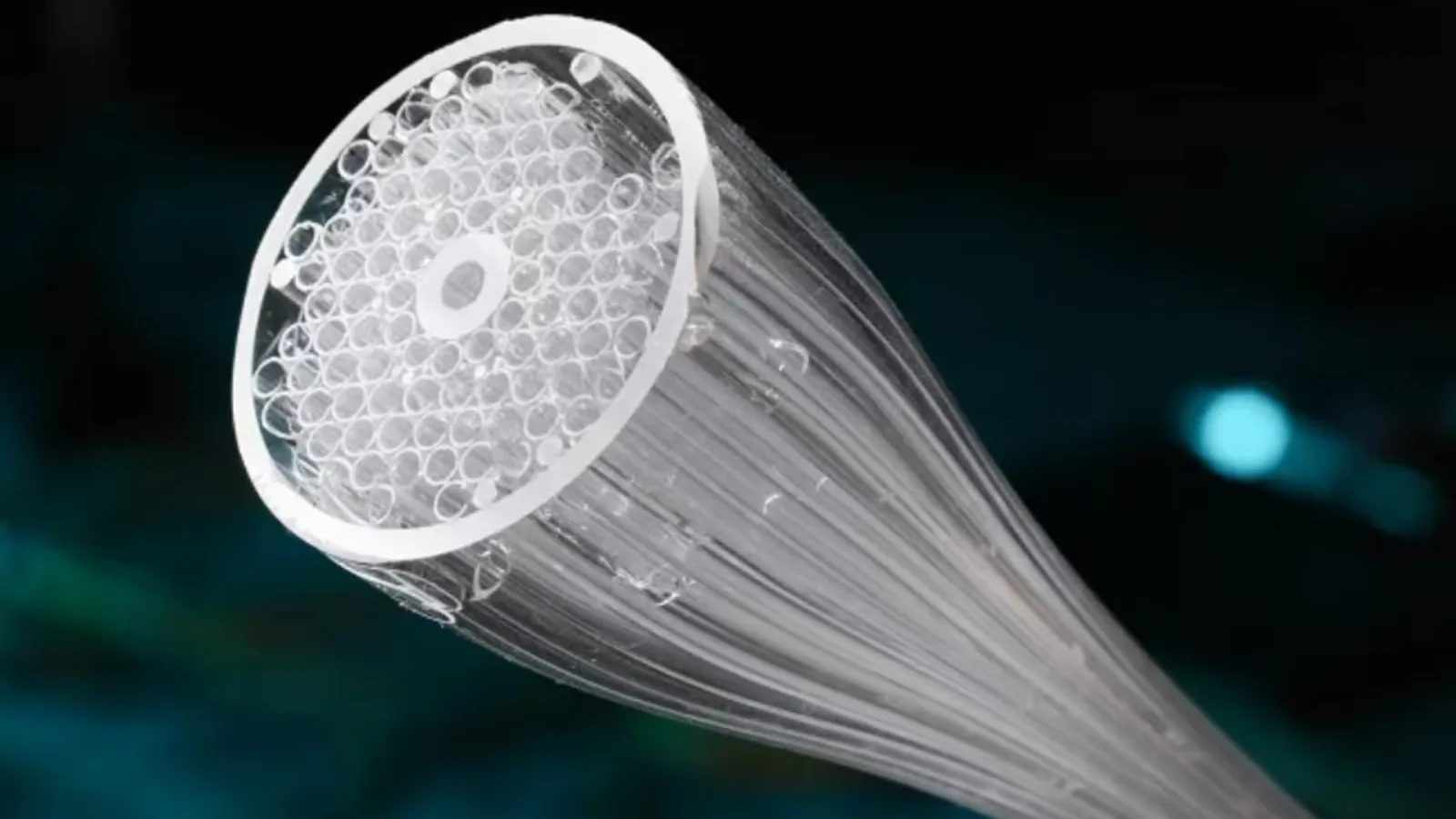
Researchers in China have successfully conducted a field trial of a next-generation hollow-core fiber optic transmission system, achieving an unprecedented 1.2 terabits per second (Tb/s) on a single wavelength. The milestone was announced by China Telecom, Yangtze Optical Fibre and Cable Joint Stock Limited Company, and Dekoli as part of a national initiative focused on advancing optical fiber technologies. This demonstration took place over the world’s longest commercial cross-border hollow-core fiber cable, spanning approximately 128 miles (206 kilometers) without the need for signal repeaters, and reached a total system capacity of 51.3Tb/s.
Unlike conventional fiber optics that transmit light through solid glass, hollow-core fiber channels light through an air-filled core. This innovative design inherently reduces signal latency and significantly boosts data transmission capacity, overcoming fundamental limitations of current fiber technology. Consequently, hollow-core fiber is being recognized as a pivotal technology for future optical networks, particularly for high-demand backbone infrastructure and large-scale data centers. The recent test successfully addressed the long-standing challenge of transmitting high-power signals within a real-world hollow-core network, a feat previously unaccomplished outside of laboratory settings. Validating stable high-speed performance under practical conditions marks a significant step toward the widespread adoption of this novel communications technology.
Optimizing Data Transmission and Amplification
The research team implemented an adaptive per-wavelength rate control mechanism and flexible channel power allocation to enhance overall transmission performance. This system dynamically adjusts data carrying capabilities for each wavelength, enabling optimized operation under variable conditions. The result is a hybrid transmission system that supports diverse data rates, channel spacings, and individually tuned power levels, striking a better balance across the entire spectrum of channels compared to uniform treatment.
To further support high-power transmission, a new amplifier architecture was developed. This design features a cascaded dual-gain-unit structure combined with multi-element doping, significantly improving both efficiency and stability. This advanced amplification enables strong gain flatness, ensuring consistent signal performance across various operating ranges. The system achieved a maximum output power of up to 33.5 dBm, contributing to more robust transmission capabilities within the fiber-optic setup.
Safety and reliability were also paramount. The system incorporates advanced safeguards, including optical-path power anomaly detection for continuous monitoring, automatic interlock shutdown functions for unsafe conditions, and alarm-linked response mechanisms. These measures facilitate rapid identification of abnormal operations and provide multiple layers of protection, preventing equipment damage and enhancing overall operational safety and reliability in high-power optical transmission environments. The findings of this significant trial were published in TrendForce.