
Gus the T. Rex Fossil May Fetch Record Price at Sotheby's Auction
A remarkably complete Tyrannosaurus Rex fossil, nicknamed Gus, is set for auction at Sotheby's, potentially becoming the most expensive dinosaur ever sold. The sale reignites debate over scientific specimens entering private collections.

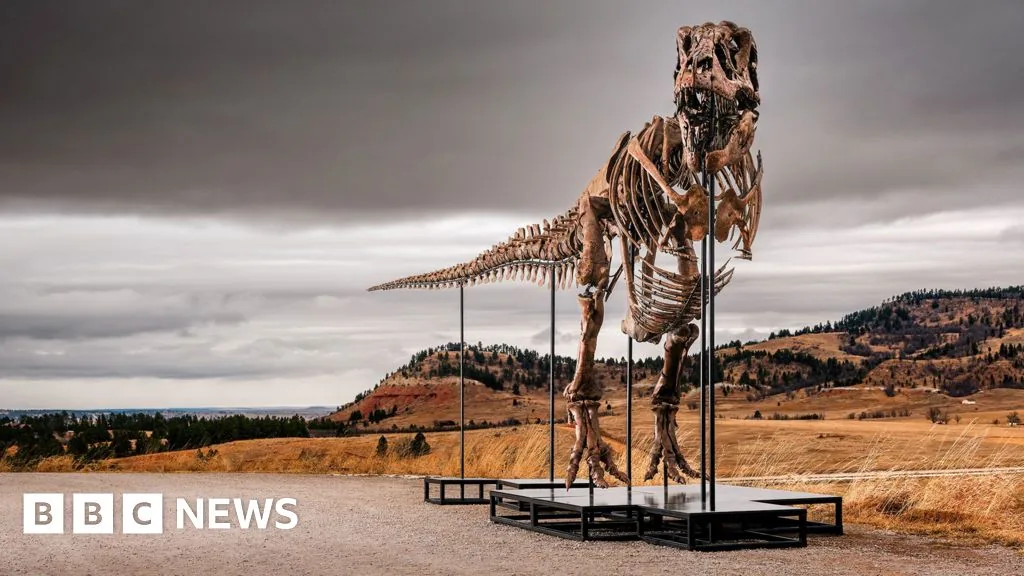
A nearly complete Tyrannosaurus Rex fossil, known as Gus, is poised to make history at a Sotheby's auction in New York on Tuesday, with an estimated value of $30 million. If bidding surpasses expectations, Gus could become the most expensive dinosaur fossil ever sold, continuing a trend of high-profile natural history sales that are increasingly drawing the attention of wealthy private collectors alongside scientific institutions.
The impending auction has intensified a long-standing debate within the scientific community: should fossils of significant scientific importance be exclusively reserved for museums and researchers, or should the individuals who discover and recover them be rewarded through sale, thereby saving them from potential decay or loss?
Cassandra Hatton, Sotheby's global head of natural history, highlighted the arduous efforts involved in fossil excavation. "People die on excavations," she stated, underscoring the extreme dedication required by paleontologists. "The people that look for these fossils will spend months out in the field with tents and their food in their backpacks and they're camping out in the middle of nowhere with the rattlesnakes and the bugs and the mountain lions," she described the challenging conditions, particularly in South Dakota's Badlands where Gus was discovered approximately 67 million years after the dinosaur roamed the Earth.
Scientific Value vs. Market Demand
The discovery of Gus, named after the late cattle rancher Gary "Gus" Licking on whose land it was found, was the culmination of a three-year excavation process led by Thomas Heitkamp and his team. "It's not the full year," Hatton explained. "You can only dig during the field season. So you have to wait till the ground has thawed. And then you are furiously digging until the ground freezes again [in September]." Following the excavation, which concluded in 2023, the team spent an additional three years documenting and reconstructing the fossil in the lab, highlighting the extensive time and resources invested.
Gus enters the auction with the highest pre-sale valuation for a dinosaur at $30 million. The current record for a dinosaur auction is held by a Stegosaurus named Apex, sold by Sotheby's in 2024 for $44.6 million – significantly exceeding its initial valuation. Bids for Gus are expected to start at no less than $19 million. However, even this substantial sum is beyond the reach of many of the world's oldest and largest natural history museums.
Professor Susannah Maidment, a dinosaur researcher at London's Natural History Museum, expressed concern over the escalating prices. "We're already priced out of having access to many, many specimens," she said. The trend is particularly concerning given that the five most expensive dinosaur sales at auction have all occurred since 2020, including a T. rex named Stan, which sold for $31.8 million in 2020 against a guide price of $6-8 million. "There's no substitute for having the real fossil. If we're going to do any sort of study, the number one thing is we need to understand the anatomy. We need to know what's real," Maidment emphasized. She also noted the critical importance of palaeobiology, the study of ancient life, especially in the context of the current mass extinction event. "We are in what is probably a mass extinction right now, we're changing our environment very, very, very rapidly. The past is really the only kind of empirical data we have to tell us about what is going on right now and in the future," she argued.
Beyond the scientific implications, Maidment noted the public's connection to natural history. Seeing real dinosaur bones in museums, she said, "helps them engage with the natural world." She worries that dinosaur specimens are increasingly viewed as art objects for wealthy collectors rather than vital scientific resources, driving up prices and limiting access.
Hatton, however, defended Gus's valuation, citing its exceptional completeness and condition. "Gus is one of the largest and most complete T. rex ever found, 61% of the bones has been identified - in general you find half of the skeleton that's a major scientific find." The fossil exhibits evidence of past trauma, including "a huge bite mark on the top of the skull, which could have been sustained during a battle. You've got broken bones - some of the ribs, you see huge lumps where they broke and they healed." Hatton stated she has contacted museums globally, hoping to secure a public institution for Gus. She maintains that auction prices must reflect the "time, skill, expense and risks" of recovery, noting that many excavators are not wealthy individuals but people investing their own savings.
The issue of private ownership poses a significant challenge for scientific research. Premier scientific journals often refuse to publish studies based on specimens held in private collections, as scientists require the ability to revisit fossils over time for verification and ongoing research. "What happens [if] that person gets bored of them, dies, gets divorced. And there have been many cases where specimens have been in private collections, and there's been a scientific description of them and [that has] gone in the skip," warned Prof Maidment. This situation risks a "second extinction" for these invaluable pieces of Earth's history, mirroring the fate of some specimens that have been lost to natural disasters or time, as illustrated by the historical accounts of collectors like Mary Anning and modern-day challenges faced by paleontologists on the Jurassic coast.