
Gravitational Waves Hint at Accidental Dark Matter Detection
Scientists propose gravitational wave data from a 2019 black hole merger might reveal the presence of dark matter. The finding, if confirmed, could unlock new methods for studying this cosmic mystery.

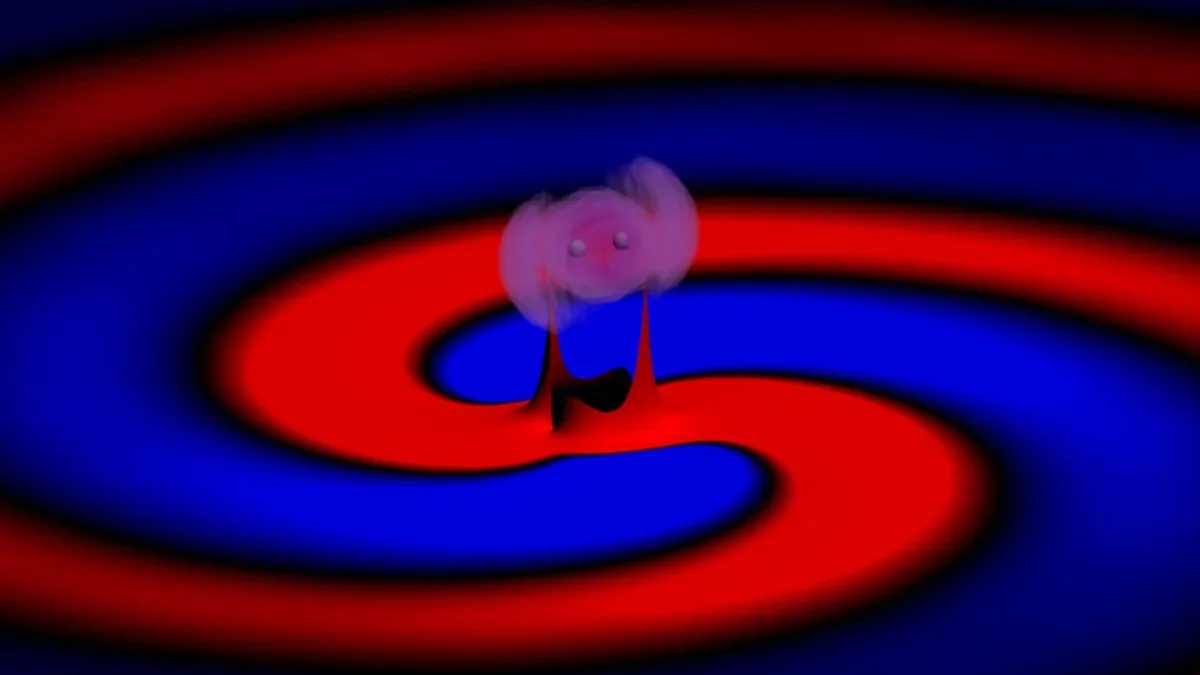
Physicists may have stumbled upon evidence of dark matter, a perplexing substance that constitutes roughly 85% of the universe's mass, through the analysis of gravitational waves. The research, involving scientists from the US, UK, and Europe, suggests that signals from colliding black holes could inadvertently carry the signature of dark matter if the cosmic event occurred within a dense dark matter cloud. This accidental detection, if validated, could revolutionize how scientists investigate both gravitational waves and the elusive nature of dark matter.
The theory posits that when two black holes merge, the gravitational waves they emit – ripples in the fabric of spacetime predicted by Albert Einstein's general theory of relativity – could be subtly altered by the surrounding dark matter. These ultralight particles, theorized to form collective waves in extreme gravitational environments, could interact with the merging black holes, leaving a distinct imprint on the emitted gravitational waves. Researchers developed a model to identify these specific signatures, differentiating between mergers occurring in a vacuum and those within a dark matter environment.
Applying this model to 28 gravitational wave events recorded by the LIGO, Virgo, and KAGRA (LVK) observatories, the team identified one signal that deviates from typical vacuum mergers. This specific event, designated GW190728 and detected in July 2019, exhibits a pattern consistent with a black hole merger taking place within a substantial dark matter cloud. While this is a tantalizing prospect, the researchers emphasize that the statistical significance is not yet high enough to declare a definitive detection of dark matter.
Unlocking New Observational Avenues
The discovery of gravitational waves in 2015 by the LVK network marked a new era in astronomy, allowing scientists to observe cosmic phenomena like black hole and neutron star mergers directly. Each detected wave carries intricate information about the masses and properties of the merging objects. The new research, however, proposes that these waves might also serve as a probe for phenomena beyond the directly observable, such as dark matter. Physicist Rodrigo Vicente of the University of Amsterdam highlighted the potential, stating, "Using black holes to look for dark matter would be fantastic. We would be able to probe dark matter at scales much smaller than ever before."
Current understanding of dark matter remains limited; its composition is unknown, with leading theories suggesting it could be made of WIMPy particles, MACHOs, or even primordial black holes. Some models propose self-interacting or inert properties, while others explore potential interactions with electromagnetism. The possibility that dark matter might not exist and that our understanding of gravity needs revision also remains on the table. This accidental detection method, if proven, could offer a novel pathway to gather empirical data on dark matter's properties and distribution.
Physicist Josu Aurrekoetxea from MIT, a member of the research team, cautioned against premature conclusions. "The statistical significance of this is not high enough to claim a detection of dark matter, and further checks should be performed by independent groups," Aurrekoetxea said. "What we think is important to highlight is that without waveform models like ours, we could be detecting black hole mergers in dark matter environments, but systematically classifying them as having occurred in vacuum." This suggests that previous analyses might have overlooked similar signals, potentially misinterpreting events within dark matter halos as occurring in empty space. Further independent verification and analysis of existing and future gravitational waves data will be crucial to confirm or refute this exciting possibility.