
Exoplanets Found With Magnetic Fields, Boosting Habitable Planet Research
Astronomers have found the strongest evidence yet that exoplanets possess magnetic fields, similar to Earth. The discovery on seven hot gas giants offers new insights into planetary characteristics beyond our solar system.

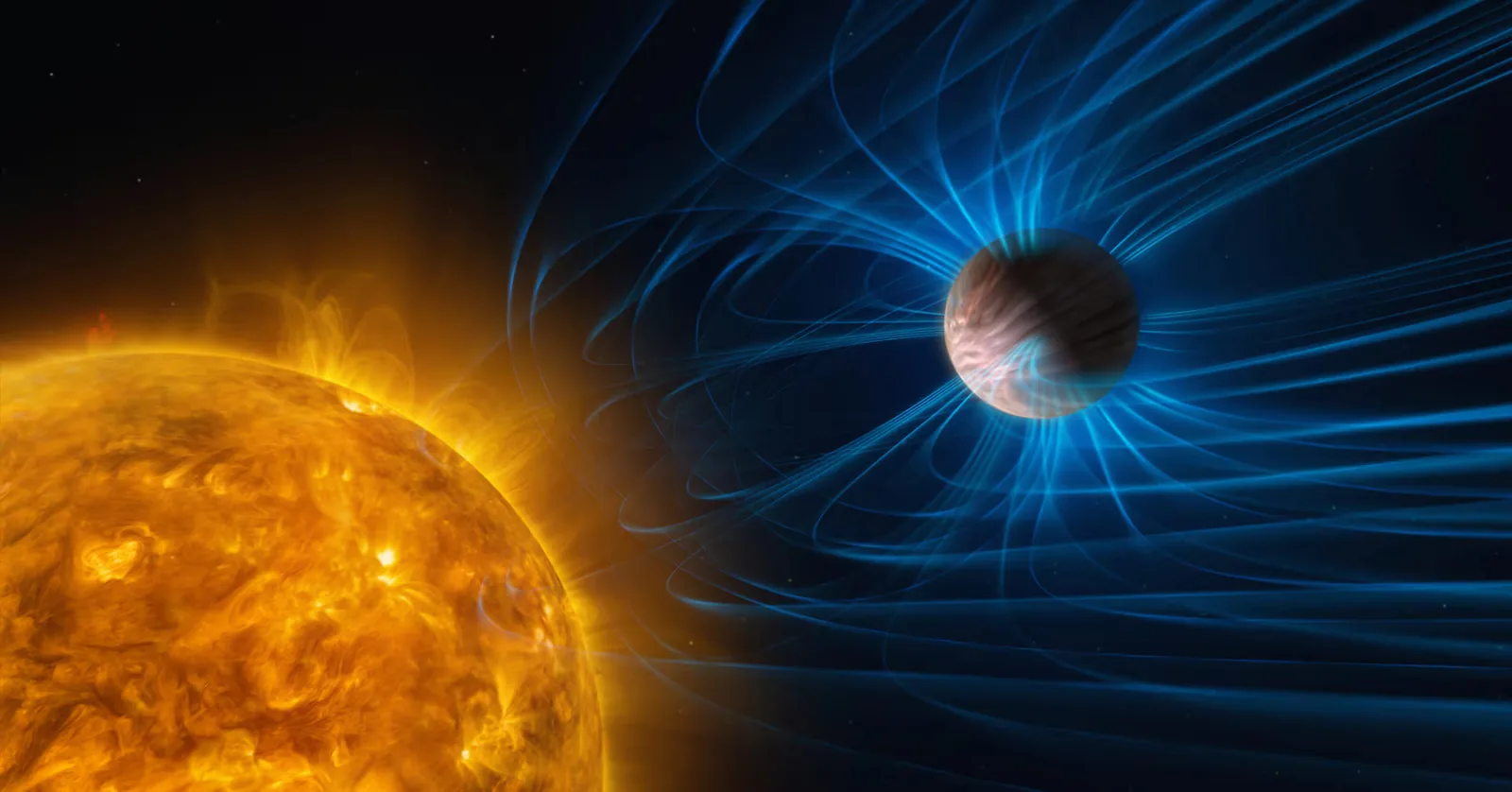
Astronomers have uncovered the most compelling evidence to date that planets orbiting stars beyond our solar system are equipped with magnetic fields, a characteristic shared by Earth and most planets within our own solar system. This groundbreaking finding, derived from analyzing the atmospheric behavior of seven large, hot gas exoplanets, significantly enhances our understanding of alien worlds by demonstrating that at least some possess a key attribute found in all but two of the solar system's eight planets.
Magnetic fields are generated deep within a planet by the motion of electrically conductive materials, typically a molten metal core, in conjunction with the planet's rotation. While the exoplanets studied are not candidates for life due to their extreme heat and proximity to their stars, the presence of a magnetic field could be a crucial factor in making rocky planets, like Earth, potentially habitable.
The seven gas giants, classified as "hot Jupiters" due to their size and composition similarities to our solar system's largest planet but with much higher temperatures, orbit extremely close to their host stars. This proximity results in one side of each planet permanently facing the star, leading to scorching atmospheric temperatures on its "dayside." These exoplanets are closer to their stars than Mercury is to our Sun.
Atmospheric Anomalies Hint at Magnetic Influence
Researchers observed that the hottest planets exhibited surprisingly weak atmospheric winds, a phenomenon that contradicts current models of atmospheric behavior. Dr. Elias Seidel, lead author of the study, explained that this atmospheric anomaly suggests that the immense energy absorbed from the star must be dissipated through an alternative mechanism. "That means all that energy that the star puts into the planet's atmosphere has to be dissipated in a different way. And the only possibility to brake the atmosphere that much that fast is via the magnetic field and its interaction with the moving charged particles of the atmosphere," Seidel stated. Wind speeds on these exoplanets were recorded at up to 15,500 miles per hour (25,000 km per hour), surpassing even Jupiter's wind speeds.
The discovery aligns with the expectation that exoplanets would possess magnetic fields, given that most planets in our solar system do. However, securing definitive proof had been a significant challenge for scientists until now. "We do not look at a singular exoplanet, but we look at a population of them and see a trend emerge," Seidel noted. The magnetic fields detected are smaller than Jupiter's but comparable to those of other planets in our solar system. Beyond Earth and Jupiter, planets like Mercury, Saturn, Uranus, and Neptune also generate global magnetic fields. Venus and Mars are the only planets in our solar system that lack such a field, although Jupiter's moon Ganymede and Earth's former moon also generate their own.
A planet's magnetic field plays a vital role in its ability to retain an atmosphere over extended periods. For example, Mars, which once had a magnetic field, lost it billions of years ago as its core cooled, resulting in its current thin atmosphere and inhospitable surface. "Although it's a common misconception that magnetic fields directly determine whether a planet is habitable, they can play an important role in how a planet evolves over time," said astronomer and study co-author Bibiana Prinoth of the European Southern Observatory. "Life as we know it relies on having an atmosphere. An atmosphere helps maintain surface pressure, regulate temperature and, on Earth, allows liquid water to exist at the surface." This research, based on observations from telescopes in Chile and Hawaii, provides crucial context for the ongoing search for potentially habitable planets outside our solar system.