
Astronomers Detect Unique Radio Pulses from Accreting White Dwarf Binary
Scientists have identified a rare celestial object, ASKAP J174508.9-505149, emitting unique radio and X-ray signals. This accreting white dwarf binary challenges existing theories of stellar evolution.

Astronomers have pinpointed a peculiar celestial object, designated ASKAP J174508.9-505149, located in a binary system where a white dwarf is actively accreting matter. This discovery, made using the Australian SKA Pathfinder (ASKAP) radio telescope, marks a significant advancement in understanding extreme astrophysical phenomena. Initial detection was made during an untargeted search for circularly polarized radio sources. Follow-up observations with the MeerKAT radio telescope refined its precise location in the sky. The object also revealed an optical counterpart in data from the Gaia DR3 catalog, appearing as a faint star with a magnitude of 19.45.
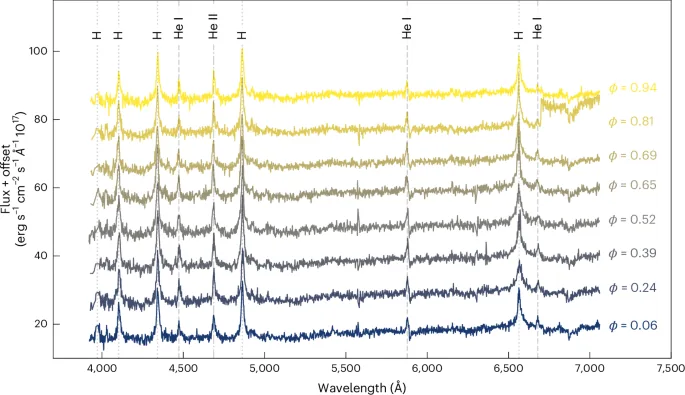
Spectroscopic analysis from the Southern Astrophysical Research (SOAR) and Magellan telescopes revealed a flat optical spectrum with a blue excess and prominent emission lines of Hydrogen and Helium. These characteristics are strongly indicative of a magnetic cataclysmic variable (CV), a type of binary system featuring a highly magnetized white dwarf and a smaller companion star, typically of spectral type K or M. The two main subtypes of magnetic CVs are polars and intermediate polars, distinguished by their magnetic field strengths and the synchronization of the white dwarf's spin with the orbital period. ASKAP J1745-5051 exhibits properties that bridge the gap between known types of CVs and another class of radio-emitting objects known as long-period radio transients (LPTs).
Unusual Radio Emission and Binary Behavior
What sets ASKAP J1745-5051 apart is its highly unusual radio emission. Unlike most CVs, it produces periodic, coherent, and strongly circularly polarized radio bursts, a hallmark of LPTs. The orbital period of the system was determined to be approximately 1.368 hours, placing it near the lower limit for CV orbital periods where the stars begin to separate. This radio pulse period, precisely measured at 1.34497 hours from nearly two years of combined observations from ATCA and ASKAP, closely matches the orbital period. Radio bursts consistently occur around orbital conjunctions, phases where the two stars are aligned from our perspective, with observations suggesting emission might occur at both conjunctions.
The radio pulses from ASKAP J174508.9-505149 are not only periodic but also exhibit complex modulation patterns and intermittency, sometimes switching off for several hours. The pulses drift in frequency and show narrow structures, resembling intensity modulation observed in the radio emissions of Jupiter. This phenomenon, known as 'modulation lanes,' has not been seen in any binary system other than Jupiter and its moon Io. Researchers suggest this indicates the presence of a local plasma acting as an interference screen, likely related to accretion onto the white dwarf.
Further supporting the accretion scenario is the detection of coincident ultraviolet (UV) and X-ray emission. These signals were captured by the Neil Gehrels Swift Observatory and the Einstein Probe X-ray Telescope. ASKAP J1745-5051 is only the third LPT to be detected at X-ray wavelengths, reinforcing the link between these enigmatic radio emitters and accreting white dwarf binaries. While residual accretion has been proposed for other systems like J1912, the evidence in ASKAP J1745-5051 is more robust, potentially confirming accretion as the energy source for LPTs.
The discovery of ASKAP J1745-5051 provides crucial insights into the relationship between magnetic cataclysmic variables and LPTs. Scientists believe this object may represent a progenitor system for a subset of LPTs, offering a unique laboratory to study the physics of accretion in extreme environments. The complex radio and X-ray behavior challenges current models and opens new avenues for research into the life cycle of binary stars and the origins of energetic cosmic phenomena. Further observation will aim to constrain the white dwarf's spin period and the exact nature of the emitting plasma.