
HP's New Windows AI Workstation Packs Nvidia GB300 for Trillion-Parameter Tasks
HP unveiled its new ZGX Fury GB300 workstation, designed for AI developers and power users. This Windows PC features Nvidia's GB300 GPU, capable of handling trillion-parameter models with 784GB of unified memory.

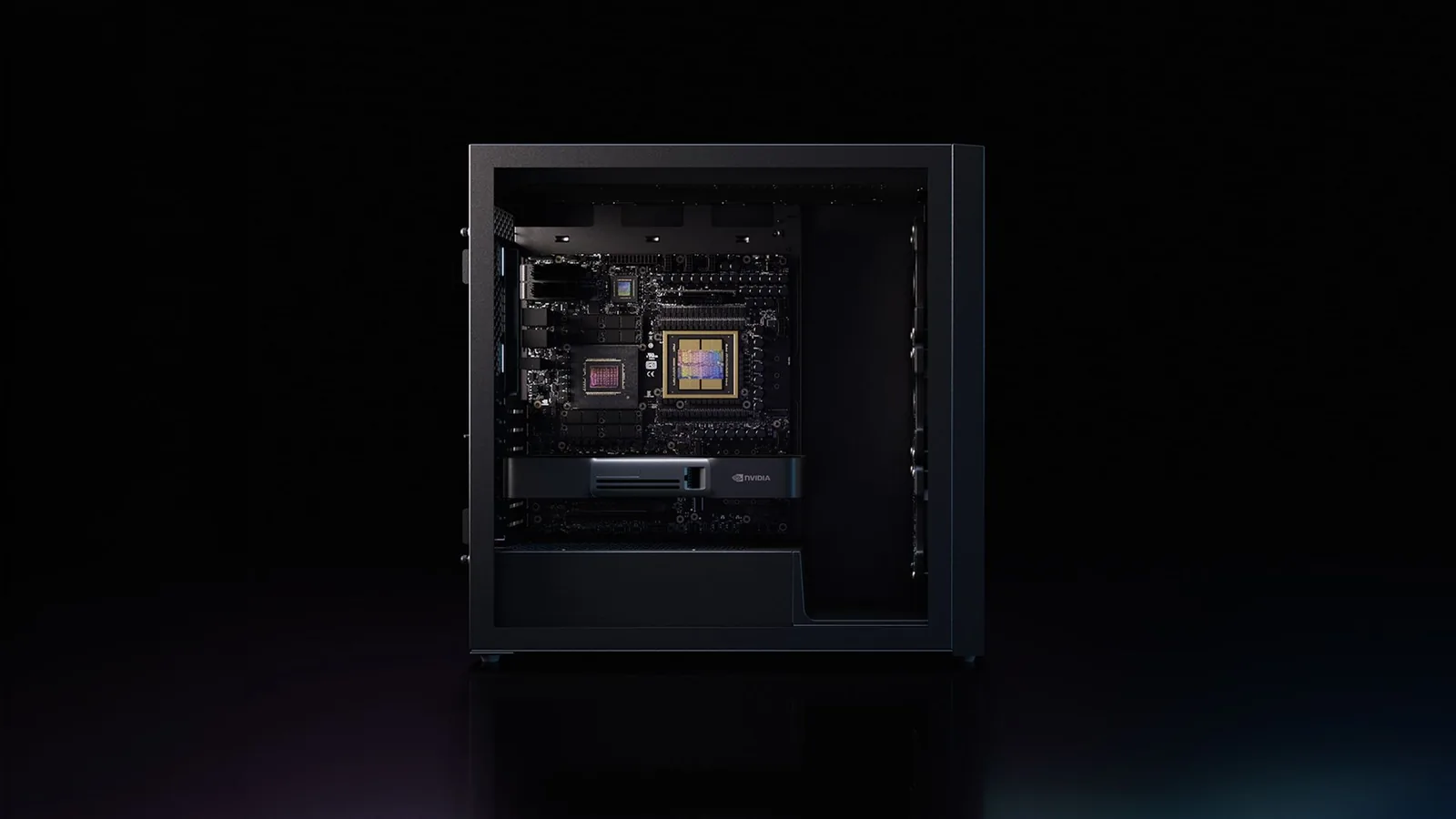
HP has officially launched its ZGX Fury GB300 workstation, a formidable new machine aimed at artificial intelligence developers and demanding professional users. Unveiled at Computex 2026, the workstation leverages Nvidia's cutting-edge GB300 Grace Blackwell Ultra Desktop Superchip, enabling it to process models with up to one trillion parameters. This high-performance system is slated for availability later in 2026.
The Computex expo, which concluded on June 7, 2026, was heavily dominated by discussions and showcases of artificial intelligence advancements, a stark contrast to just a few years prior. Nvidia's presence was significant, with parallel announcements made during its GTC 2026 event. Among its key reveals was the Nvidia DGX Station, a powerful deskside supercomputer engineered to deliver datacenter-level compute power locally, powered by the GB300 superchip and substantial memory configurations.
This new wave of AI hardware signifies a major leap in localized processing capabilities. Previously, handling models with such a high parameter count was exclusively the domain of large-scale datacenter infrastructure. Nvidia's new offerings, including the GB300 GPU and its associated systems like the DGX Station, are designed to bring this power directly to the user's workspace.
A New Era for Localized AI Processing
Chris Marriott, vice president of enterprise platforms at NVIDIA, emphasized the growing need for accessible AI infrastructure. "As enterprises scale AI agents across their organizations, they need AI infrastructure that can connect directly to the applications and workflows that power their business," Marriott stated. This sentiment highlights a shift towards integrating advanced AI capabilities directly into business operations, reducing reliance on distant cloud resources for complex tasks.
While HP has not yet disclosed the official price for the ZGX Fury GB300, industry analysts predict it will be substantial, aligning with Nvidia's own DGX Station pricing, which can range from tens of thousands to nearly $200,000 for higher-end configurations. This positions the ZGX Fury GB300 as a premium solution for enterprise clients who require the immense computational power for tasks such as trillion-parameter inference or fine-tuning large, multi-billion-parameter models. The ability to process data locally also offers enhanced security and reduced latency.
According to Jim Nottingham, SVP and Division President of Advanced Compute and Solutions at HP Inc., customer demand has been a driving force behind this development. "Over 70% of enterprise PCs run Windows, and our customers have asked for AI supercomputing power that can seamlessly integrate into their existing environments," Nottingham said. The ZGX Fury GB300 is engineered to meet this demand, offering up to 784GB of coherent memory and up to 20 petaflops of FP4 compute performance. It also includes specialized enterprise networking solutions tailored for AI workloads.
The HP ZGX Fury GB300 is expected to launch in the fourth quarter of 2026, coinciding with the release of Nvidia's DGX Station. HP is working alongside other partners, including Dell, MSI, ASUS, and Supermicro, to bring these powerful AI workstations to market. This collaboration underscores the industry-wide effort to democratize high-performance AI computing for professional applications.