
NASA's SkyFall Mars Helicopters to Feature Radar 'Capes' for Ice Hunting
NASA's upcoming SkyFall mission will deploy three small helicopters to Mars, each equipped with unique radar "capes" designed to detect subsurface water ice. These innovative flexible antennae will enable low-altitude surveys crucial for future human exploration.

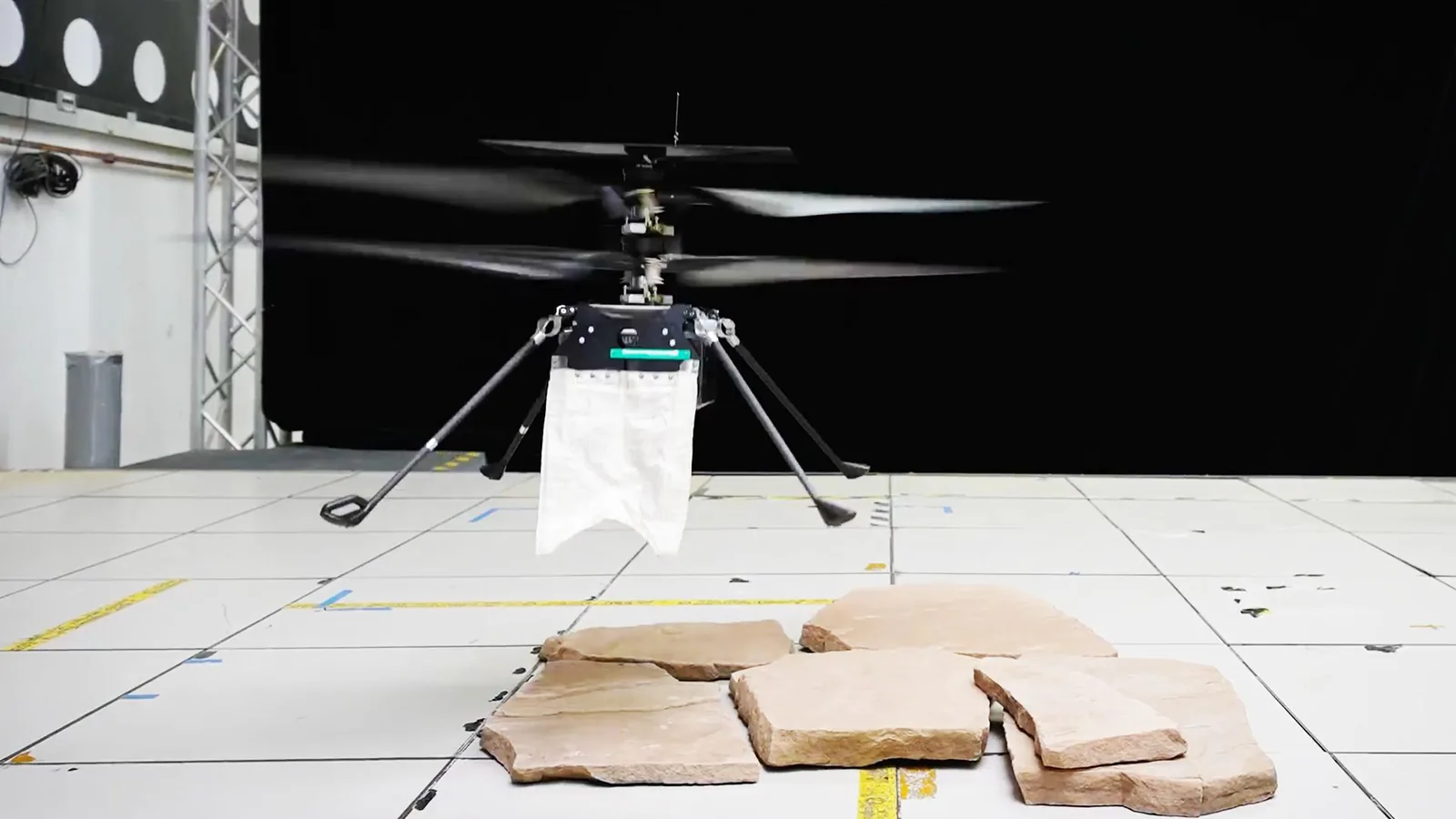
A trio of innovative rotorcraft, dubbed the SkyFall mission, is slated to launch with NASA's latest endeavor to explore Mars. These miniature helicopters will carry specialized ground-penetrating radar technology, cleverly disguised as tiny "capes," enabling them to search for vital water ice deposits hidden beneath the Red Planet's surface. The unique design was showcased in recent videos from NASA's Jet Propulsion Laboratory (JPL), where the drones were seen practicing landings with the distinctive fabric-like appendages.
These so-called capes are, in fact, highly flexible antennae essential for the craft's mission objective. "The only way to detect shallow subsurface ice remotely is to fly close to the ground," explained Adrian Tang, SkyFall’s ground-penetrating radar lead instrument scientist at JPL. "By flying low and slow, a SkyFall helicopter could capture radar images that resolve the fine layering where dry soil gives way to ice, detecting its presence and mapping its extent." This capability aims to overcome the limitations of orbiting spacecraft, which, despite decades of study, cannot image the crucial uppermost few feet of Martian regolith where ice is most likely to be found in accessible quantities.
Innovative Antenna Design for Martian Terrain
The SkyFall helicopters build upon the legacy of Ingenuity, the pioneering rotorcraft that proved powered flight was possible on Mars. While sharing a similar lightweight design, the SkyFall drones are engineered for a more ambitious scientific purpose. Their "capes" utilize a type of flexible antenna known as Vivaldi, originally invented in 1978, but miniaturized and adapted for the Martian environment. This radar system is designed to survey depths of up to 16 feet (5 meters) below the surface, potentially mapping ice concentrations in the planet's shallow subsurface layers. The antenna's flexible nature is critical, allowing it to bend and accommodate uneven terrain during landings without sustaining damage.
"Although we managed to shrink the antenna quite a bit, it is about 1.5 times longer than the helicopter’s legs," stated Christine Gebara, SkyFall ground-penetrating radar mechanical lead at JPL. "That means during landing, the Vivaldi has to bend out of the way — and if it lands on a rock, it bends even further." Ensuring durability for repeated use was paramount, as the SkyFall mission anticipates dozens of flights. The antenna needed to reliably spring back into its operational position after each landing, maintaining its integrity for continuous data collection. To achieve this resilience, engineers encased the antenna in layers of polyester and Vectran, a strong yet flexible material famously used in the airbags for NASA's Spirit and Opportunity rovers. Flexible fiberglass tape springs and a lightweight structural reinforcement further enhance its robustness. Each antenna weighs a mere 5 ounces (142 grams).
Rigorous testing was conducted at JPL's Environmental Test Laboratory to simulate the harsh Martian conditions. The rotorcraft and their radar antennae underwent extensive stress tests, including repeated flexing to mimic numerous landings, exposure to extreme temperatures, and continuous checks for signal transmission and reception functionality. The antenna successfully endured 200 simulated Mars landings, exceeding the mission's expected operational demands. "This test checked every box it was supposed to and answered our biggest technical questions," Tang confirmed. "While we still have work ahead of us before the antenna is fully flight-qualified, this was a major milestone, and the hardware performed exactly as expected." The data gathered by SkyFall's radar capes could prove invaluable for future human explorers, providing critical information about the safety and accessibility of subsurface resources like water ice, essential for sustaining life and operations on the Red Planet.