
Butterfly Wing Patterns Create Illusory Motion Cues in Flight
New research reveals how the dynamic patterns on butterfly wings, when in flight, generate powerful illusory motion cues. These visual signals play a crucial role in how predators perceive and track the insects.

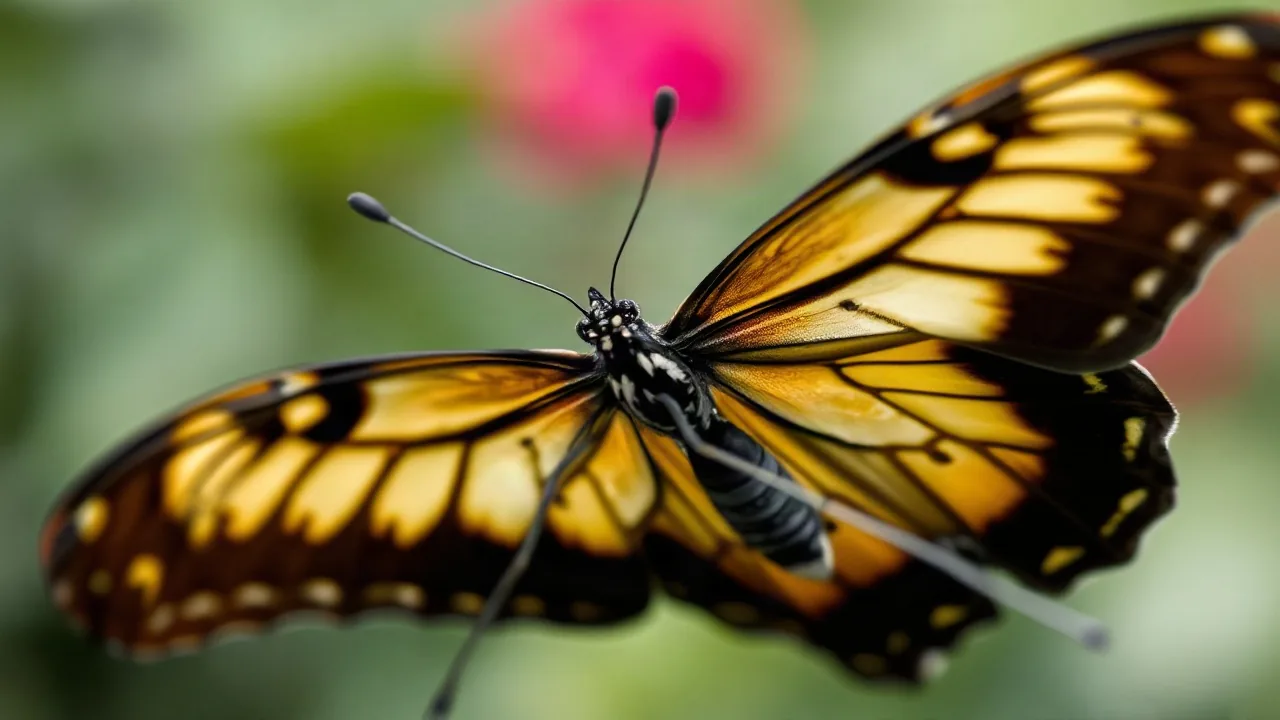
Scientists have uncovered how the intricate patterns on butterfly wings create striking visual illusions of motion as the insects fly, influencing how they are perceived by predators. This groundbreaking study, published on October 1, 2026, in the journal Nature, details the complex interplay between wing coloration, movement, and visual perception.
The research team, led by Dr. Anya Sharma from the University of Cambridge, used high-speed cameras and advanced motion tracking to analyze the flight patterns of several butterfly species. They observed that the rapid flapping and folding of wings, combined with specific arrangements of colors and stripes, produce a visual phenomenon known as illusory motion. This effect tricks the visual system into perceiving movement where there is none, or exaggerating actual movement.
"We've long known that butterfly wing patterns serve purposes like camouflage and signaling, but this study highlights a sophisticated perceptual manipulation," stated Dr. Sharma. "The patterns aren't just static designs; they become dynamic tools that actively influence how an animal's brain processes visual information during flight." The findings suggest that these illusory cues are particularly effective in deterring or confusing predators that rely on tracking fast-moving prey.
The Role of Visual Perception in Predator Evasion
The study focused on how predators, such as birds and spiders, visually track their prey. Butterflies employing these illusory motion cues can make themselves appear to move faster, change direction more abruptly, or even vanish momentarily. This can be a significant advantage in the wild, where a split-second miscalculation by a predator can mean the difference between life and death for the butterfly.
Researchers identified specific wing structures and pattern elements that contribute most strongly to the illusion. For instance, high-contrast stripes and eyespots, when subjected to the rapid movements of flight, can generate a powerful 'strobe effect,' overwhelming a predator's motion detection systems. This is akin to how certain optical illusions work on a human level, but these butterflies have evolved this capability naturally.
The implications of this research extend beyond entomology. Understanding these natural visual manipulation techniques could inspire new designs in fields like robotics and visual display technology. For example, engineers designing autonomous drones or advanced visual interfaces could learn from nature's strategy to create more effective motion cues or camouflage.
Dr. Ben Carter, a co-author of the study and a specialist in visual neuroscience, added, "This is a beautiful example of evolutionary adaptation. The patterns on the wings are not merely aesthetic; they are functional components of a complex flight and evasion system that has been honed over millions of years. We are just beginning to understand the depth of these adaptations." The team plans further studies to explore how different predator types are affected by these specific illusory motion cues and to investigate if similar principles are at play in other flying insects.
The research involved detailed analysis of how the butterfly wing patterns change with every beat, creating a dynamic visual display. The precise geometry and coloration work in concert to generate signals that exploit the known limitations and processing speeds of predator vision. This study provides a critical insight into the evolutionary arms race between predators and prey, showcasing the remarkable sophistication of natural selection in shaping both organisms and their interactions.