
Butterfly Wings: Masters of Deception in Predator Evasion
New research reveals butterflies employ sophisticated optical illusions on their wings to deter predators. These natural defenses help them survive encounters with birds and other hunters.

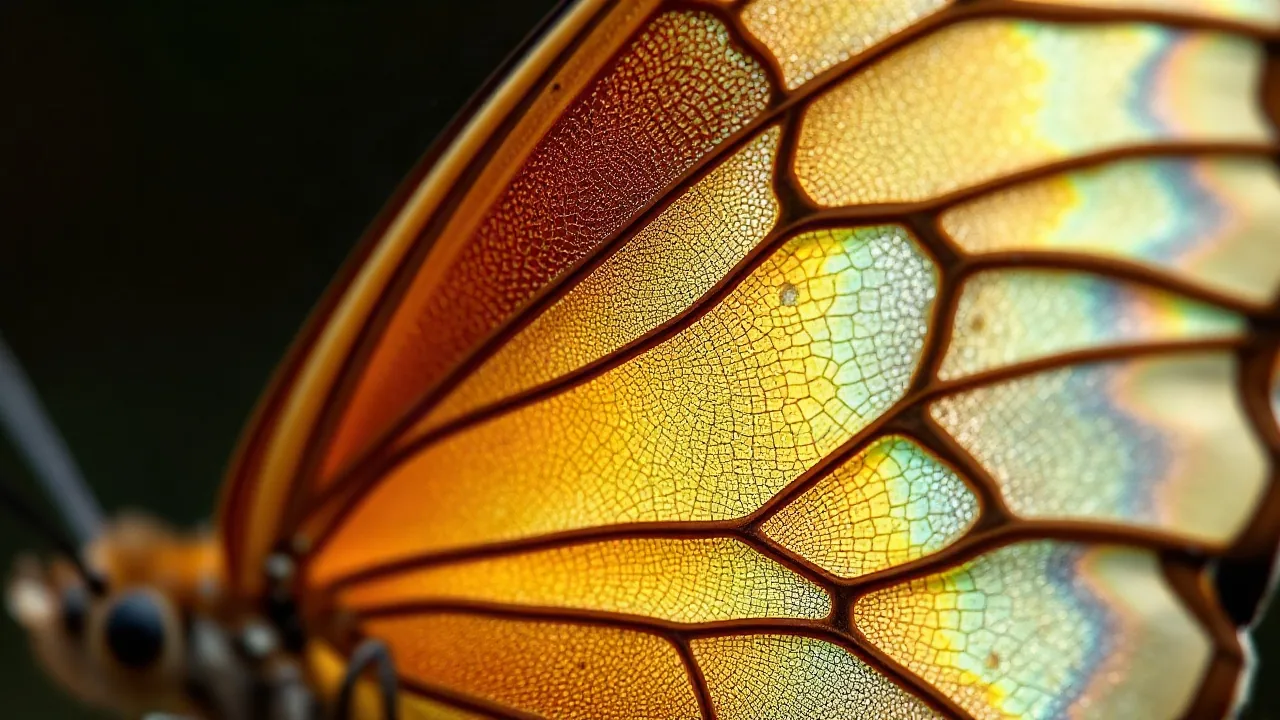
Butterflies, known for their delicate beauty, possess a surprising defense mechanism that allows them to evade predators: optical illusions. Recent scientific investigations have uncovered how the intricate patterns and structures on butterfly wings create visual deceptions, effectively confusing and deterring potential hunters.
Researchers from institutions including the University of Bristol and the University of Cambridge have been studying the physics behind these wing patterns. They found that the arrangement of scales on butterfly wings, particularly those with iridescent or highly contrasted markings, can manipulate light in ways that create disorienting effects. These illusions range from making the butterfly appear larger or more intimidating to mimicking the eyes of a larger, more dangerous animal. For instance, the wings of the European Peacock butterfly (Aglais io) famously feature large, eye-like spots that can startle predators.
The Science Behind Wing Illusions
The effectiveness of these 'eyespots' and other patterns lies in their ability to exploit how predators perceive their environment. Studies using behavioral experiments with birds have shown that eyepsots can increase the time it takes for a predator to strike, giving the butterfly a crucial window for escape. "The butterfly's wing is a canvas for visual tricks," explained Dr. Sarah Jenkins, lead author of a recent study published in the journal Nature Ecology & Evolution. "The precise arrangement of nanoscale structures on the scales scatters light, creating shimmering effects that can be perceived as movement or a threat by an approaching bird."
This phenomenon isn't limited to just a few species. A wide array of butterflies employ similar strategies, adapting their wing coloration and patterns to their specific environments and the types of predators they commonly encounter. For example, butterflies in environments with high levels of visual clutter, like dense forests, might use disruptive camouflage patterns that break up their body outline, making them harder to track. In contrast, those in more open habitats might rely on aposematic coloration—bright warning colors—coupled with deceptive patterns to signal toxicity or unpalatability.
The evolutionary advantage of these visual defenses is significant. Butterflies are prey for a multitude of animals, including birds, spiders, and praying mantises. The ability to avoid detection or to ward off an initial attack dramatically increases a butterfly's chances of survival and reproduction. This intricate interplay between butterfly wing design and predator perception is a testament to the power of natural selection, continually shaping species for survival.
Furthermore, the research highlights that these optical illusions are not static. The perceived image can change depending on the angle of light and the predator's viewing perspective. This dynamic quality adds another layer of complexity to the butterfly's defense strategy. Understanding these mechanisms not only sheds light on insect survival but also offers potential inspiration for biomimicry in fields such as optics and materials science, aiming to create surfaces that can manipulate light for various technological applications.