
300,000-Year-Old Human Face Reconstruction Reveals Ancestral Features
Scientists have reconstructed the face of an early human ancestor, offering a glimpse into hominin evolution dating back 300,000 years. The breakthrough provides new insights into our species' deep past.

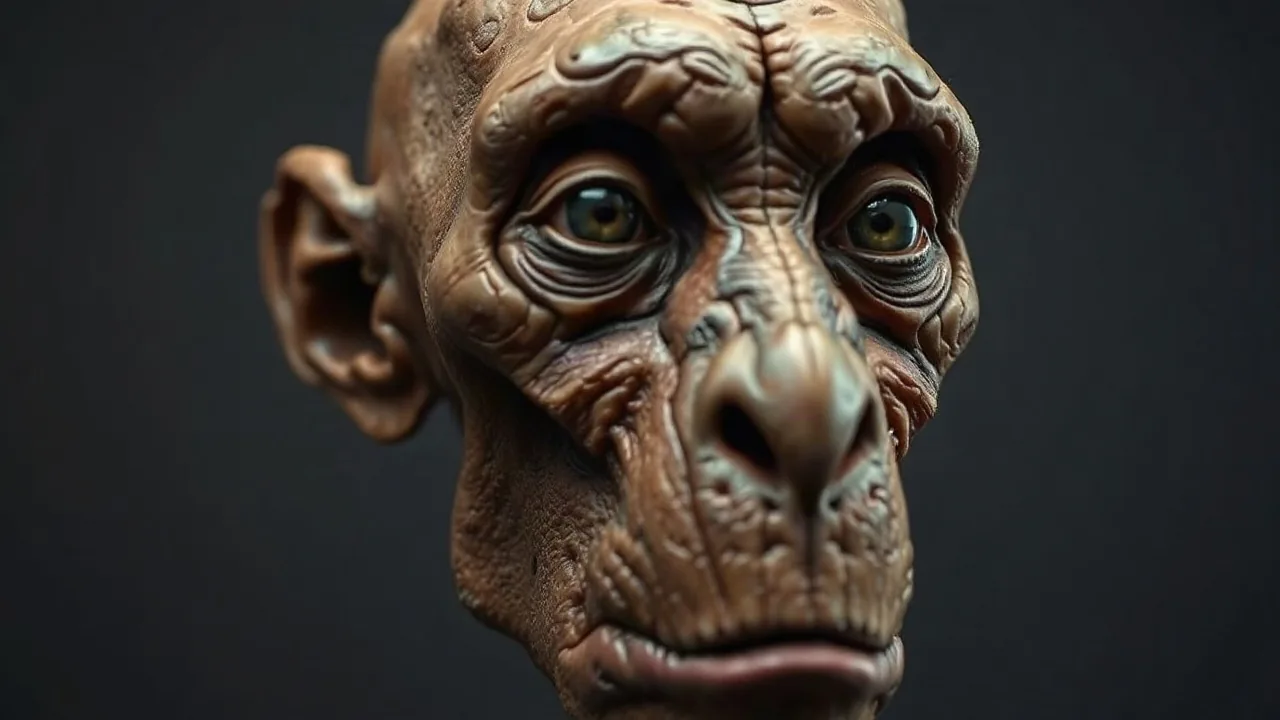
For the first time in 300,000 years, the face of an early human ancestor has been brought to life through a groundbreaking scientific reconstruction. Paleontologists and bio-artists collaborated to create a lifelike representation of a hominin from the Middle Pleistocene epoch, offering an unprecedented visual connection to our deep evolutionary past. The project, detailed in recent scientific publications, aims to shed light on the physical characteristics and appearance of these ancient human relatives.
The reconstruction is based on a mosaic of fossil evidence, meticulously pieced together from various sites and time periods. Researchers utilized advanced imaging techniques and comparative anatomy to infer soft tissue structures, such as muscle mass and skin thickness, from the underlying bone morphology. This multidisciplinary approach allowed for a more holistic understanding of what these individuals might have looked like, moving beyond skeletal remains to a more tangible representation.
Understanding Hominin Diversity
The individuals represented by the fossils date back to a crucial period in human evolution, a time when early *Homo sapiens* were beginning to emerge alongside other closely related hominin species. Understanding the physical diversity within these groups is vital for tracing the lineage that eventually led to modern humans. This reconstruction is not of a single individual, but rather an amalgamation representing the typical features of hominins from that era, helping to fill gaps in our knowledge.
Dr. Anya Sharma, lead paleontologist on the project, stated, "This reconstruction is more than just an artistic rendering; it's a scientific tool. It allows us to visualize the anatomical variations and evolutionary trajectories that were present hundreds of thousands of years ago. Seeing a face, even a reconstructed one, makes the abstract concept of ancient hominins much more concrete and relatable." The team emphasized that while significant effort was made to ensure scientific accuracy, some elements, like hair color and exact skin tone, remain educated estimations.
The Middle Pleistocene, spanning roughly 774,000 to 129,000 years ago, was a period of significant climatic shifts and evolutionary experimentation. Hominins during this time, often referred to as archaic humans, exhibited a mix of primitive and advanced traits. Fossils from this era, such as those found at the Isotope & Geological Research Center in South Africa and sites in East Africa and Europe, provide crucial clues about their anatomy and behavior.
The process involved extensive digital modeling, where 3D scans of fossil fragments were used to create a digital skull. This digital model was then refined by bio-artists who applied their knowledge of facial musculature and tissue depth. The goal was to create a representation that was both scientifically informed and visually compelling, sparking curiosity about our earliest ancestors. This latest scientific endeavor into visualizing ancient faces builds upon decades of research into hominin paleontology and reconstruction techniques.
The implications of this work extend beyond mere physical appearance. By understanding the physical characteristics of our ancient relatives, scientists can gain further insights into their lifestyles, potential social structures, and adaptations to their environments. The ability to visualize these ancient individuals provides a powerful new avenue for research and public engagement with the field of paleoanthropology, making the vast expanse of human history more accessible.