
SpaceX Rocket Upper Stage Leaves New Crater on Moon
A SpaceX Falcon 9 rocket's upper stage has impacted the moon, creating a new crater. South Korea's Danuri orbiter captured early images of the aftermath, while NASA's Lunar Reconnaissance Orbiter also searches for the site.

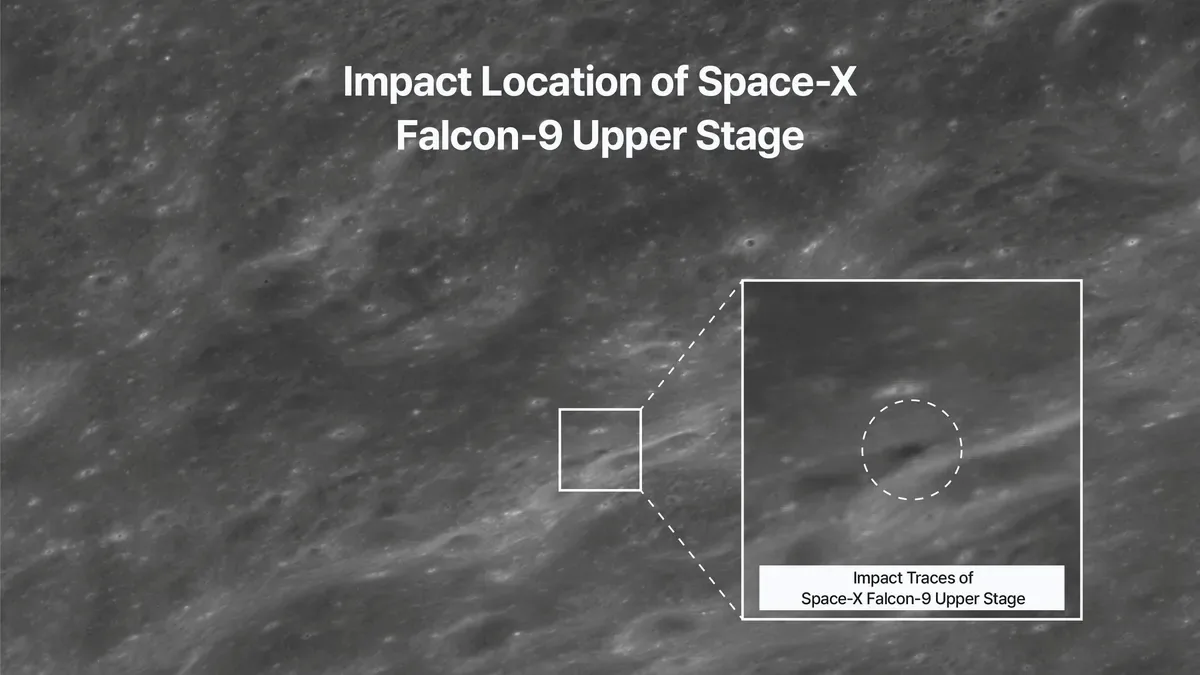
The upper stage of a SpaceX Falcon 9 rocket, weighing approximately 8,800 pounds, collided with the lunar surface on August 5, 2026, astronomers confirmed. The impact occurred near the Einstein crater, leaving behind a newly formed crater. South Korea's lunar orbiter, Danuri, operated by the Korea Aerospace Research Institute (KARI), has provided some of the first images documenting the event and its consequences.
The specific piece of hardware that struck the moon was the rocket's second stage, which had been used in a January 2025 launch to propel Firefly Aerospace's uncrewed commercial lunar lander. After exhausting its fuel, the stage entered a state of 'orbital limbo,' according to SpaceX, rather than returning to Earth. This trajectory was a result of the thrust required to send the lunar lander on its mission. Independent astronomer Bill Gray, using data from the software Project Pluto, was among the first to calculate and predict the precise impact using ground-based telescope observations, designating the object as 2025-010D.
Lunar Orbiter Captures Aftermath
The Korea Pathfinder Lunar Orbiter, known as Danuri, initiated observations around 30 minutes before the predicted impact and continued monitoring the site afterward. KARI reported conducting "a total of 8 imaging sessions" and confirmed that "changes in the terrain around the impact site and traces of ejecta spread were confirmed." The orbiter captured before-and-after imagery, revealing the substantial crater left by the collision, which was estimated to be about 60 feet wide and 12 feet deep.
While Danuri provided early visual evidence, NASA is also actively searching for the impact site using its Lunar Reconnaissance Orbiter (LRO), which has been in lunar orbit since 2009. However, locating the precise location presents challenges, as it depends on factors such as "lighting, orbital timing and spacecraft position," according to a NASA press release. The space agency stated that it might take "several days to receive imagery" if any is captured. "Any data collected will help scientists better understand artificial impacts and their exploration implications," NASA added.
The Falcon 9, manufactured by Elon Musk's SpaceX, is a workhorse in the global launch industry. This two-stage rocket, standing 230 feet tall, is capable of carrying significant payloads to low-Earth orbit and is also used to transport astronauts to the International Space Station via SpaceX's Dragon capsule. Typically, the first stage of a Falcon 9 separates and returns to Earth for recovery and reuse, while the upper stage's fate varies depending on the mission's requirements.
SpaceX has emphasized its commitment to responsible space hardware disposal. In a statement on X, the company noted, "We actively work to be as responsible as possible with hardware left in space to ensure space safety, including for more complex missions." Regarding this specific incident, SpaceX stated, "Impacts like this are rare, but they can happen with objects in these types of orbits, and we worked with NASA on the optimal disposal solution." The company also referenced its Starship program, highlighting that its second stage is designed for reusability, aiming to further reduce human-made debris in orbit.
This is not the first instance of a spacecraft impacting the moon. In 2022, Bill Gray tracked a similar event involving a Chinese rocket's upper stage. NASA itself has intentionally impacted spacecraft on the moon, such as in 2009, when two spacecraft were crashed to search for evidence of water ice near the lunar south pole. NASA Administrator Jared Isaacman commented on the recent event, noting that such occurrences have a long history, dating back to the Apollo era when NASA intentionally crashed spent stages for scientific research, including seismic studies.