
Space Elevator Breakthrough: Graphene Cable Moves Cosmic Project Closer
Scientists are reporting a significant breakthrough in material science that could pave the way for constructing a space elevator. Polycrystalline graphene offers the strength and scalability needed for a 66,000-mile tether to orbit.

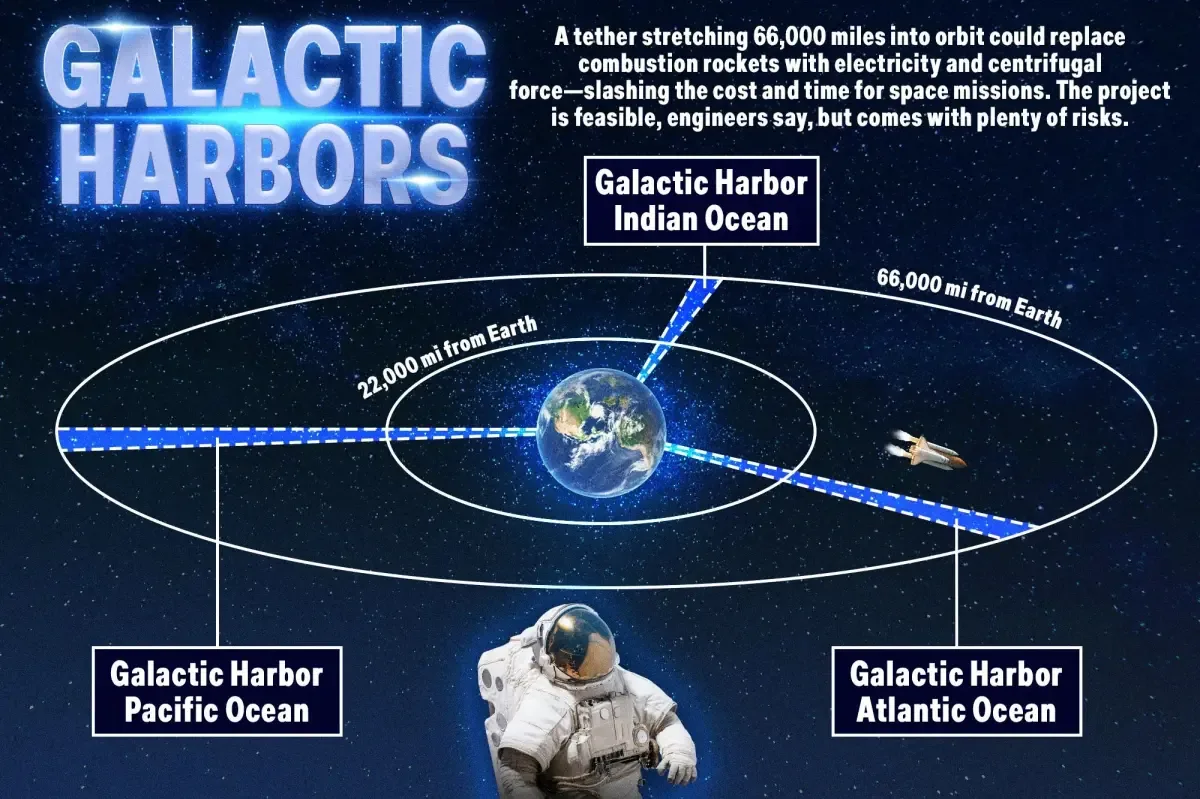
Researchers are reporting a pivotal advancement in material science that brings the long-imagined concept of a space elevator closer to reality. The International Space Elevator Consortium (ISEC) announced a promising candidate material, polycrystalline graphene, which could form the backbone of a 66,000-mile cable stretching from Earth's equator into orbit. This breakthrough addresses the primary obstacle that has historically stalled development of such ambitious infrastructure.
Pete Swan, president of ISEC, described the space elevator as a "bridge to space," offering a cleaner, cheaper, and safer alternative to conventional rocket technology. "The beauty is that raising it with electricity saves our atmosphere from pollution, it doesn’t leave any debris along the way and it will be routine, daily, inexpensive, safe," Swan said. "It’s gonna be a bridge to space." Unlike rockets that rely on volatile chemical propellants, a space elevator would utilize electricity to ascend a tether, significantly reducing the environmental impact and cost of space access.
The concept involves an ultra-strong, electrified cable anchored at Earth's equator and extending beyond geostationary orbit (GEO). A counterweight in space would keep the tether taut, allowing vessels, dubbed "climbers," to ascend. Polycrystalline graphene, a two-dimensional material known for its exceptional strength and light weight, is now considered the most viable option for constructing this colossal tether. Researchers noted its widespread use in consumer electronics, and specifically highlighted that its strength is such that a single layer can stop a bullet.
Advancements in Graphene Manufacturing
Historically, the primary hurdle for the space elevator has been the lack of a suitable tether material. It requires a substance that is scalable, over 100 times stronger than steel, exceptionally lightweight, and can be efficiently spooled. Scientists believe they have found this in polycrystalline graphene. "It looks like we found the material," Swan stated. "We’re a heck of a lot further along than we were six months ago." He explained that technological progress often involves "huge jumps in capability" driven by specific discoveries, which is precisely what is happening in the realm of tether materials.
Engineers in South Korea have already demonstrated the manufacturability of polycrystalline graphene molecules, producing a 1,000-meter long, half-meter wide structure at a rate of approximately two meters per minute. Each strand of the space elevator tether would ideally be a single molecule, one atom thick and one meter wide, extending the 100,000 kilometers required. A full tether would consist of 20,000 stacked sheets of this material.
The potential benefits of a space elevator are profound. The journey to geostationary orbit, approximately 22,000 miles above Earth, would take about two weeks. Beyond GEO, centrifugal force would propel climbers into deep space without further energy input. This would drastically cut travel times to destinations like the Moon, potentially reducing a journey that currently takes three days to mere hours. Trips to Mars could be shortened from the current seven months to between 61 and 120 days, enabling routine launches rather than waiting for specific launch windows.
Despite the optimism, challenges remain. Space debris in low Earth orbit poses a significant risk to the tether, prompting proposals for multiple redundant tethers and dedicated "no-fly zones" for satellites. Furthermore, securing the substantial funding for such a monumental undertaking is a major obstacle. Armen Papazian, a space economics professor at the American University in Dubai, cautioned that even if construction began immediately, it would likely take one to two decades to complete, assuming smooth progress. The International Space Elevator Consortium estimates the initial cost at $15 billion, a fraction of the projected $200 billion for NASA's Artemis program by 2030.
If realized, a space elevator could revolutionize space logistics, capable of delivering an estimated 30,000 metric tons of cargo annually, far exceeding the total mass of all objects sent into space since 1957. ISEC envisions the first decade focused on cargo transport, with human missions and return cargo capabilities following within 15 to 20 years. This vision represents a fundamental shift from the current reliance on the "tyranny" of the rocket equation, which necessitates rockets being predominantly fuel.