
Russian Cosmonauts Install Sun Telescope During 6-Hour ISS Spacewalk
Two Russian cosmonauts completed a six-hour spacewalk outside the International Space Station to install a new telescope designed to study solar flares and retrieve science experiments.

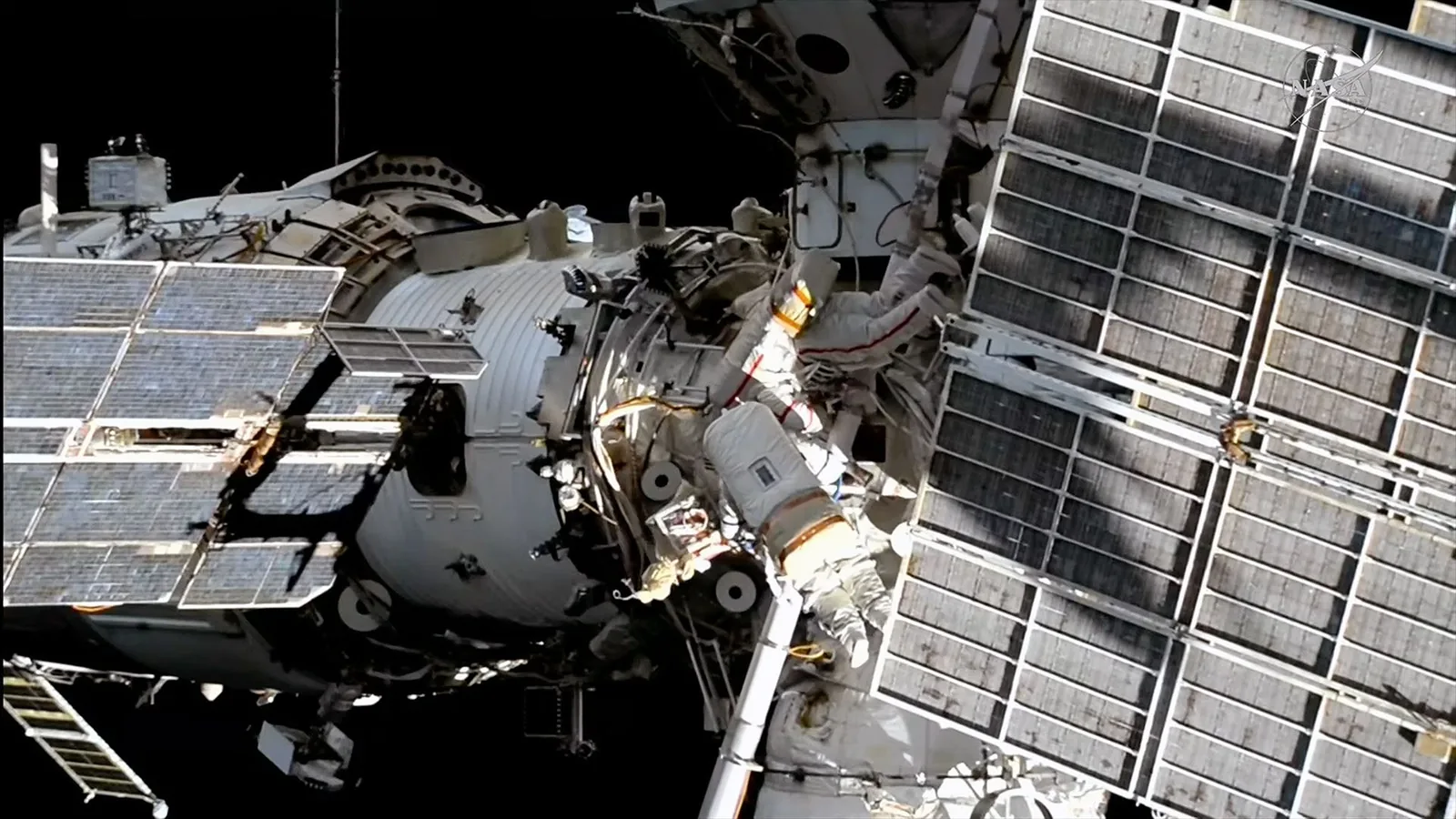
Two Russian cosmonauts successfully completed a six-hour spacewalk outside the International Space Station on Wednesday, May 27, 2026, installing a new telescope aimed at studying solar activity and retrieving vital science experiments. Commander Sergey Kud-Sverchkov and flight engineer Sergei Mikaev spent 6 hours and 5 minutes conducting the extravehicular activity (EVA), which began at 10:18 a.m. EDT.
The primary objective of the spacewalk was the installation of the Solntse-Teragerts telescope onto the exterior of the Zvezda service module. This advanced instrument is designed to observe and gather data on intense solar flares, crucial for improving scientific prediction models and understanding solar activity across various frequencies. The telescope is expected to operate until 2028, providing valuable insights into the sun's behavior.
In addition to the new telescope, the cosmonauts retrieved science hardware from the Poisk and Nauka modules. They utilized the European Robotic Arm (ERA), a 40-foot remote manipulator, to collect a cassette containing semiconducting material from the Ekran-M molecular beam epitaxy (MBE) experiment. This experiment, which uses gallium arsenide to create ultra-pure thin films in microgravity, encountered some challenges during retrieval. The cosmonauts faced difficulties, including the temporary loss of tools and issues with ground commands controlling the experiment's internal mechanisms. Despite these hurdles, they managed to secure the sample for return to the station.
Ongoing Research and Historic Milestones
The spacewalk also served as a moment to commemorate the 80th anniversary of RKK (RSC) Energia, the Roscosmos design bureau founded in August 1946. Kud-Sverchkov and Mikaev paused their work to hold up a commemorative logo card and pose for photographs, acknowledging the significant history of space exploration contributions by the organization. During their excursion, the cosmonauts also noted the city of St. Petersburg's birthday.
Further tasks included inspecting and securing one of the Kurs rendezvous antennas on the Progress MS-33 cargo spacecraft. This antenna had failed to deploy upon the vehicle's March launch, necessitating a manually controlled docking. The cosmonauts also retrieved a Biorisk science container, which held samples of bacteria, seeds, and other biological organisms. Before concluding their EVA, they jettisoned a bundle of used window cleaning materials.
This spacewalk marked the second for Kud-Sverchkov, who has now accumulated 12 hours and 11 minutes of experience working in space, and the first for Mikaev. All planned activities were successfully accomplished, underscoring the meticulous planning and execution involved in ISS operations. Such EVAs are critical for maintaining and upgrading the station, conducting experiments that require the unique environment of space, and advancing our understanding of both Earth and the cosmos.