
Perseverance Rover Captures New Mars 'Selfie' from Jezero Crater
NASA's Perseverance rover has sent a new self-portrait back to Earth. The composite image, taken from the "Lac de Charmes" location in Jezero Crater, showcases the rover and its surroundings on Mars.

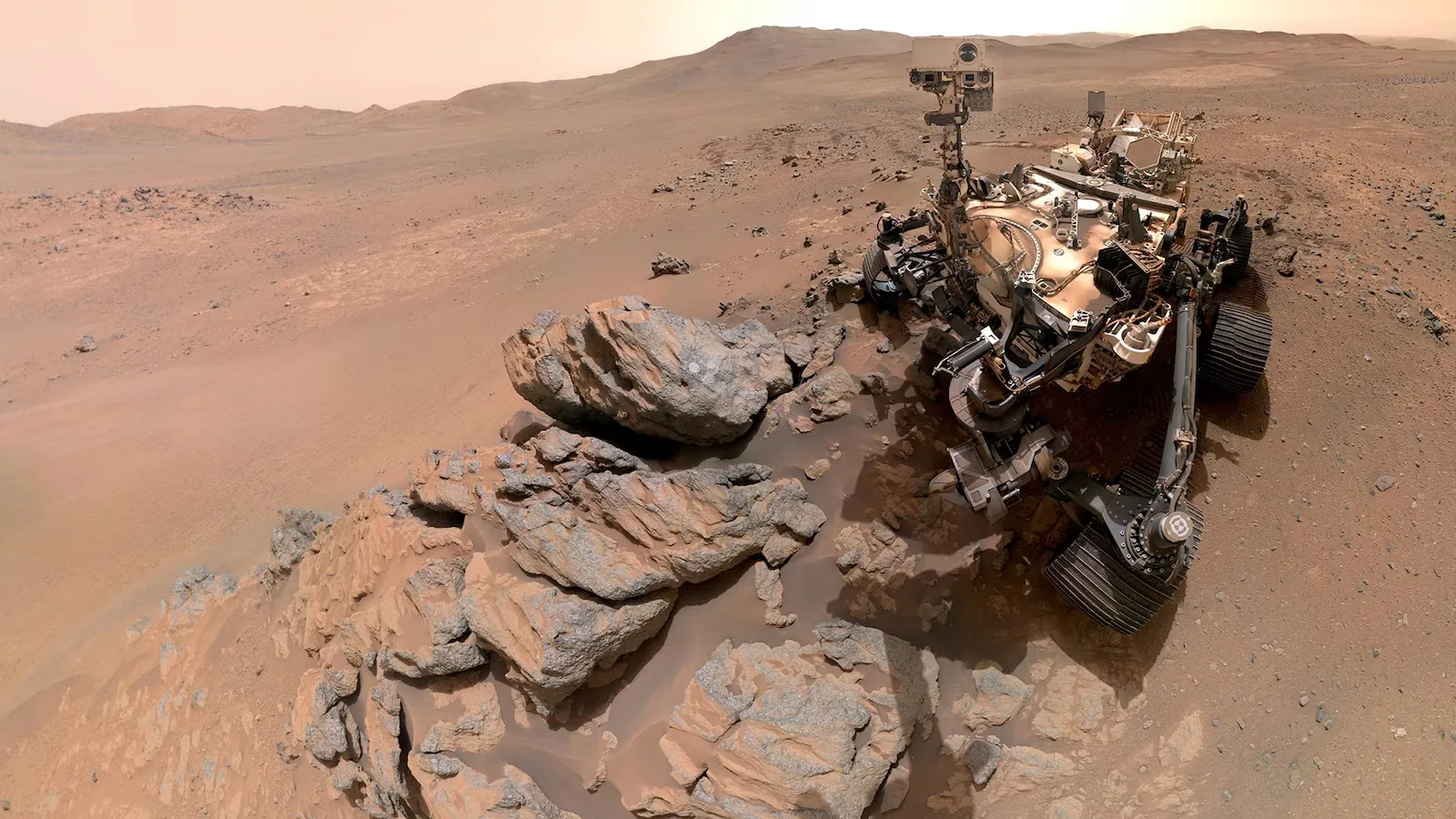
NASA's Mars Perseverance rover has transmitted a striking self-portrait to Earth, offering a new glimpse of the Red Planet. The space agency unveiled the latest snapshot on Tuesday, revealing the rover at a site dubbed "Lac de Charmes." This intricate image is a composite of 61 individual photographs, meticulously assembled by the rover's science team.
The "selfie" depicts Perseverance with its mast trained on a rocky outcrop. In the foreground, the rover has prepared the surface by creating a circular abrasion patch, a process designed to expose the rock's interior for analysis. The western edge of the vast Jezero Crater stretches out behind the rover, providing a sweeping panorama.
"During abrading, the rover grinds down a portion of the rock's surface, allowing the science team to analyze what's inside," NASA explained in a statement. This particular photograph was captured on Monday, March 11, during the rover's most extensive westward excursion beyond the crater's confines. Perseverance, which landed on Mars on February 18, 2021, is approaching its 1,800th Martian day of operations.
Analyzing Martian Geology
This marks the sixth "selfie" taken by the Perseverance rover since its arrival. The sophisticated image was acquired using the WATSON (Wide Angle Topographic Sensor for Operations and eNgineering) camera, which is mounted on the end of the rover's robotic arm. To construct the detailed composite, the arm performed 62 precise movements over the course of approximately one hour. This capability allows scientists to gain close-up views of the Martian surface, aiding in the search for signs of ancient microbial life.
The rover's mission is to explore the Jezero Crater, a region believed to have once hosted a lake and river delta. Scientists are particularly interested in analyzing rock and soil samples for evidence of past habitability. The abrasion technique used to create the selfie spot is crucial for this scientific investigation, enabling instruments to study the composition of the rocks without contamination from the surface dust.
Perseverance has been instrumental in gathering data that contributes to our understanding of Mars' geological history and potential for supporting life. The rover carries a suite of advanced scientific instruments, including cameras, spectrometers, and drills, all designed to conduct in-depth analyses. The data collected by NASA is crucial for planning future human missions to the planet.
The ability of the rover to capture such detailed self-portraits not only serves scientific purposes but also provides compelling visual narratives of its exploration. These images help the public connect with the ongoing efforts of robotic exploration on other worlds. The rover's ongoing mission continues to push the boundaries of our knowledge about the Red Planet, with each new image and data point adding to the comprehensive picture of Mars.