
Perseverance Rover Sets New Mars Driving Record for NASA
NASA's Perseverance rover has shattered the record for the longest distance driven by a spacecraft off Earth. The rover continues its mission exploring Mars' Jezero Crater.

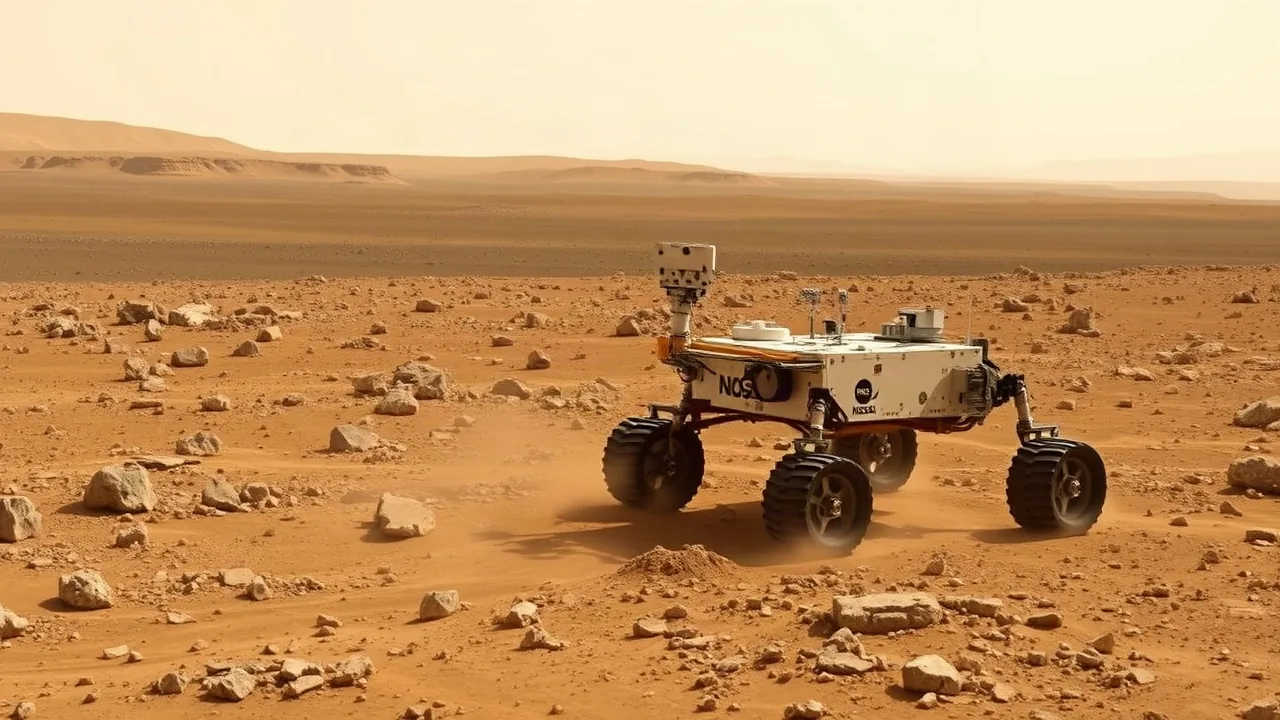
NASA's Perseverance rover has officially set a new interplanetary driving record, marking a significant milestone in its ongoing exploration of Mars. The six-wheeled robot, currently traversing the Jezero Crater, has surpassed all previous off-world distance achievements by any robotic vehicle launched from Earth. This record-breaking drive underscores the rover's resilience and the ambitious scope of its mission.
The rover's journey on the Martian surface has accumulated a substantial distance, extending its exploration capabilities far beyond initial expectations. While the exact mileage is continuously increasing, the rover has now surpassed the previous interplanetary driving record held by a lunar rover. This achievement is a testament to the engineering and operational planning that have allowed Perseverance to cover such vast terrain.
Continuous Exploration and Future Goals
Perseverance's mission, which began with its landing in Jezero Crater on February 18, 2021, was initially designed with specific scientific objectives and a projected operational lifespan. However, the rover's robust design and the strategic navigation employed by the team at NASA's Jet Propulsion Laboratory (JPL) have enabled it to far exceed these initial parameters. The rover is actively collecting geological samples and searching for signs of ancient microbial life, a primary goal of the Mars 2020 mission.
Scientists are particularly interested in the geological diversity of Jezero Crater, which is believed to have once hosted a lake and river delta. Perseverance's ability to cover more ground allows for a broader sampling strategy, potentially leading to more significant discoveries. The data collected by the rover is crucial for understanding Mars' past habitability and informing future human missions to the Red Planet.
The previous interplanetary driving record was held by China's Yutu lunar rover, which covered over 10.9 kilometers (6.8 miles) on the Moon. Perseverance has now far surpassed this figure, demonstrating advanced mobility and endurance on a planetary body. This new record is not just a number; it represents the accumulated scientific data gathered from diverse locations, enhancing our understanding of Martian geology and atmospheric conditions.
The NASA team is meticulously planning the rover's routes to maximize scientific return while ensuring its longevity. This involves navigating challenging Martian terrains, including rocky fields and sandy patches, which require precise control and advanced autonomous capabilities. The continued success of Perseverance highlights the cutting-edge technology deployed in robotic exploration and the dedication of the engineers and scientists managing its mission.
Looking ahead, Perseverance is far from concluding its exploration. The rover is equipped with sophisticated instruments, including cameras, spectrometers, and a drill, to analyze rocks and soil. Its mission is set to continue for the foreseeable future, with plans to explore additional geological features within Jezero Crater and potentially beyond, further solidifying its status as a record-breaking explorer.