
Jurassic Bird Fossil Challenges Flight Evolution Theories
A newly discovered Jurassic bird fossil in China with unusually small wings is prompting scientists to reconsider the evolutionary path of early birds. The find suggests not all ancient avian relatives pursued enhanced flight.

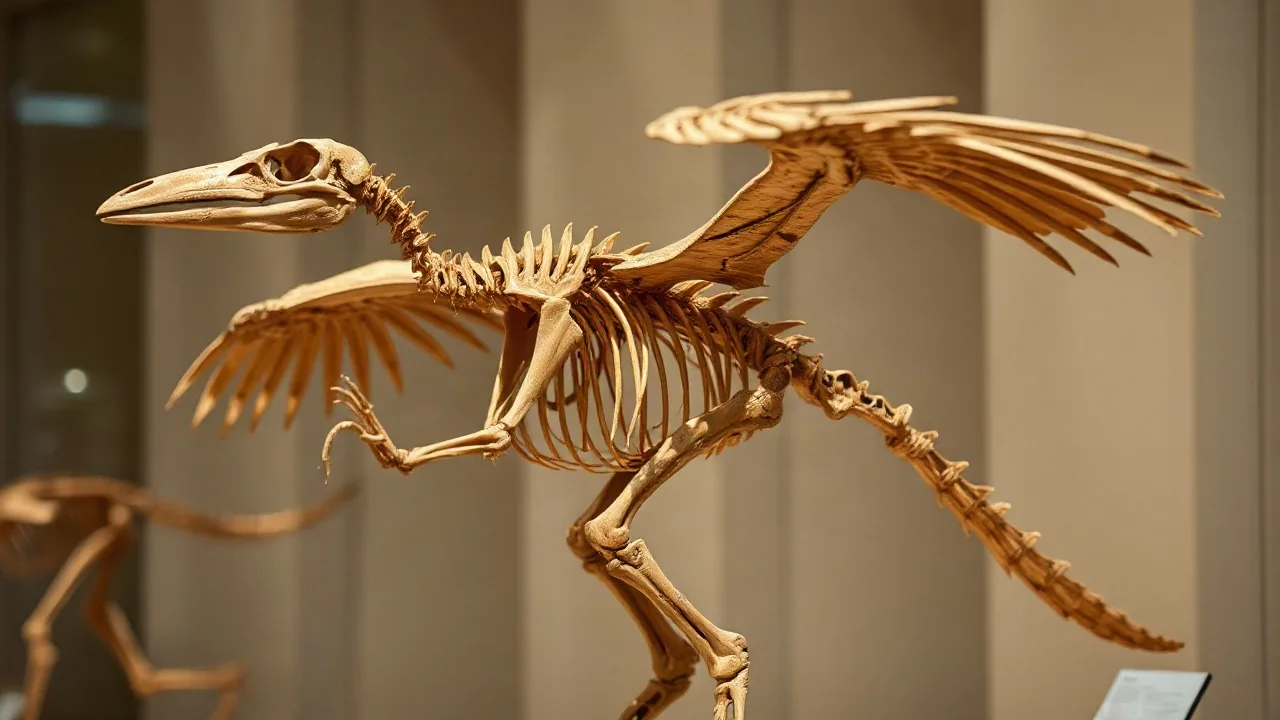
Paleontologists in China have unearthed the fossilized remains of a remarkable ancient bird from the Jurassic period, dating back approximately 160 million years. This discovery, detailed in the journal Nature, features an avialan with significantly undersized wings, challenging long-held assumptions about the primary evolutionary drivers of early bird species. The specimen, found in the Tiaojishan Formation of northeastern China, indicates that ecological diversity among early birds may have been greater than previously understood, with some lineages diverging from the path toward enhanced flight.
The bird, tentatively named Fukuiraptor auratus, was a small, predatory creature that likely spent its time foraging on the ground rather than soaring through the skies. Its wing structure is described as rudimentary, suggesting limited aerodynamic capability. This contrasts sharply with other well-known Jurassic avialans like Archaeopteryx, which displayed more developed wings, albeit still primitive compared to modern birds. The implications of this find suggest that the evolution of flight in birds was not a singular, linear progression but a more complex process with multiple experimental pathways.
Shifting Understanding of Avian Ancestry
For decades, the prevailing scientific narrative has been that early birds and their immediate ancestors were primarily driven to evolve larger, more functional wings as a means of escaping predators, finding food, or navigating their environment. This new fossil, however, suggests a more nuanced picture. Dr. Li Wei, lead paleontologist on the excavation, stated, "This discovery forces us to rethink what was considered 'typical' for an early bird. It points to a period of significant experimentation in form and function within the avialan lineage." The existence of ground-dwelling avialans like Fukuiraptor implies that adaptations for terrestrial life were as significant for some early birds as adaptations for flight were for others.
The Tiaojishan Formation is renowned for its exceptionally well-preserved fossils, offering a unique window into the ancient ecosystem of the late Jurassic. This particular fossil was found embedded in fine-grained volcanic ash, which contributed to its remarkable state of preservation. Researchers were able to study not only the skeletal structure but also some faint impressions of soft tissues, further aiding in the interpretation of the bird's lifestyle and physical capabilities. The discovery contributes to a growing body of evidence suggesting that the transition from non-avian dinosaurs to modern birds was not a simple, unidirectional process.
The significance of this fossil extends beyond avian evolution. It provides crucial data points for understanding the broader diversification of theropod dinosaurs and the development of distinct ecological niches during the Jurassic period. The presence of both flying and potentially flightless or ground-dwelling avialans within the same geological strata underscores the complex tapestry of life that existed millions of years ago. It also raises new questions about the selective pressures that favored different evolutionary trajectories.
Further research will focus on comparative anatomy, examining the limb proportions and skeletal structure of Fukuiraptor in relation to other known Jurassic birds and their dinosaur relatives. Scientists hope to determine its precise phylogenetic position and infer more about its diet and predatory behavior. The avian evolution narrative is clearly still being written, with each new discovery adding crucial chapters to our understanding of life's ancient past.