
NASA SpaceX Crew 13 Launch Sends Four Astronauts to ISS
Four astronauts lifted off aboard a SpaceX Dragon capsule on October 2, 2026, beginning their multi-month mission to the International Space Station. The Crew-13 flight marks the 13th operational crew rotation for NASA's Commercial Crew Program.

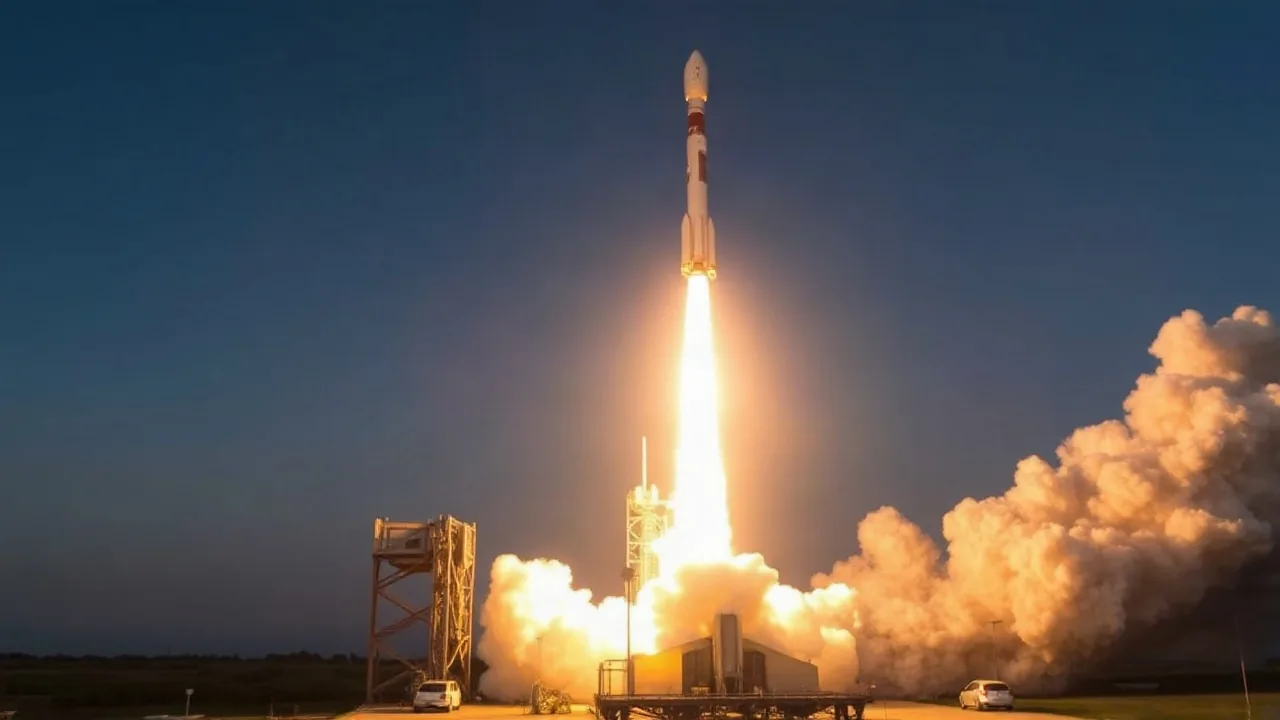
A SpaceX Falcon 9 rocket carrying four astronauts lifted off from Kennedy Space Center on October 2, 2026, at 10:17 a.m. EDT, marking the 13th crewed mission under NASA's partnership with the commercial spaceflight company. The four crew members are bound for the International Space Station, where they will relieve the Crew-12 astronauts and conduct approximately six months of scientific research and station maintenance operations.
The crew aboard Dragon capsule "Freedom" includes Commander Andrea Dawe, Pilot Nicholas Hague, Mission Specialists Sophia Santos, and European Space Agency astronomer Klaus Richter. Mission Control confirmed all systems nominal during the nine-minute ascent, with the Dragon capsule reaching orbital velocity and beginning its chase toward the space station.
"Today's launch represents the continued success of commercial spaceflight and NASA's trust in SpaceX to safely carry our astronauts," said NASA Administrator Bill Nelson during post-launch remarks from Kennedy Space Center. The statement underscores the agency's reliance on commercial partners for crew transportation, a shift from the Space Shuttle era that concluded in 2011.
Journey to Orbit and Docking
The Dragon capsule is scheduled to rendezvous with the ISS approximately 24 hours after launch, following an automated approach and docking sequence tested on previous missions. The spacecraft will dock to the forward-facing port of the station's Harmony module, a standard berthing location used by all Crew Dragon missions.
Prior to final approach, Dragon's sensors and guidance systems will perform multiple checkpoints to ensure the capsule is properly aligned and traveling at safe relative velocity. This procedure, refined over 12 previous Crew missions since 2020, has proven reliable and efficient.
Once docked, Crew-13 will conduct a standard crew handover with Crew-12, involving briefings on station status, emergency procedures, and ongoing experiments. The two crews will overlap for approximately one week before Crew-12 returns to Earth aboard their own Dragon capsule.
Six-Month Mission Focus and Scientific Priorities
During their stay, the Crew-13 astronauts will maintain ISS mission operations and support multiple scientific investigations in microgravity. Priority research areas include protein crystal growth studies for pharmaceutical development, materials science experiments, and technology demonstrations funded by both NASA and international partners.
Commander Dawe and her crew will also oversee routine station maintenance, including thermal radiator inspections and software updates to the station's guidance systems. SpaceX launches are typically scheduled roughly every six months to maintain continuous human presence on the orbiting laboratory, which has been continuously crewed since November 2000.
Mission specialist Santos will lead payload operations for the European payload rack, while Richter will conduct atmospheric composition studies using external instruments mounted on the station's exterior. Both investigations tie directly to climate monitoring and Earth science objectives outlined in NASA's 2026 research agenda.
"Our crew is prepared for the full spectrum of station activities, from routine maintenance to complex science operations," said Lead Capcom James Morrison at Johnson Space Center during final pre-launch briefings. Morrison, a former SpaceX launch director, has overseen crew training for the past 18 months.
Commercial Crew Program Track Record
The Crew-13 mission continues an unbroken string of successful crewed SpaceX Crew 13 and Dragon flights dating to May 2020, when SpaceX first demonstrated it could safely carry astronauts to orbit. The Commercial Crew Program, a public-private partnership between NASA and SpaceX (with backup support from Boeing), has successfully rotated crews every six months since the program began regular operations.
Through October 2026, SpaceX has launched 13 operational crew missions without a single crewed emergency or abort. This safety record has allowed NASA to retire its dependence on Russian Soyuz vehicles for crew transportation, a capability the agency relied on exclusively after the Space Shuttle retirement.
The program's cost-sharing model, where SpaceX develops and operates Dragon largely at company expense while NASA provides crew selection and mission oversight, has proven financially sustainable. NASA pays approximately $55 million per seat on Dragon flights, significantly less than the $90 million per seat NASA paid Russia under the Soyuz contract during the 2010s.
Today's launch reflects the maturity of the commercial spaceflight industry and demonstrates the viability of astronaut launch operations conducted by private companies. SpaceX is actively preparing Crew-14 for a similar launch window in spring 2027.
For the next six months, Crew-13 will keep the International Space Station staffed and operational, advancing human space exploration and scientific research in low Earth orbit. Their successful rendezvous, docking, and operations will further validate the Commercial Crew Program as a cornerstone of American spaceflight capability.