
NASA Space Shuttle: 30 Years of Reusable Spacecraft Innovation
The Space Shuttle program revolutionized orbital spaceflight with the first reusable spacecraft system, launching 135 missions over three decades. Its legacy continues to shape modern aerospace design and deep-space exploration strategies.

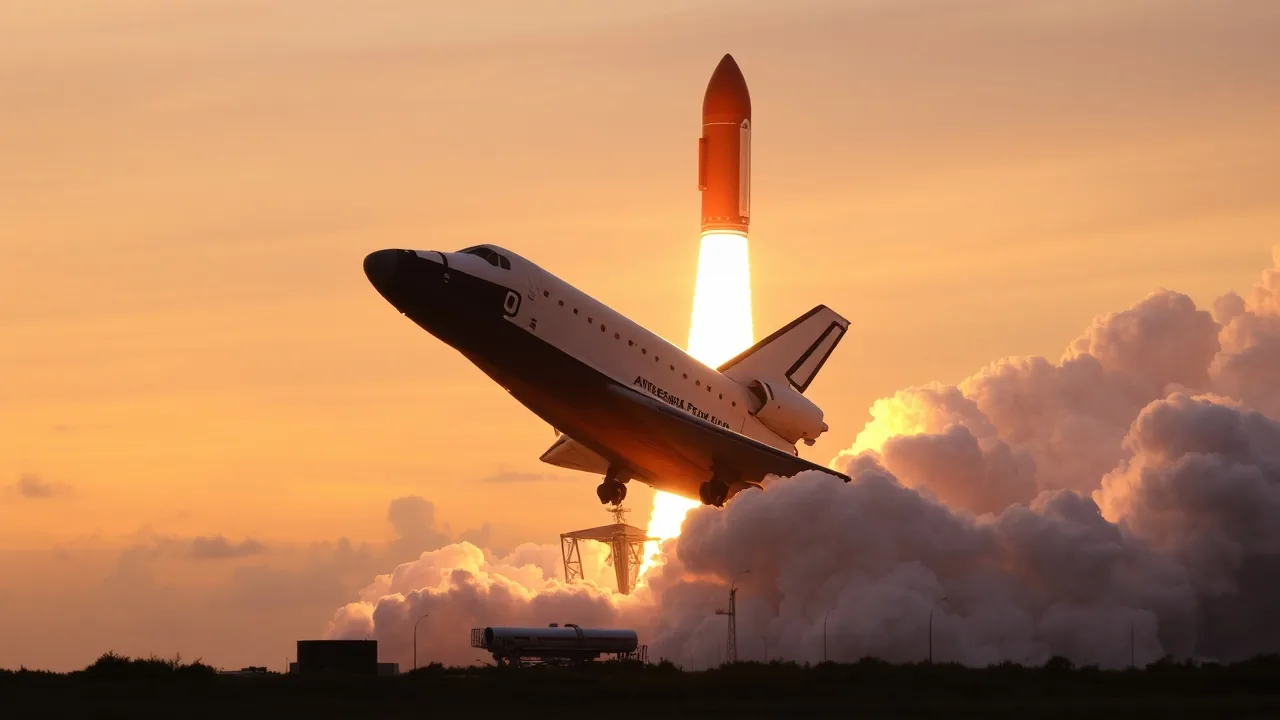
On April 12, 1981, Columbia lifted off from Kennedy Space Center as the first orbital vehicle designed to fly like an airplane and land like one too. The Space Shuttle represented a fundamental shift in how NASA approached space exploration history, abandoning the one-use capsule model for a winged, reusable system that promised to lower launch costs and increase flight frequency.
That first mission, piloted by John Young and Robert Crippen, validated a concept that seemed audacious at the time. The NASA Space Shuttle program would eventually operate 135 missions across five orbiters, deploying the Hubble Space Telescope, building the International Space Station, and conducting thousands of scientific experiments in low-Earth orbit.
The shuttle's engineering achievements set new standards for spaceflight. Early designs had to solve problems never before tackled at operational scale: thermal tiles that could withstand reentry temperatures exceeding 3,000 degrees Fahrenheit, a cargo bay large enough to carry 65,000-pound payloads, and main engines capable of throttling their thrust during ascent.
How the Shuttle Changed Orbital Operations
Before the Space Shuttle, satellite deployment meant waiting for dedicated expendable launch vehicles and hoping your payload fit their constraints. The shuttle changed that equation fundamentally. "The Space Shuttle essentially created a space trucking service," explains John Logsdon, former director of the Space Policy Institute at George Washington University. "It allowed NASA and other organizations to treat space as a working environment rather than a destination for one-off missions."
This capability enabled unprecedented scientific achievements. Between 1990 and 2009, astronauts conducted five servicing missions to the Hubble Space Telescope, replacing instruments and correcting its initial optical flaw. Without the shuttle's cargo capacity and human repair capability, the telescope would have remained a costly failure instead of becoming one of humanity's most valuable scientific instruments.
The shuttle also became essential to assembling the International Space Station. From 1998 through 2011, shuttle crews delivered 37 assembly missions, carrying modules, components, and supplies that would have been impossible to deliver using any other vehicle then available. Dozens of spacewalks performed by shuttle-based astronauts connected solar arrays, installed docking ports, and repaired critical systems.
Key operational capabilities included:
- Cargo bay capacity of 65,000 pounds in low-Earth orbit
- Ability to deploy and retrieve satellites
- Onboard laboratory modules for microgravity research
- Crew capacity of up to eight astronauts
- Reentry landing at runway facilities like Kennedy Space Center and Edwards Air Force Base
The Cost of Innovation and Lessons Learned
The program's promise of routine, cost-effective spaceflight never fully materialized. Early estimates suggested launch costs would drop to $10 million per flight; actual costs hovered around $450 million per mission in its final years. The shuttle required extensive refurbishment between flights, extensive ground crews, and continuous upgrades to safety systems.
Two tragedies reshaped how the program operated. Challenger broke apart 73 seconds after launch on January 28, 1986, killing all seven crew members. The accident revealed that external tank O-rings failed in cold weather, a risk the program had accepted without fully understanding its magnitude. Thirteen years later, Columbia disintegrated during reentry on February 1, 2003, when foam insulation from the external tank damaged the leading edge of the left wing during ascent.
Despite these catastrophes, the shuttle program implemented rigorous safety improvements and continued flying for eight more years. The final mission, STS-135 on Atlantis, launched July 8, 2011, delivering supplies to the International Space Station. That flight marked the end of an era that had fundamentally changed how humanity accessed and used space.
Reusable spacecraft design principles pioneered by the shuttle program persist in current aerospace development. SpaceX's Falcon 9 rocket lands its first stage for reuse, reducing launch costs and advancing the vision the shuttle program established decades earlier.
The shuttle's 30-year operational lifespan generated irreplaceable data on long-duration spaceflight, aerospace technology integration, and the challenges of maintaining complex hardware in the harsh space environment. NASA continues analyzing shuttle missions to inform designs for the Artemis program, which aims to return humans to the Moon and eventually reach Mars.
Today, five orbiters reside in museums: Discovery at the National Air and Space Museum in Washington D.C., Endeavour at the California Science Center in Los Angeles, Atlantis at Kennedy Space Center, Columbia's remains at the Smithsonian, and Enterprise in New York. Together they tell the story of how shuttle program personnel turned an ambitious engineering concept into a vehicle that flew 354 million miles, spent 1,323 days in orbit, and carried 852 crew members to space.
The shuttle's legacy extends beyond hardware and statistics. It proved that humans could work productively in space, that complex systems could be maintained and repaired in orbit, and that spaceflight could become routine enough to accommodate international partnerships, commercial payloads, and long-duration scientific missions. These lessons remain central to how NASA and the broader aerospace industry approaches human spaceflight today.