
Milky Way's Origin: Thousands of Galaxies Formed Early Universe
New simulations suggest our Milky Way galaxy may have formed from the merger of thousands of smaller proto-galaxies in the early universe. This challenges previous theories about galactic formation.

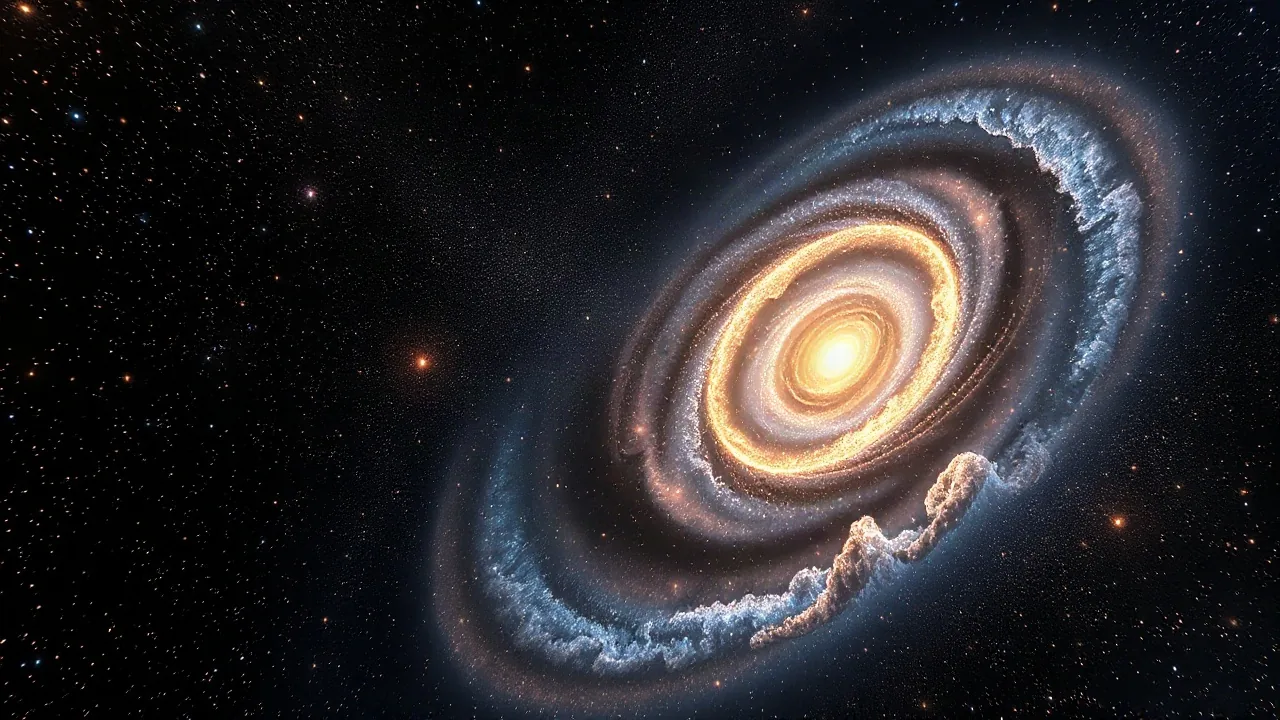
Our vast Milky Way galaxy might have originated not from a single, large entity, but from the chaotic collision and merging of thousands of smaller galaxies in the universe's infancy, according to groundbreaking new simulations. This revised understanding of galactic genesis emerged from advanced computational models that trace the cosmos's earliest moments. Researchers are now re-evaluating how the fundamental structures of the universe, including our own galactic home, came to be.
The simulations, nicknamed MEGATRON, were developed to model the complex interplay of matter and energy in the nascent universe. By simulating the conditions just a few hundred million years after the Big Bang, scientists were able to observe the formation and evolution of the very first stars and galaxies. These early cosmic structures were significantly smaller and more numerous than the majestic galaxies we observe today. The findings suggest that these "proto-galaxies" coalesced over billions of years, drawn together by gravity to form the grand spiral we inhabit.
Early Universe's Chemical Signatures
A key aspect of the MEGATRON simulations involves identifying the chemical fingerprints left by the universe's first stars. These massive, short-lived stars produced heavier elements through nuclear fusion and then dispersed them into the surrounding intergalactic medium when they exploded as supernovae. Scientists can potentially detect these "chemical fossils" in the oldest regions of the Milky Way and in distant quasars, providing observational evidence to support the simulation's predictions. Understanding this early chemical enrichment is crucial for comprehending the subsequent formation of stars and planets, including those within our own solar system.
"The process of galactic assembly in the early universe was far more fragmented than previously thought," explained Dr. Evelyn Reed, lead astrophysicist on the project. "Instead of a few large building blocks, we see evidence for a multitude of smaller structures that gradually merged. Our simulations allow us to connect the dots between the initial conditions of the universe and the complex galaxies we see today." This research not only sheds light on the Milky Way's past but also refines our understanding of cosmological evolution as a whole. It implies that many other galaxies observed across the universe may have followed similar paths of hierarchical formation.
The implications of this study extend to the ongoing quest to understand dark matter and dark energy, which play significant roles in galactic dynamics. By modeling the gravitational interactions of thousands of early galactic components, the simulations offer new insights into the distribution and behavior of these mysterious cosmic constituents. The research team plans to further refine the MEGATRON simulations by incorporating more detailed astrophysical processes, aiming to produce even more accurate predictions about galactic evolution across cosmic time. Future observations with advanced telescopes like the James Webb Space Telescope will be critical in validating these new theoretical models.