
Milky Way Discovered to Have Devoured Ancient Galaxy 'Loki'
Astronomers have identified remnants of a dwarf galaxy, named Loki, that the Milky Way likely consumed around 10 billion years ago. The discovery offers new insights into the galaxy's early evolution.

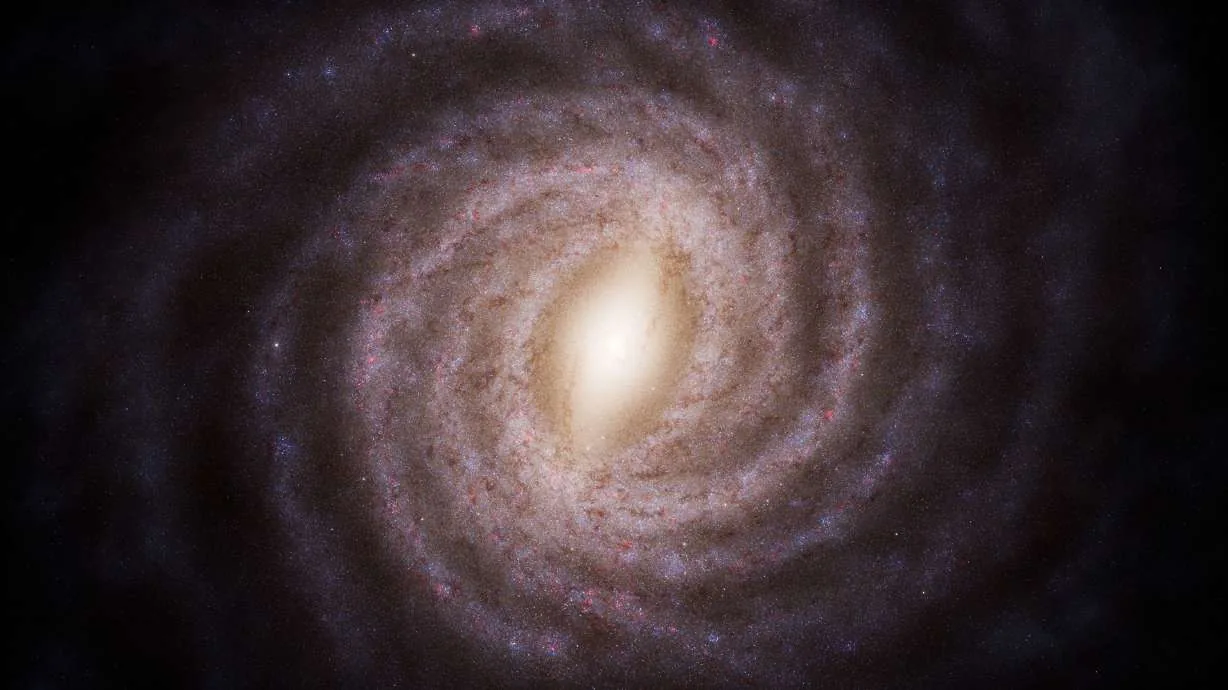
Astronomers have identified a cluster of metal-poor stars that they believe are the remnants of a dwarf galaxy, nicknamed Loki, which the Milky Way devoured approximately 10 billion years ago. This significant finding, detailed in the journal Monthly Notices of the Royal Astronomical Society, could fundamentally alter our understanding of how the Milky Way grew into the vast galaxy it is today.
The Milky Way, a cosmic structure spanning roughly 100,000 light-years and housing between 100 billion and 400 billion stars, was not always so massive. Its growth began about 12 billion years ago through continuous mergers with numerous smaller, dwarf galaxies. However, the precise scale and mass of the early Milky Way remain subjects of intense scientific inquiry. To reconstruct this history, researchers are actively seeking evidence of these long-vanished galactic companions.
The latest investigation focused on a group of stars exhibiting a notable lack of metals, discovered in an unusual proximity to the galactic disk. The galactic disk, a vast, flattened region, contains the majority of the Milky Way's stars. The composition of these stars is key: the earliest stars in the universe were primarily hydrogen and helium. Heavier elements, often referred to as metals by astronomers, were forged in subsequent generations of stars. Therefore, stars with a low metal content are typically indicative of much older stellar populations, often originating from ancient dwarf galaxies.
Dr. Cara Battersby, an associate professor of physics at the University of Connecticut who was not involved in the study, described astronomers as "detectives of the universe." She explained that very metal-poor (VMP) stars are crucial tools for this research, "holding within them clues to the formation of the universe's earliest generations of stars." Studying the chemical makeup and movement of these VMP stars can unlock critical details about the early universe's conditions.
Searching the Galactic Disk for Clues
Traditionally, the search for these ancient merger remnants has concentrated on the galactic halo, a diffuse, spherical region surrounding the disk. However, the dense concentration of young, metal-rich stars and abundant dust within the disk itself has made it challenging to detect older, metal-poor populations there. Federico Sestito, a lead author of the study and a postdoctoral fellow at the University of Hertfordshire's Centre for Astrophysics Research, noted this difficulty.
Using data from the European Space Agency's Gaia telescope, which meticulously mapped the positions and movements of over 2 billion stars between July 2014 and January 2025, Sestito and his team identified 20 metal-poor stars situated surprisingly close to the galactic disk. Further observations using the high-resolution spectrograph on the Canada-France-Hawaii Telescope in Hawaii allowed them to analyze the stars' chemical composition.
While precisely dating these stars is difficult, their chemical signatures strongly suggest an age exceeding 10 billion years. All 20 stars are located approximately 7,000 light-years from Earth. Crucially, their similar chemical compositions indicate a shared origin, likely from a single, metal-poor dwarf galaxy. Intriguingly, 11 of these stars orbit in the same direction as the galactic disk (prograde), while nine move in the opposite direction (retrograde). This mixed orbital pattern is consistent with stars from a galaxy absorbed by the Milky Way relatively early in its history, possibly within the first few billion years after the Big Bang, which occurred approximately 13.8 billion years ago.
"If the Loki scenario is correct, then a system merged with our galaxy could deposit its stars into both prograde and in the opposite direction," Sestito explained via email. "This can be allowed only if the merger event happened when our Milky Way was still infant/smaller and its gravitational potential was weaker than nowadays. Cosmological simulations suggest that this could have happened no later than 3 or 4 billion years from the Big Bang."
Dr. Hans-Walter Rix, director at the Max Planck Institute for Astronomy, highlighted the study's impressive use of detailed chemical abundances to establish a common birth origin for the stars, even with their differing orbital paths. "The search for metal-poor stars is key to understanding galactic evolution," he stated.
The name "Loki" was chosen because, like the Norse god of mischief, the stars' behavior initially presented a puzzle. "Similarly, our accreted stars gave us some hard time in understanding their origin," Sestito said. "At first it was not easy to reconcile the fact that an accreted system can disperse its stars in both prograde and opposite orbits." While another possibility is multiple merger events, the single-galaxy hypothesis is particularly compelling.
Galactic cannibalism, the process by which larger galaxies absorb smaller ones, is a primary driver of galactic growth. Alexander Ji, an assistant professor at the University of Chicago, explained that while minor mergers are common, major events significantly reshape a galaxy's history. One such massive merger was the Gaia-Sausage-Enceladus event, which occurred between 8 and 10 billion years ago and is thought to have transitioned the Milky Way from a turbulent early phase to its current stable disk structure.
The potential merger with Loki appears to have been a significant event, possibly comparable in scale to Gaia-Sausage-Enceladus, but its remnants have remained hidden due to their location near the galactic disk. "If this is real, it would indicate that we are missing a major part of our Milky Way's formation history, and we might need to revisit our current picture to see the impact of such an event," Ji commented. While Ji expressed some skepticism that Loki represents an entirely unknown galaxy, he acknowledged the study's intriguing possibilities and anticipates further investigations using larger datasets to verify the findings.