
Milky Way Black Hole Winds Found After 50-Year Quest
Astronomers have detected powerful winds emanating from Sagittarius A*, the supermassive black hole at the Milky Way's core, after a 50-year search. This groundbreaking discovery offers new insights into black hole behavior.

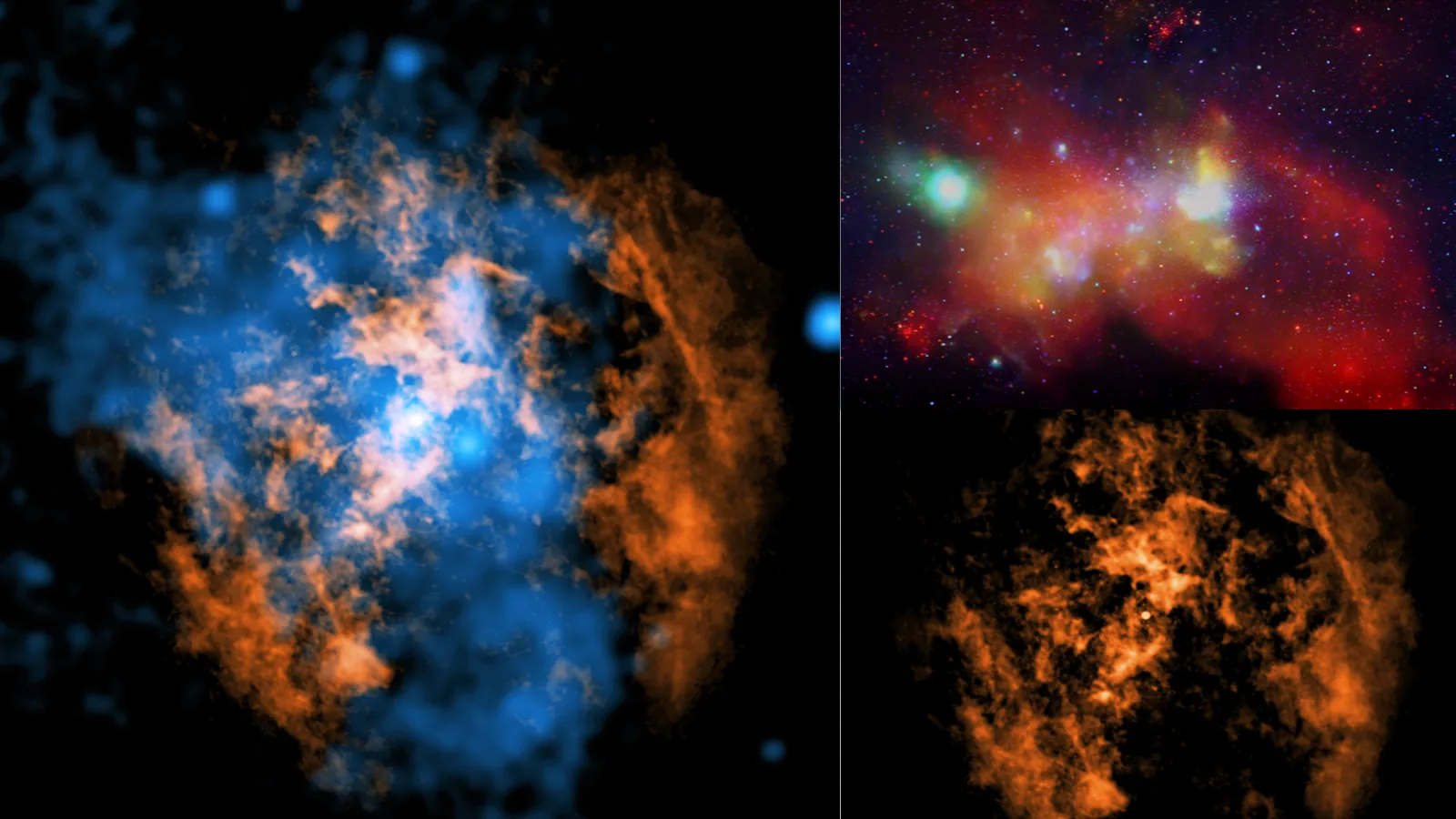
For half a century, astronomers have theorized about and searched for evidence of powerful winds escaping the supermassive black hole at the center of our galaxy, Sagittarius A* (Sgr A*). Now, researchers report they have finally observed the imprint of these winds, marking a significant advancement in understanding the dynamics of galactic cores and black hole physics. The discovery confirms that even black holes consuming meager amounts of material, like Sgr A*, expel energy and matter. "Unless a black hole exists in a perfect vacuum, it must blow a wind somehow," said team co-leader Mark Gorski of Northwestern University. "With new observations, this is the first time we’ve had a clean enough view to see the wind's imprint. We looked at the data and said, 'There it is.'"
The concept of "black hole winds" describes the outflow of material generated as black holes consume surrounding gas and dust. While these winds have been observed emanating from more active, ravenously feeding black holes, Sgr A* has presented a unique challenge. Its extremely low rate of material consumption – the equivalent of a human eating one grain of rice every million years – and its location obscured by the Milky Way's dense galactic plane have historically hindered detection. "To observe our own black hole, we have to look through the plane of our galaxy," explained team co-leader Lena Murchikova, also from Northwestern. "That means we have to peer through gas, dust and ionized structures, and you can’t really see through all of that easily.” The detection of molecular gas very close to Sgr A*, previously reported by the same team, has now provided crucial context, demonstrating that our galaxy's central black hole behaves similarly to others, despite its quiet appetite.
Carving a Cosmic Cavity
To overcome these observational hurdles, the research team utilized five years of detailed data from the Atacama Large Millimeter/Submillimeter Array (ALMA), a collection of 66 radio antennas situated in Chile's Atacama Desert. These observations yielded the most detailed image to date of cold molecular gas within approximately three light-years of Sgr A*. A striking feature that emerged was a cone-shaped cavity, spanning three light-years, within this gas cloud. Scientists postulate that this void was created by a hot black hole wind clearing the region. "If you blow hot material from the black hole, it's not going to want to exist with the cold material," Gorski stated. "It's either going to push the cold material out or heat it up."
The region surrounding Sgr A* is densely populated with stars, each emitting its own stellar winds. However, the team calculated that these stellar outflows do not possess sufficient energy to carve out such a substantial cavity. "It's a huge absence of material. We calculated how much energy was needed to create this cavity. It is more than can be provided by the stars in that area," Gorski elaborated. "Basically, there has to be input from the supermassive black hole. And, if you follow the shape of the cone, it's pointed directly at the black hole.” This points strongly to Sgr A* as the source of the clearing phenomenon.
Further validation came from NASA's Chandra X-ray Observatory. "Exceptional claims require exceptional evidence," Gorski noted. The Chandra data provided X-ray emissions precisely from the location of the cavity, aligning perfectly with the ALMA findings and ruling out imaging artifacts. "When you find something that no one has seen before, the first thought that runs through your mind is not 'Oh my god, we made a discovery,'" Murchikova admitted. "It's 'Oh my god, what's wrong with my analysis?' But when we overlaid our image with the X-ray image, it started to make sense."
While Sgr A* is significantly quieter than the supermassive black holes found at the centers of active galactic nuclei (AGN) in other galaxies, the detected wind is still substantial. The researchers estimate this outflow has been active for approximately 20,000 years. This discovery provides a unique window into the quiescent state of black hole evolution, a phase that is believed to be the dominant state for most galaxies, including our own Milky Way.