
Euclid Telescope Delivers Most Detailed Milky Way Galactic Center Image
The European Space Agency's Euclid telescope has captured the most detailed visible-light image of the Milky Way's galactic bulge, revealing over 60 million stars and aiding exoplanet research.

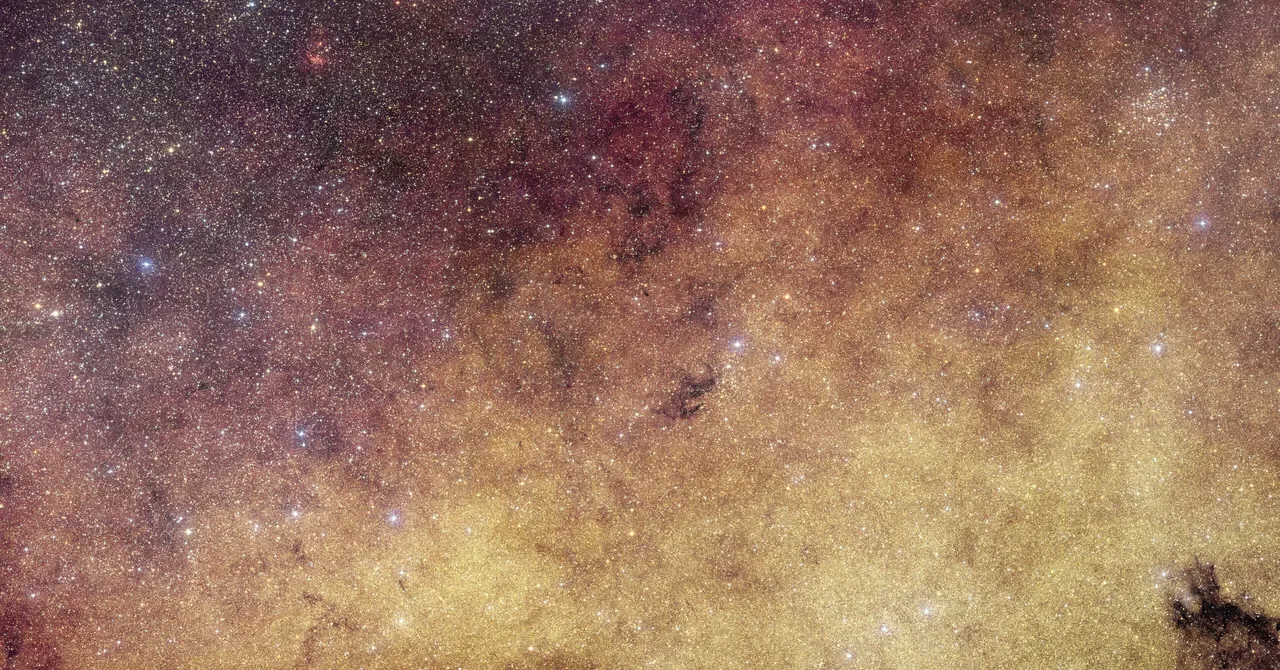
The European Space Agency’s (ESA) Euclid space telescope has produced the most extensive and detailed visible-light image ever captured of the Milky Way's galactic bulge, the dense central region of our galaxy. This new mosaic image, comprising more than 60 million stars alongside nebulae and star clusters, is expected to significantly advance the search for exoplanets through microlensing techniques and enhance the precision of their mass measurements.
While Euclid was primarily designed to study distant galaxies, its sensitive visible-light camera is capable of resolving individual stars even in the extremely bright and crowded environment of the galactic center without being overwhelmed. On March 23, 2025, Euclid focused on this region, gathering data for an immense image in just 26 hours. The resulting mosaic is an impressive compilation of nine separate exposures, each covering a sky area larger than the full moon. Although the visual quality of Euclid's images rivals that of the Hubble Space Telescope, Euclid possesses a key advantage: its pointings capture a field of view 270 times larger than Hubble's, and it operates much faster. For perspective, the Keck Observatory would need approximately 2,000 hours to produce a comparable mosaic.
Advancing Exoplanet Discovery and Measurement
The new Euclid image offers an unprecedented view of over 60 million stars, nebulae, and star clusters within one of the Milky Way's most congested areas. This dense stellar field is ideal for searching for exoplanets using gravitational microlensing, a method that detects planets by the way their gravity bends light from background stars. "To catch microlensing, you need to observe parts of the sky that are crowded with stars, such as close to the centre of our galaxy," stated Jean-Philippe Beaulieu, who led the observing campaign, in a press release. "During the last 20 years, almost 300 exoplanets have been discovered using this technique, all with ground-based telescopes and all towards the center of our galaxy. This image from Euclid includes 51 known planetary systems—and it will assist in studying many more that will be found."
Although the detection of a new microlensing event typically requires several weeks of continuous observation, precluding Euclid from identifying novel events during its initial short campaign, the image's true value lies in its comprehensive data. This data is crucial for measuring the masses of both already discovered planets and those yet to be found. "In 24 hours, Euclid has already captured the stars involved in all the future microlensing events that the Roman space telescope will detect, but before the stars and planets involved have aligned," explained Natalia Rektsini, who led the publication of the data. (The Nancy Grace Roman Space Telescope is scheduled to launch later in 2026.) "This means that anyone who detects a microlensing event in the same region, for example with Roman, will be able from now on to use Euclid data as a time reference in the past and see how the stars looked before they overlapped." Effectively, Euclid's observations will function as a vital reference archive for future missions, enabling more in-depth studies of exoplanets and more accurate mass determinations.
"In just 24 hours, Euclid has delivered unique data on the Milky Way’s center, with a large and sharp view of this region," commented Valeria Pettorino, ESA’s Euclid project scientist. "This data can also be used for other scientific applications, from brown dwarfs and binary stars to stellar motions and dust across our galaxy." This comprehensive dataset promises to be a cornerstone for astronomical research for years to come.