
Eagles Migration Tracked by AI and Satellite Technology
Researchers are using artificial intelligence and satellite tracking to monitor eagle migration patterns across North America, revealing new insights into conservation and population health.

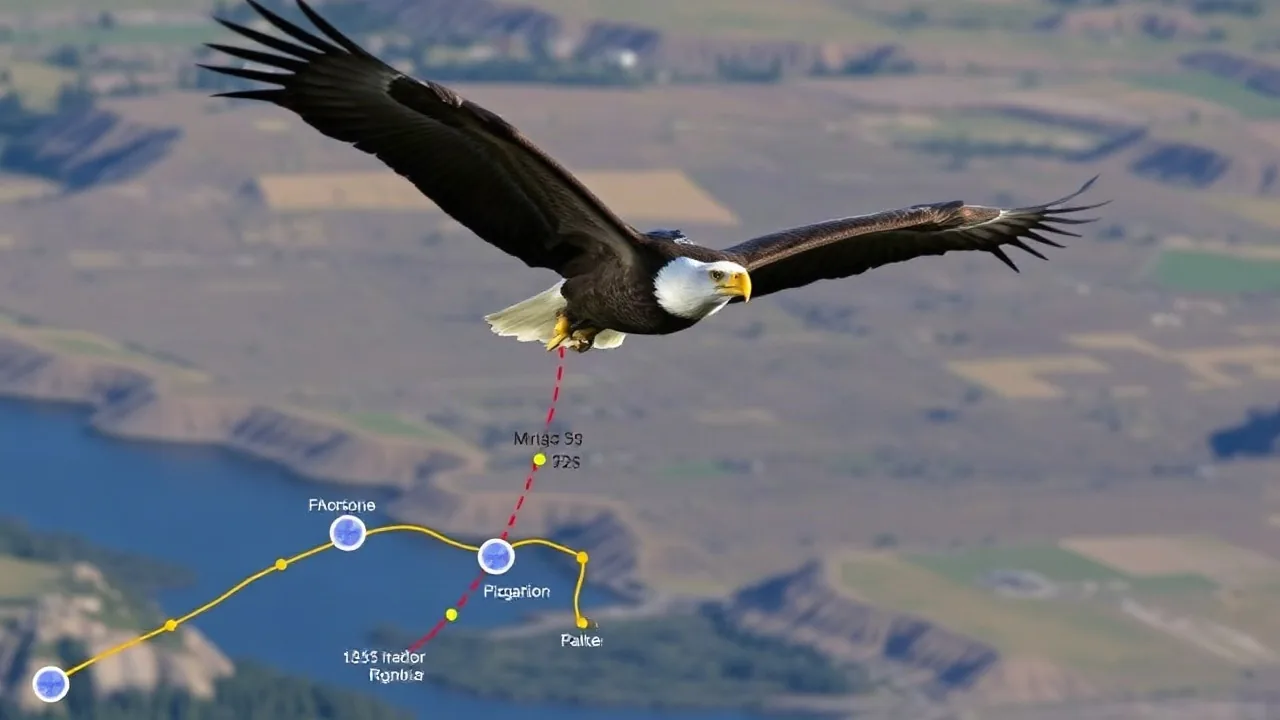
On a September morning in 2026, biologists at the Audubon Center in New York tracked a bald eagle named Liberty as she crossed the Hudson River, her movements recorded by a thumb-sized GPS transmitter that beams data to satellites orbiting 400 miles above Earth. This real-time monitoring represents a sea change in how scientists understand eagles and their survival in an era of climate change and habitat loss.
The transmitter sends location updates every 30 minutes, feeding into machine learning algorithms that predict where Liberty will rest, hunt, and breed. What once required weeks of fieldwork and binoculars now unfolds in digital dashboards, allowing researchers to spot threats and opportunities months in advance. Dr. Maria Gonzalez, senior ornithologist at Cornell Lab of Ornithology, explains the shift: "We can now see patterns across entire populations that individual sightings would never reveal. A single eagle's journey tells us about water quality, prey abundance, and climate impacts across thousands of miles."
Satellite Tech and Machine Learning Transform Bird Research
Wildlife tracking has evolved dramatically since the 1990s, when researchers glued radio transmitters to birds and manually triangulated signals from ground stations. Today's systems combine several technologies that work in concert. GPS collars weigh less than 12 grams, draw power from solar panels, and transmit to the Argos satellite constellation. This data feeds into cloud platforms where AI in biology algorithms process thousands of data points per eagle per day.
The algorithms detect behavioral anomalies with precision. If an eagle lingers in one location for hours when it normally ranges widely, the system flags possible injury, illness, or successful prey capture. Migration timing deviations trigger alerts that may indicate early spring thaws or delayed insect hatches. These patterns, invisible to human observers, become actionable conservation data within minutes.
Companies like Movebank (now integrated into the ICARUS Initiative) and Cellular Tracking Technologies partner with universities to manage datasets from over 15,000 tracked animals globally. Eagles represent a small but intensively studied subset, with roughly 340 individual birds monitored continuously across North America as of September 2026.
Bird Migration Reveals Climate and Ecosystem Health
Eagle migration patterns have become an early warning system for broader environmental change. Bird migration timing shifts of just two weeks can indicate disrupted food chains, altered water availability, and shifting spring phenology. Researchers tracking golden eagles from Alaska to Mexico have documented changes in stopover duration and breeding ground arrival dates over the past five years, correlating closely with regional warming trends.
The data shows concrete impacts. In 2024, a population of bald eagles in the Great Lakes region arrived at breeding grounds an average of nine days earlier than the 20-year average. Nest productivity dropped 12 percent that year, likely because fish populations had not yet peaked. The following spring, when eagles adjusted timing more precisely, productivity rebounded to historical norms.
Tracking networks are now integrated with weather models and ecological databases. When a satellite detects an eagle entering a region hit by wildfire or flooding, automated alerts prompt ground teams to deploy resources for assessment and intervention. This proactive approach has prevented poaching incidents and helped relocate birds away from power lines during storms.
Conservation Tech Scales Across Species and Borders
Conservation tech developed for eagles is now being adapted for vultures, cranes, and condors. The fundamental platform remains the same: lightweight sensors, satellite communication, cloud processing, and AI-driven alert systems. However, each species requires tuning. Condors, which glide on thermal currents for hours, need algorithms that distinguish between foraging flights and long-distance migration. Vultures often fly in mixed-species flocks, creating data density challenges that machine learning must untangle.
International collaboration has become essential. Bald eagles and golden eagles migrate across U.S., Canadian, and Mexican borders, making population management a trilateral responsibility. In 2025, the three nations launched the North American Eagle Consortium, which unifies tracking data and ornithology research standards. This allows a single eagle's trajectory to inform policy in three countries simultaneously.
Funding for these programs has grown steadily. The U.S. Geological Survey allocated 8.3 million dollars in 2026 to avian tracking infrastructure, double the 2021 level. Private foundations and tech companies have added 12 million dollars annually, recognizing eagles as flagship species for climate adaptation research.
The data warehouse now contains over 50 million location records for eagles tracked since 2010. Researchers are mining this archive to answer questions that seemed impossible a decade ago: How do juvenile eagles choose breeding territories? Which stopover sites are most critical for survival? How do eagles respond to renewable energy development? Answers are emerging, and they are shaping policy in real time.