
Dying Star's Debris Forms New Planet Candidate, Astronomers Find
Astronomers have identified a candidate for a "second-generation" planet forming from the remnants of a dead star. This discovery, made possible by NASA's Hubble Space Telescope, offers new insights into planetary formation.

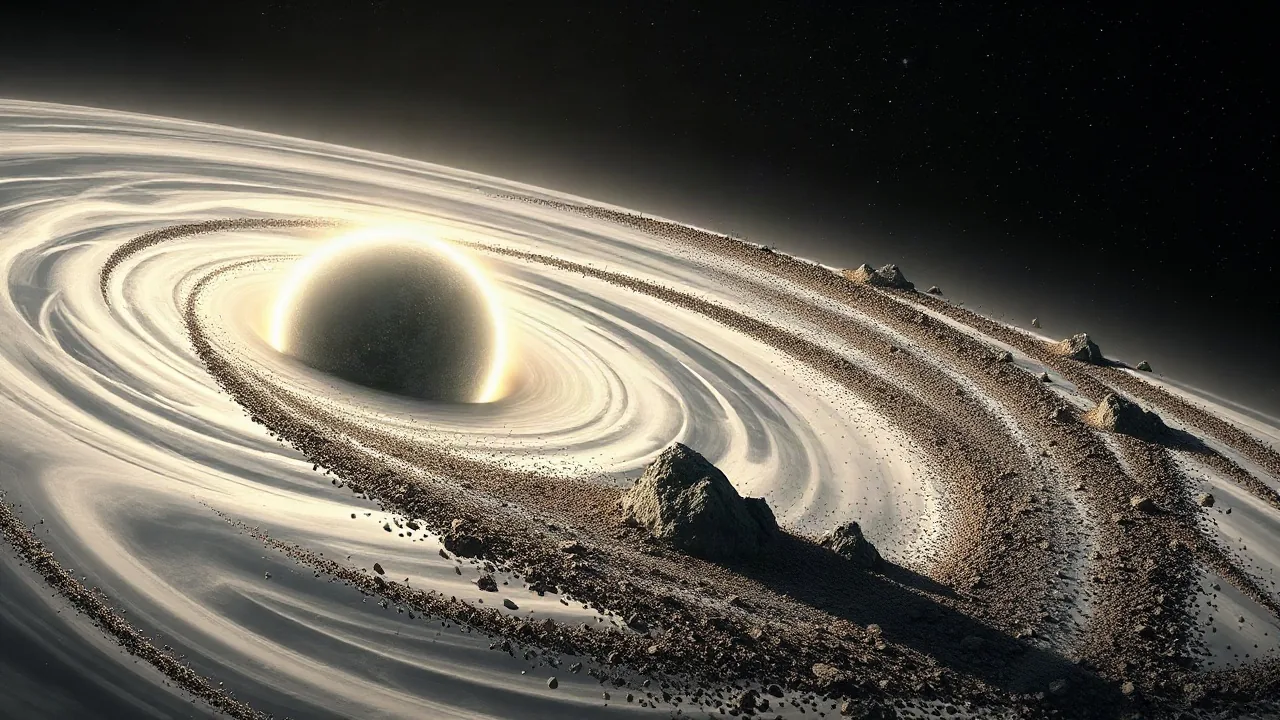
Astronomers using data from NASA's Hubble Space Telescope have discovered evidence of a potential "second-generation" planet candidate forming from the debris of a dying star. The object is accreting material onto a white dwarf, the dense remnant core of a star that has exhausted its nuclear fuel.
This celestial body represents a significant find, as it suggests that planets can form even after a star has entered its final stages of life. The process involves the white dwarf pulling in material from its surroundings, likely remnants of its former planetary system that were disrupted as the star evolved.
A Cosmic Cycle of Creation
The discovery challenges previous understandings of planetary formation, which often focused on the early stages of stellar life. In this case, the material available for planet building comes from the shredded remains of older planets and asteroids. The white dwarf, designated WD 1145+017, is located approximately 570 light-years away in the constellation Virgo. Observations indicate that it is actively consuming a disintegrating asteroid or planetesimal.
"We are observing the building blocks of a potential new world being assembled from the wreckage of an old one," said Dr. John Debes, a senior scientist at the Space Telescope Science Institute, who was part of the research team. "It's a remarkable demonstration of how the universe recycles material over vast timescales." The team utilized Hubble's sensitive instruments to analyze the light passing through the debris disk surrounding the white dwarf, detecting the chemical signatures of the accreting material.
This phenomenon is not entirely unprecedented; astronomers have observed white dwarfs with orbiting debris disks before, and even instances of objects impacting these stellar remnants. However, the evidence for an actively forming planet, or at least a substantial planetary embryo, is particularly compelling in this case. The continuous accretion process observed could eventually lead to the formation of a small planet. Understanding these processes is crucial for grasping the full spectrum of planetary system evolution.
The researchers are particularly interested in the composition of the accreting material. Initial analyses suggest it contains elements like carbon and oxygen, consistent with rocky planetary bodies. Further observations are planned to confirm the presence and composition of the potential second-generation planet and to study its formation process in greater detail. This discovery offers a unique laboratory for studying the late stages of planetary system evolution and the resilience of planet formation.